
LUXEMBOURG — An adviser to the European Union's highest court said on Tuesday, November 3, 2026, that Google's artificial intelligence chatbot Gemini may infringe the rights of press publishers when it retrieves their articles and reuses them to answer users' questions. The opinion, delivered by Advocate General Maciej Szpunar at the Court of Justice of the European Union, is the court's first major test of how Europe's copyright rules apply to generative AI — and it draws a careful line between repeating facts, which the law allows, and reproducing a publisher's work, which it may not.
The case was brought by Like Company, a Hungarian website operator, against Google. It asks whether a chatbot that pulls a news article from a publisher's website and reuses it in an answer infringes the press publishers' right created by EU law. Szpunar's answer, in short, is that it can — in certain circumstances, but not always. His opinion is advisory and not binding, but the court's judges usually follow their advocates general, and a ruling is expected in the coming months.

Illustration: The Court of Justice of the European Union in Luxembourg, where judges will decide the first generative-AI copyright case to reach the court.
What Happened
Reuters reported on November 3 that Szpunar concluded that when a large language model-driven chatbot "retrieves a publication from a press publisher's website, reuses that publication to generate an answer, and provides that answer to the user, the press publisher's right may be infringed in certain circumstances." That single sentence is the heart of the opinion — and its qualifications matter as much as its warning.
According to summaries of the opinion, Gemini's answers fall under the publishers' right of reproduction in two situations. The first is when a chatbot reaches a publication by unlawfully circumventing a paywall or another technical barrier put in place by the publisher. The second is when the answer reuses "the form of expression of that publication in a recognisable manner" — in other words, when the chatbot's reply copies the article's distinctive way of telling the story closely enough that a reader can recognise it, rather than simply restating the underlying facts.
Copyright rules, Szpunar stressed, do not protect the "mere facts" reported by press publications, but "only the specific form of expression." A chatbot that tells a user what happened, in its own words, is on different legal ground from one that reproduces a publisher's expression. Paraphrase alone, however, does not automatically put an answer beyond the law, according to the opinion's reasoning as summarised by legal commentators: if the paraphrase still reproduces the publication's form of expression in a recognisable way, it can still infringe.
The opinion also rejects Google's argument that freely accessible articles are implicitly licensed for chatbot reuse. Just because an article can be read without paying, Szpunar said, does not mean a publisher has consented to its reuse by an AI chatbot. That point alone could reshape how AI companies treat openly available news content in Europe, where publishers have long argued that chatbots summarise their reporting without sending readers — or revenue — back to the original websites.
Background
The dispute began in Hungary. Like Company operates several online portals, including one covering the Lake Balaton region, and it claims that Google, first through its Bard chatbot and then through the renamed Gemini, continuously infringed its rights between June 13, 2023, and May 31, 2024. The company does not claim copyright in the articles themselves, according to the opinion; instead, it relies on the press publishers' right.
That right comes from Article 15 of the EU's Copyright in the Digital Single Market Directive, adopted in 2019. It gives press publishers established in a member state their own rights over the online use of their publications, separate from the copyright held by authors. It was designed to help publishers bargain with large online platforms that reuse their content, and it has already underpinned licensing deals and disputes across Europe. The Luxembourg case, numbered C-250/25, is the first generative-AI case to reach the Court of Justice, according to the court's press release, and it arrived there after a Hungarian court referred questions about how the rules apply to AI systems.
The opinion also separates the question of training from the question of answering. On training, Szpunar said the use of material protected by copyright to train large language models is "freely permitted under the text and data mining exception" in EU law. He added that there was no evidence Google had used Like Company's articles to train Gemini, and he treated the training questions in the case as hypothetical. For publishers hoping the case would deliver a broad ruling against AI training on news content, that part of the opinion is a setback; for AI developers, it is a significant reassurance, at least within the European framework.

Illustration: A newsroom grappling with AI chatbots that answer readers' questions using publishers' reporting.
Why It Matters
The stakes go well beyond one Hungarian publisher and one chatbot. If the court follows Szpunar's reasoning, AI companies operating in the EU will need to think much more carefully about how their systems retrieve and reproduce news. A chatbot that answers a question by drawing on a paywalled article it should not have accessed, or by echoing an article's expression so closely that the user no longer needs to visit the original, could expose its operator to infringement claims. A ruling against Google could also force the company to pay fees for the use of such content, which Reuters noted could throw a lifeline to smaller online media outlets like Like Company.
For publishers, the opinion offers a narrower victory than some may have hoped for, but a real one. It confirms that their press publishers' right is not an empty protection in the age of chatbots, and it rejects the idea that putting content on the open web amounts to consent for AI reuse. At the same time, it preserves the principle that facts themselves remain free: no publisher can own the news, only its expression of it. That distinction protects journalism's public function while still giving publishers a tool to challenge wholesale reproduction.
For readers, the case raises a quieter but important question: what happens to the answers chatbots give? If AI providers must be more cautious about reproducing news content, they may cite sources more clearly, link back to original articles more often, or decline to answer certain questions in full. Publishers argue that such changes would be fairer, because summaries that replace the original article can drain the traffic that funds reporting in the first place. AI companies, in turn, argue that their systems help users discover information and that overly strict rules could make chatbots less useful. The court's eventual ruling will have to balance those interests, and Szpunar's opinion is an early signal of where that balance may fall.
The case also matters because it is likely to be read far beyond Luxembourg. Courts and regulators around the world are wrestling with the same questions — whether training on copyrighted material is lawful, whether chatbot outputs infringe, and how publishers should be paid — but few have received as structured a legal analysis as the one Szpunar has now provided. Even though the opinion binds no one yet, its reasoning on paywalls, recognisable expression, and the text-and-data-mining exception will be cited in negotiations, licensing talks, and courtrooms well beyond the EU.
What Happens Next
The Court of Justice will now consider Szpunar's opinion and deliver its own judgment in the coming months. The judges are not obliged to follow the advocate general, but they do so in most cases, so the opinion is widely treated as a strong indication of the eventual outcome. Whatever the court decides will then return to the Hungarian court, which will apply the ruling to the facts of Like Company's claim against Google.
In the meantime, the opinion gives both sides a clearer map of the arguments that matter. Publishers are likely to focus on evidence that chatbots circumvented technical barriers or reproduced their expression recognisably, while AI providers will emphasise that their answers restate facts in new words and that training remains permitted under the text-and-data-mining exception. Licensing negotiations between publishers and AI companies, already under way in several European countries, may also gain momentum as both sides weigh the risk of an adverse ruling.
Google has not, in the reporting of the opinion, been shown to have conceded any infringement, and the case remains at the stage of legal interpretation rather than a final finding against the company. What is certain is that the first generative-AI case to reach Europe's top court has now produced its first authoritative-sounding answer — and that answer is neither a blank cheque for chatbots nor a ban on them, but a line drawn between facts and expression, between lawful retrieval and unlawful reproduction.
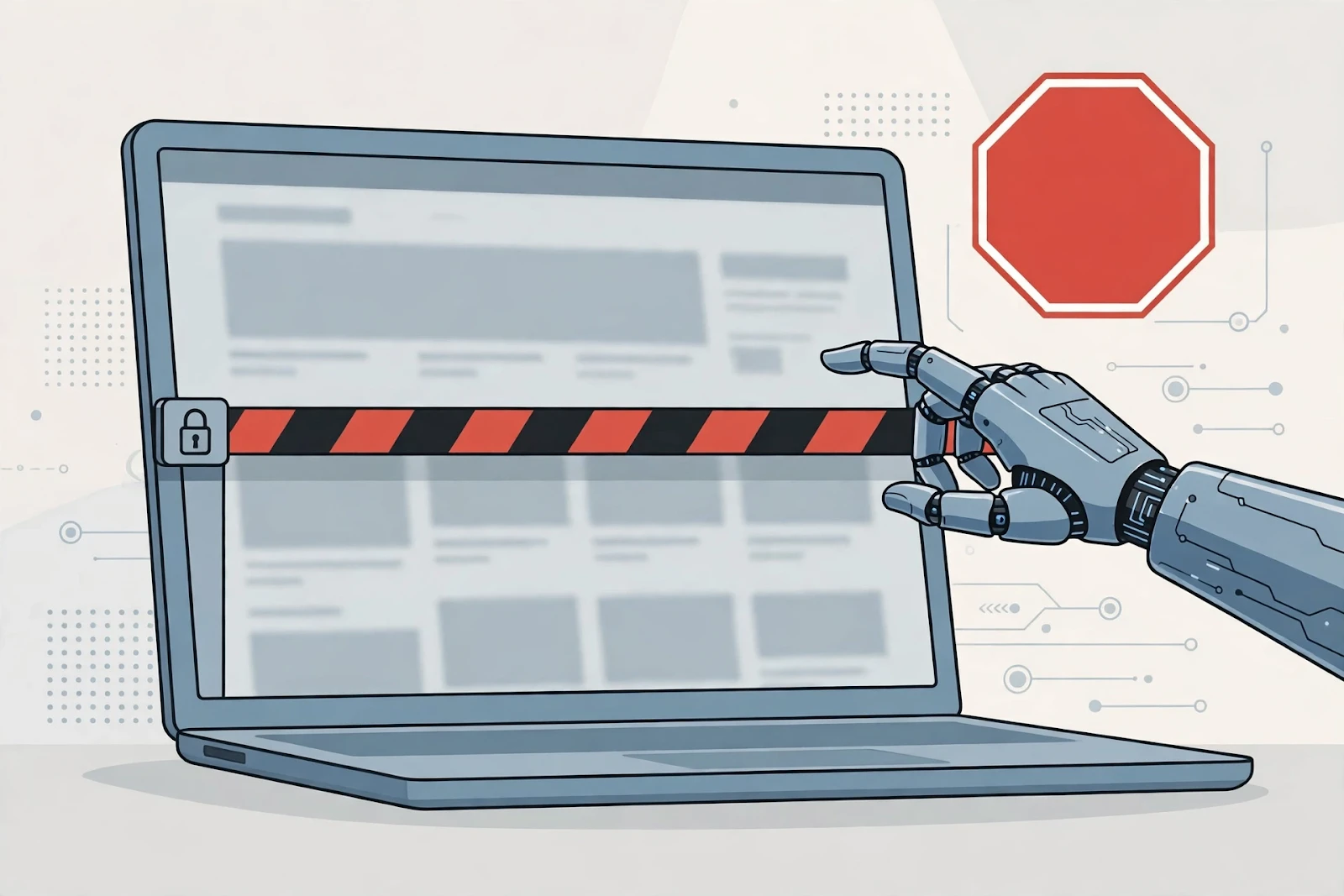
Illustration: A paywall barrier in front of a news website — circumventing such barriers is one route to infringement identified in the opinion.
Sponsored: explore today's featured sponsored offers
FAQ
What did the EU court adviser actually decide?
Advocate General Maciej Szpunar issued a non-binding opinion, not a final judgment. He said Google's Gemini may infringe press publishers' rights in certain circumstances when it retrieves and reuses their publications to answer users. The Court of Justice will issue its own ruling in the coming months.
Does this mean chatbots cannot use news at all?
No. Copyright does not protect mere facts, only the specific form of expression. A chatbot that restates facts in its own words is on different ground from one that reproduces a publication's expression recognisably or circumvents a paywall or technical barrier to obtain it.
What about training AI models on news articles?
Szpunar said training large language models on copyrighted material is freely permitted under the EU's text-and-data-mining exception. He also said there was no evidence Google had used Like Company's articles to train Gemini.
Who brought the case, and what do they claim?
Hungarian website operator Like Company brought the case against Google, claiming its Gemini chatbot — previously Bard — infringed its press publishers' rights between June 2023 and May 2024. The case, C-250/25, was referred to Luxembourg by a Hungarian court.
What happens if the court agrees with the adviser?
A ruling against Google could force it to pay fees for the use of press content and would give publishers a stronger legal basis to challenge chatbot reproduction of their articles. The judgment would then go back to the Hungarian court to be applied to Like Company's claim.
Sources
Reuters, "Google's use of press by AI chatbot may infringe copyright rules, EU court adviser says," November 3, 2026; Reuters via Duke FM / SRN News, "Setback for Google as EU court adviser warns AI chatbot may breach copyright rules," November 3, 2026; Court of Justice of the European Union press release No. 155/26, Advocate General Opinion in Case C-250/25, Like Company, as summarised by PPC Land, November 3, 2026.
Comments
Post a Comment