
CAMBRIDGE, Massachusetts — The Hubble Space Telescope has caught a distant rocky world vanishing behind its star — the first time Hubble has ever detected the secondary eclipse of a rocky exoplanet, astronomers reported this week, opening a new way to measure the heat, air and bare-rock surfaces of the galaxy's most extreme planets.
The planet is TOI-2431b, a lava world that whips around its orange host star once every 5.4 hours, so close and so hot that its dayside glows at 2,524 kelvin — about 2,251 degrees Celsius — hot enough to melt most kinds of rock. The result, published in The Astrophysical Journal Letters, makes the scorched world a benchmark for studying lava planets, a class of rocky worlds that astronomers are only beginning to understand.
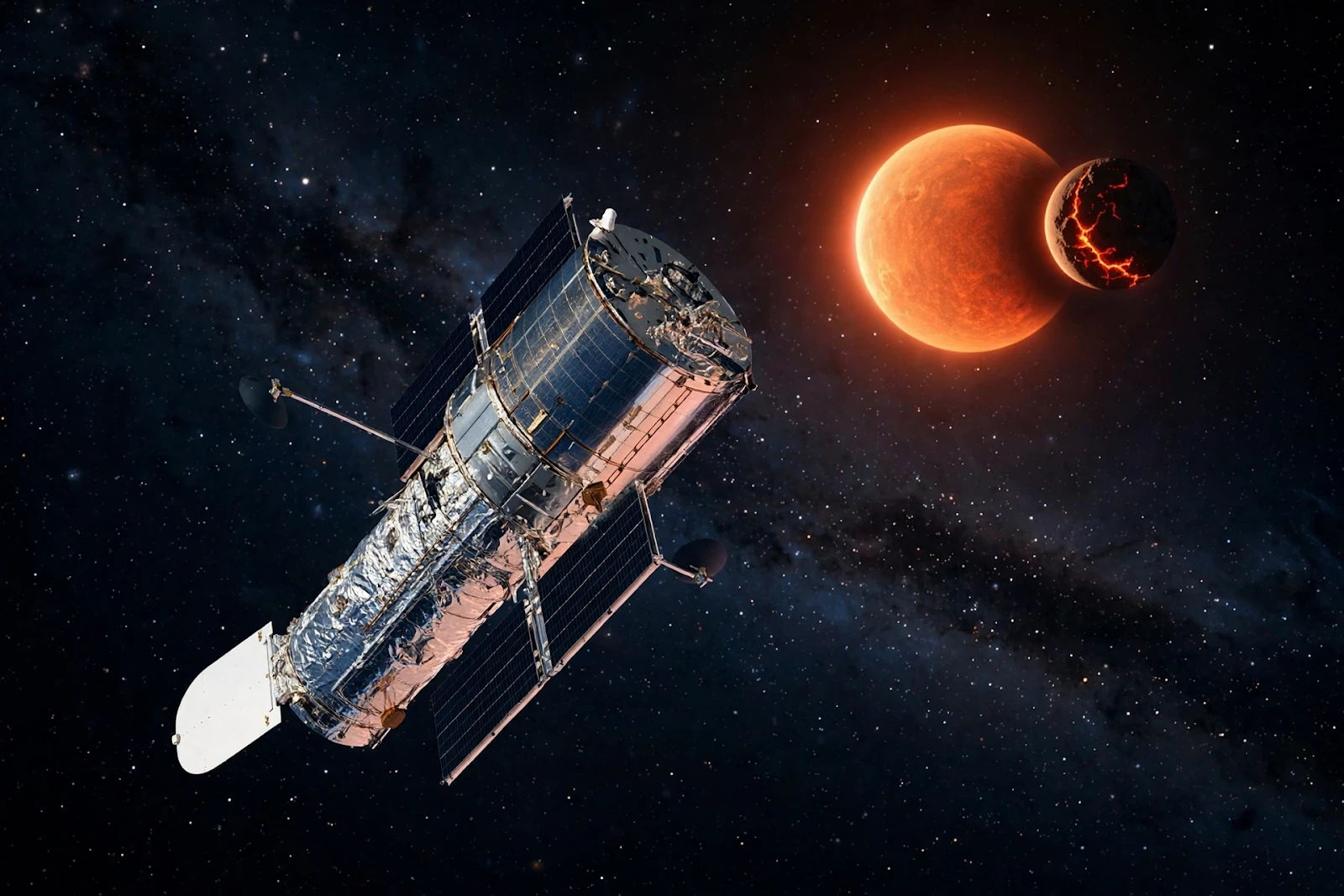
Illustration: Lava world TOI-2431b slips behind its orange host star, dimming the system's light by a tiny but measurable amount.
What Happened
A team led by Sebastian Zieba of the Center for Astrophysics | Harvard & Smithsonian used Hubble's Wide Field Camera 3 to watch TOI-2431b through a complete orbit, tracking the system's light as the planet crossed in front of its star, swung around to show its heated dayside, and then slipped behind the star. That disappearance — the secondary eclipse — is the key measurement: when the planet hides behind its star, the total light drops by exactly the amount the planet itself was contributing, letting astronomers measure the world's own glow.
The dip is vanishingly small. In Hubble's near-infrared band, the planet-to-star flux ratio measured 69 parts per million, with an uncertainty of about 14 parts per million — the equivalent of spotting a firefly dimming beside a lighthouse. Combined with visible-light data from NASA's Transiting Exoplanet Survey Satellite (TESS), which measured an eclipse depth of 37 parts per million, the two measurements together pin down the planet's dayside brightness temperature at 2,524 kelvin, give or take about 80 kelvin, according to the paper.
"This marks the first secondary eclipse detection of a rocky exoplanet using HST and establishes TOI-2431 b as a benchmark target for studying properties of lava worlds," the authors wrote in the paper, published on 30 October 2026 in The Astrophysical Journal Letters (volume 1011, L32). The American Astronomical Society highlighted the result on 4 November 2026.
The temperature is remarkable not only for its size but for how close it sits to a theoretical limit. A planet that absorbs all the light hitting it and carries none of that heat to its night side would reach a maximum dayside temperature of 2,574 kelvin. TOI-2431b's measured 2,524 kelvin is 98 percent of that maximum — a world sitting almost exactly at the zero-albedo, no-redistribution limit, the authors found.
Hubble's full phase curve backs up that picture. The telescope saw essentially no light from the planet's night side and no measurable shift of the hottest spot away from the point facing the star — both signs that heat is barely moving from the dayside to the nightside at all. That sets TOI-2431b apart from other lava worlds studied so far, which have shown more evidence of heat being carried around their globes.
Background
TOI-2431b was first flagged by TESS, which detected the characteristic dimming as the planet crossed in front of its host star in 2019. A discovery and confirmation paper by Taş and colleagues, published in Astronomy & Astrophysics in March 2026, established the planet's basic properties: 6.2 times the mass of Earth and 1.54 times Earth's radius, orbiting a dim, orange K-type dwarf star about 117 light-years from Earth, according to reporting on the discovery.
At 5.4 hours, its orbit is the shortest of any known planet with a measured mass and radius. The planet is expected to be a lava world — a rocky planet so hot that all or part of its surface is molten. Its equilibrium temperature, the temperature it would have if it spread its heat evenly, is about 2,063 kelvin, well above the melting point of rock, making it one of the hottest known rocky worlds.

Illustration: Hubble's Wide Field Camera 3 tracked the planet through a full orbit to catch its secondary eclipse.
Secondary eclipses are a standard tool for gas giants: Hubble and other telescopes have measured them for hot Jupiters for years, using the dip to weigh a planet's heat and chemistry. Rocky planets are a far harder target. They are smaller, cooler and dimmer than gas giants, so their eclipses are measured in a few dozen parts per million — a signal that sits at the edge of what Hubble, launched in 1990, was designed to detect. That is why the first rocky-planet detection took 36 years of Hubble operations.
The new paper also shows the limits of what Hubble and TESS can say on their own. At the optical and near-infrared wavelengths the two telescopes probe, a planet's own thermal glow and the starlight it reflects look very similar, so the two effects cannot be cleanly separated. If TOI-2431b reflected a tenth of the light hitting it, its dayside temperature would fall to about 2,407 kelvin, the authors calculated — still extraordinarily hot, but a reminder that the headline number depends on an assumption about reflectivity.
The same ambiguity applies to the question of an atmosphere. The team modelled a possible rock-vapor atmosphere — a thin envelope of vaporised minerals boiled off the molten surface — and found that the planet's light would look much the same with or without one at the wavelengths Hubble and TESS can see. The current data are consistent with TOI-2431b having no atmosphere at all, but they do not rule one out.
Why It Matters
The result matters first because it proves a technique. Rocky planets are the most common kind of planet in the galaxy, and the ones most likely to resemble Earth — but their atmospheres and surfaces have been far harder to study than those of gas giants. A secondary eclipse gives astronomers a direct measurement of a rocky world's dayside heat, independent of the transit measurements that reveal its size. Having shown that Hubble can do this for a rocky planet, the same approach can now be aimed at other lava worlds.

Illustration: The dayside of TOI-2431b glows at 2,524 kelvin, hot enough to melt rock.
It matters second because TOI-2431b is now a benchmark. Its dayside sits almost exactly at the theoretical maximum for a dark, airless rock with no heat transport, while other lava worlds studied so far have shown more redistribution. That contrast gives theorists a clean test case: a planet at one end of the scale, against which models of lava-world atmospheres, magma oceans and heat flow can be checked. If a planet this hot can hold onto so little heat on its night side, it sharpens the question of what, if anything, is carrying heat on its warmer cousins.
It matters third for the search for atmospheres on rocky worlds. Whether small, hot planets can keep an atmosphere at all is one of the open questions in exoplanet science, and it feeds directly into the search for habitable worlds: the same physics that strips or sustains air on a lava world shapes the prospects of cooler, Earth-sized planets. TOI-2431b cannot settle that question — the data are deliberately ambiguous — but it frames the test that the James Webb Space Telescope is now equipped to run.
Finally, it matters as a reminder of Hubble's reach. More than three decades after launch, and with Webb now operating, Hubble has still produced a first — the first rocky-planet secondary eclipse — by staring at a single system long enough to pull a signal of a few dozen parts per million out of the noise. The telescope's long baseline and stable instruments remain a tool that no other observatory quite replaces.
What Happens Next
The next step is already planned. Observations with Webb's Mid-Infrared Instrument in low-resolution spectroscopy mode are expected to push into longer wavelengths, where a rock-vapor atmosphere would leave spectral features that Hubble and TESS cannot see. Those observations should break the degeneracy between reflected light and thermal glow, pin down the dayside temperature more firmly, and test directly whether TOI-2431b has an atmosphere of vaporised rock.
Astronomers will also be watching whether the same method works on other lava worlds. TOI-2431b's extreme orbit makes it an unusually favourable target — the shortest period of any planet with a measured mass and radius — but the demonstration that Hubble can catch a rocky secondary eclipse at all widens the list of candidates for phase-curve studies. Each new world adds a point to the emerging picture of how rocky planets handle heat.
The paper itself, Zieba and colleagues' 21-page study, is now public as a preprint on arXiv (2609.31966), submitted on 25 September 2026 and accepted for publication on 25 September 2026 before its formal appearance in The Astrophysical Journal Letters on 30 October. Its data will be re-examined as Webb's observations arrive — and as the catalogue of lava worlds, and of rocky planets with measured eclipses, begins to grow from one.
Sponsored: explore today's featured sponsored offers
FAQ
What is a secondary eclipse?
A secondary eclipse happens when a planet passes behind its star, so the star blocks the planet's own light. The system's total brightness dips by the small amount the planet was contributing — for TOI-2431b, just tens of parts per million — and measuring that dip reveals how hot the planet's dayside is. It is the counterpart of a transit, in which the planet crosses in front of the star.
How hot is TOI-2431b?
Its dayside brightness temperature is 2,524 kelvin, about 2,251 degrees Celsius (4,084 degrees Fahrenheit), according to the joint Hubble and TESS measurement reported by Zieba and colleagues. That is about 98 percent of the theoretical maximum of 2,574 kelvin for a dark planet that carries no heat to its night side.
Does TOI-2431b have an atmosphere?
It is not yet known. The current Hubble and TESS data are consistent with the planet having no atmosphere, but they cannot rule out a thin atmosphere of vaporised rock, because thermal glow and reflected starlight look alike at the wavelengths those telescopes probe. Planned James Webb Space Telescope observations should be able to tell the difference.
Why is this a first for Hubble?
Hubble has detected secondary eclipses of gas-giant exoplanets before, but never of a rocky planet. Rocky worlds are smaller and dimmer, so their eclipses are far fainter — TOI-2431b's dip is measured in dozens of parts per million. Catching one required a full-orbit phase curve with Hubble's Wide Field Camera 3 and careful combination with TESS data.
What happens next for TOI-2431b?
Observations with the James Webb Space Telescope's Mid-Infrared Instrument are planned, and they are expected to test for a rock-vapor atmosphere and pin down the planet's heat distribution. TOI-2431b is now established as a benchmark target for studying lava worlds, and the same technique can be applied to other hot rocky planets.
Sources
- AAS Nova, 4 November 2026 — "First Detection of a Rocky Exoplanet's Secondary Eclipse by Hubble" (Hubble's first secondary-eclipse detection of a rocky exoplanet; TOI-2431b orbits its K-type host star every 5.4 hours, the shortest-period planet with a measured mass of 6.2 Earth masses and radius of 1.54 Earth radii; dayside brightness temperature 2,524 K, near the zero-albedo, no-redistribution expectation; atmosphere not ruled out; JWST to follow up).
- Zieba et al. 2026, The Astrophysical Journal Letters 1011:L32, published 30 October 2026, doi:10.3847/2041-8213/aeb4ab — "The First Hubble Detection of a Secondary Eclipse from a Rocky Exoplanet: The 5.4 hr Planet TOI-2431 b" (Hubble WFC3 G141 phase curve; eclipse depths 37 ± 10 ppm in TESS optical and 69 +14/−13 ppm in Hubble near-infrared; joint brightness temperature 2,524 +77/−84 K; theoretical maximum 2,574 K; ratio 0.980; phase curve consistent with zero nightside emission and no measurable hotspot offset; geometric albedo 0.1 would lower the temperature to 2,407 K; planned JWST/MIRI LRS observations).
- arXiv:2609.31966, submitted 25 September 2026 — preprint of Zieba et al. (received 4 August 2026; revised 17 September; accepted 25 September 2026; 21 pages; same measurements and conclusions as the published paper).
- TechTimes, 30 September 2026 — "Hubble Finds Lava World at Theoretical Max Temperature in First Rocky Eclipse" (host star about 36 parsecs, or 117 light-years, from Earth; orbit of 5 hours and 22 minutes; equilibrium temperature about 2,063 ± 30 K; TESS first detected TOI-2431b in 2019; discovery and confirmation paper by Taş et al., Astronomy & Astrophysics, March 2026).
Comments
Post a Comment