
BUDAPEST — Hungary on Wednesday, November 4, 2026, opened its communist-era secret police archives to the public through a searchable online database, releasing the names of tens of thousands of people linked to the former state security services in what the country's government calls a long-overdue reckoning with its totalitarian past.
Prime Minister Péter Magyar announced the release at a briefing at the archives in Budapest, saying that some 60,000 names have now been made public. The move comes more than 36 years after communist rule in Hungary ended in 1989, and it ends decades in which ordinary Hungarians could only view records about themselves or close relatives, while broader access was limited to researchers.

Illustration: A quiet archive reading room in Budapest, where researchers examine the newly opened communist-era secret police files.
What Happened
On Wednesday, Hungary's Historical Archives of the State Security Services (ÁBTL) launched an online database covering the vast informer network that the communist regime used to spy on its own citizens between 1945 and 1989. Anyone can now search the database for names linked to the former state security services, using a person's name, date and place of birth, mother's name, code name, or the type and number of a document, according to reports of the launch.
The release includes the officers and handlers of the former security services, the informants they recruited, and in some cases the people those informants reported on. Historians estimate that between 50,000 and 60,000 people are named in the surviving records, and roughly one in ten of them is believed to still be alive today.
"We are implementing now, after 36 years ... what was the promise of the change of regime," Magyar told the briefing at the archives, according to Reuters. He urged the public to approach the publication with care, saying: "I ask everyone to treat this long overdue publication of documents with dignity and humanity ... as many families will now face difficult information often related to a deceased member of their family ... It is impossible to process a trauma without discussion and asking questions."
The release is timed to the 70th anniversary of the Soviet crushing of the 1956 Hungarian uprising. The original plan had been to publish the records around the anniversary of the uprising itself, but the government later moved the publication date to November 4, the date on which Soviet forces crushed the revolt in 1956.
Former Prime Minister Viktor Orbán said on Tuesday that the communist secret services had tried to recruit him as an informer while he was doing his military service, but that he refused, and later became the target of heavy police surveillance, Reuters reported. Orbán's centre-right successor, Magyar, whose Tisza party ended Orbán's 16 years in power at the parliamentary election in April 2026, had made opening the files a campaign pledge.
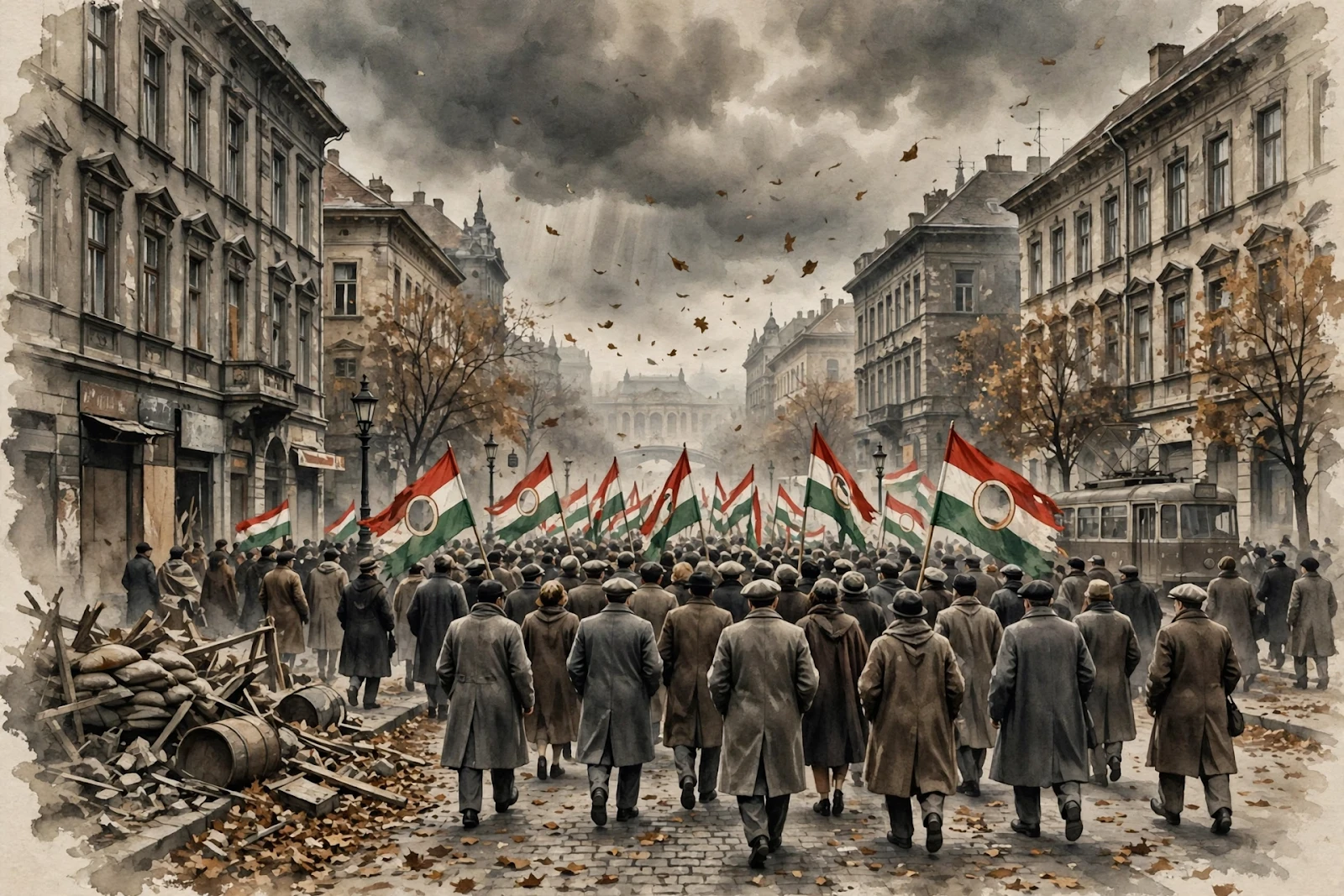
Illustration: Budapest in 1956, the year of the uprising whose Soviet crushing the November 4 release commemorates.
Background
For more than four decades, Hungary's communist authorities maintained a wide network of informants who watched their own communities, reported on neighbours, colleagues, friends and family members, and helped the regime suppress political opposition and maintain control. Like other secret police agencies across Cold War-era Eastern Europe, the Hungarian services relied on collaborators drawn from the public, often recruited through blackmail, threats or rewards, Reuters reported.
Although communist rule ended in 1989, Hungary delayed fully opening the files, which Reuters attributed to a lack of strong political will from successive governments. Until Wednesday, the records sat largely in the basement of the Historical Archives of the State Security Services in Budapest, accessible only in narrow circumstances. The archive's academic head, historian István Papp, has described the opening as a door being thrown wide after years of standing only slightly ajar, according to The Guardian's reporting on the planned release.
The surviving collection is extensive but far from complete. Laid end to end, the documents would stretch for about three miles, according to reports citing the archives. Many files were destroyed in 1956 during Hungary's anti-Soviet uprising and again in 1988–1989, during the transition away from communism. As a result, although up to 60,000 people are named in the records, detailed files — background checks and statements — exist for only around 9,000 of them.
Those fuller files, known as "B dossiers," are expected to be published in a second phase on February 25, 2027, after material protected by privacy law has been removed. Sensitive personal information will be redacted before publication, including health records, information on addictions and sexuality, and anything that could identify victims. Additional files will also be uploaded by February 2027, Magyar said.
Hungary is not the first former Eastern Bloc country to confront its secret police past, but researchers cited in The Guardian's reporting said the searchable online database would make Hungary's former security service among the most open to public scrutiny anywhere in the former Eastern Bloc.

Illustration: A researcher searching the new online database of Hungary's former state security archives.
Why It Matters
The publication matters first of all for the families directly affected. For decades, Hungarians have lived with unanswered questions about who reported on them or their relatives, and why a career stalled, a university place vanished, or a friendship suddenly cooled. The database now gives them a way to search for answers themselves, rather than waiting for a researcher or an official to grant access.
It also matters for Hungary's public life. Magyar has framed the release as essential to rebuilding trust in democratic institutions, arguing that a country cannot move forward while a central chapter of its past remains sealed. "Without confronting the past, there can be no genuine political change," he said ahead of the launch, according to reports of his announcement. The release fulfils a central pledge of the Tisza government, which came to power promising a break with the Orbán era.
At the same time, the publication carries real risks, and Magyar himself acknowledged them. Some of those named may have been coerced into informing, some may have been recorded inaccurately, and some are still alive. Historians and archivists have long warned that secret police files are not neutral records: they reflect what handlers chose to write down, what informants chose to report, and what the regime wanted to believe. The redactions planned for the second phase reflect that sensitivity, but the first-phase names alone will be enough to reopen painful family arguments across the country.
Beyond Hungary, the opening is a reminder of how unevenly Europe has dealt with the archives of its dictatorships. More than three decades after the fall of the Berlin Wall, some countries have opened their files widely, others only partially, and the debate over privacy, justice and historical truth continues. Hungary's decision to publish online, searchable by anyone, sets a new benchmark for openness — and will be watched closely by historians and archivists in neighbouring countries still wrestling with their own sealed files.
What Happens Next
In the coming days, Hungarian families, journalists and historians are expected to begin searching the database and publishing what they find, and the first personal stories emerging from the files are likely to dominate public discussion. The government and the archives will face questions about individual cases, including claims that names were recorded wrongly or that people were coerced into cooperating.
The next formal milestone is February 25, 2027, when the roughly 9,000 fuller "B dossiers" are scheduled for release, once privacy redactions are complete. Until then, researchers caution that the names published on Wednesday are only part of the picture: the detailed files that explain what a person actually did, and under what pressure, are still to come.
How Hungary handles the fallout — whether with the dignity and humanity Magyar called for, or with score-settling — will shape whether this long-delayed opening becomes a genuine act of national reckoning or another source of division. For now, the archives are open, and after 36 years of waiting, Hungarians can finally read their own history in the files of the secret police who once watched them.
Sponsored: explore today's featured sponsored offers
FAQ
What did Hungary publish on November 4, 2026?
Hungary published a searchable online database from the Historical Archives of the State Security Services, naming tens of thousands of people linked to the communist-era secret police between 1945 and 1989, including officers, handlers and recruited informants. Prime Minister Péter Magyar said some 60,000 names have been made public.
How many people are named in the files, and how many are still alive?
Historians estimate that between 50,000 and 60,000 people are named in the surviving records, and roughly one in ten is believed to still be alive today. Detailed files exist for only about 9,000 of them; those fuller "B dossiers" are due for release on February 25, 2027, after privacy redactions.
Who could access the files before this release?
Before Wednesday, access was narrow: apart from researchers, ordinary people were limited to viewing records about themselves or close relatives. From November 4, anyone can search the online database by name, date and place of birth, mother's name, code name, or document type and number.
Why did it take Hungary 36 years to open the files?
According to Reuters, Hungary delayed fully opening the files due to a lack of strong political will from successive governments after communist rule ended in 1989. Prime Minister Magyar made publication a campaign pledge, and his Tisza party ended Viktor Orbán's 16 years in power at the April 2026 parliamentary election.
Are the files complete?
No. Many documents were destroyed in 1956 during the anti-Soviet uprising and again in 1988–1989, during the transition from communism. The surviving documents would stretch about three miles if laid end to end, but the record is uneven, and sensitive personal information — including health details, addictions, sexuality and victims' identities — is being redacted under data-protection rules.
Sources
- Reuters, "Hungary opens communist-era informer files in belated reckoning with Cold War past," November 4, 2026.
- The Guardian (via World Right Now), "'Traitors in every family': Hungary to unmask communist-era informants and confront past," November 2, 2026.
- Dagens, "Up to 60,000 names going online: Hungary opens communist secret-police files on Wednesday," November 3, 2026.
- Informat.ro, "Péter Magyar will publish, on November 4, the secret police files from the communist era," November 1, 2026.
- The English Chronicle, "Hungary to Reveal Names of Communist-Era Informants," November 2, 2026.
Comments
Post a Comment