
DOHA — Iranian negotiators were in Doha on Sunday, November 1, 2026, for a third consecutive day of talks with Qatari mediators aimed at pushing for a deal to end the eight-month-old war between the United States, Israel and Iran, an official briefed on the discussions told Reuters. At the centre of the mediation is a proposal, described by Iran's foreign minister, that could reopen the Strait of Hormuz within two days of an agreement — if Washington meets Tehran's conditions.
The talks come at a moment of acute tension. The conflict has disrupted global oil supplies and spilled across the Middle East, and diplomats fear it could escalate again after the United States holds its midterm elections on Tuesday, November 3. President Donald Trump has said the United States will not launch new attacks on Iran before the vote, while also saying talks with Tehran have been productive — though he has not ruled out further military action afterwards.
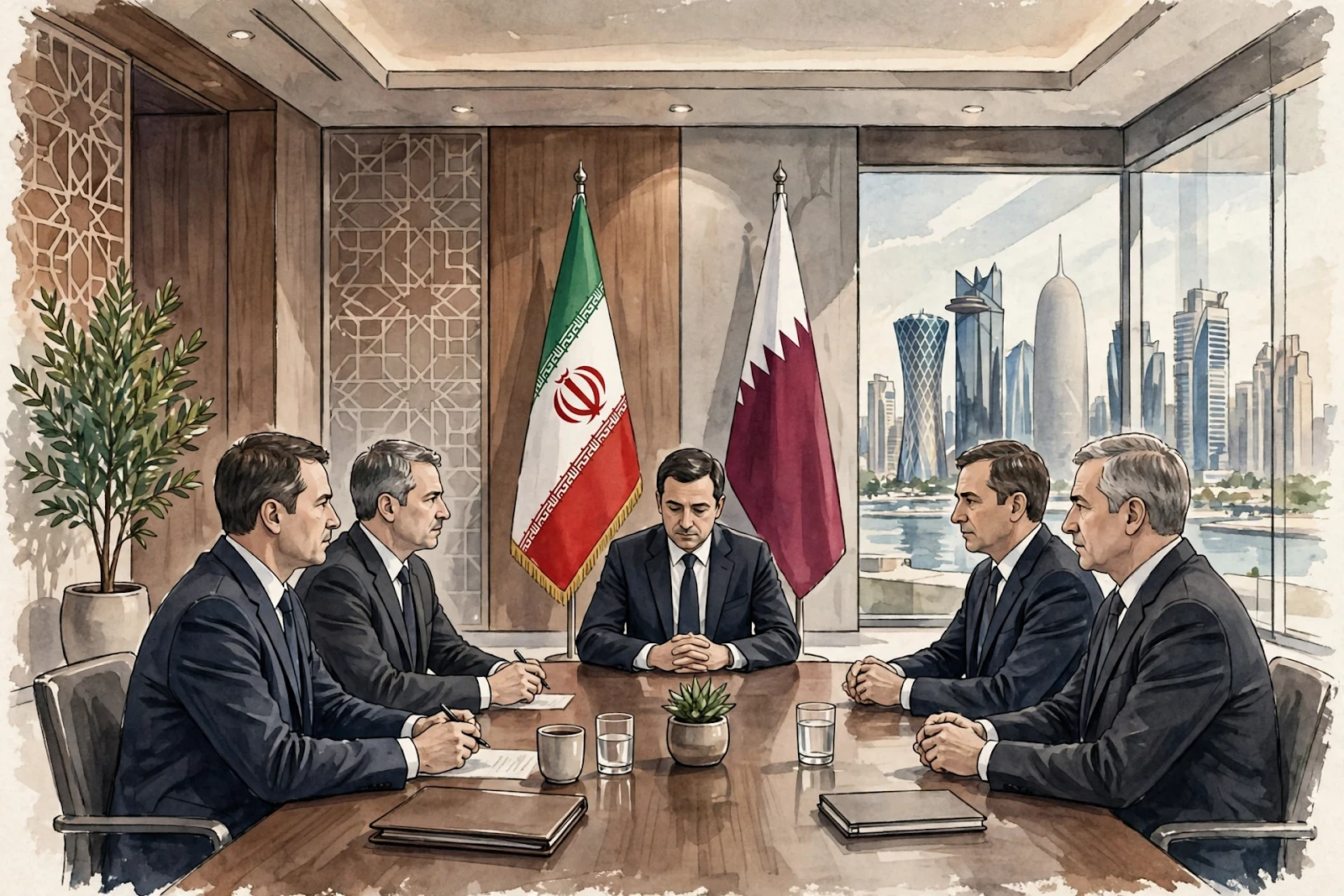
Illustration: Diplomats meet around a conference table during mediation talks in Doha. This is an AI-generated illustration, not a photograph of the actual negotiations.
What Happened
According to Reuters, Iranian negotiators spent Sunday in Doha in their third straight day of discussions with Qatari mediators. The mediation effort began last week in Tehran: Qatari mediators were in the Iranian capital on Friday, October 30, for discussions with Iranian officials before the talks moved to Doha on Saturday. The official briefed on the discussions said the talks were being coordinated in regular contacts with Washington, even though Tehran says it is not engaged in direct negotiations with the United States.
Iranian Foreign Minister Abbas Araghchi told Al Jazeera that consultations with the Qatari mediators had produced a proposal under which the Strait of Hormuz could reopen within two days of a potential agreement. Qatar had initially proposed a five-day implementation window, Araghchi said, but the two sides had arrived at a proposal shortening that period to two days. He stressed that the timetable would begin only if the United States accepted Tehran's conditions — it is not a confirmed reopening, and no deal has been announced.
Araghchi listed Iran's conditions as lifting sanctions imposed after the Islamabad memorandum, reducing the American military presence in the region, restoring waivers for Iranian oil exports, and releasing frozen Iranian funds, including assets held in Qatar. He also said Iran wants recognition of a shipping route through the strait that it discussed with Oman, with other routes closed, and an end to the war on all fronts, including Israeli attacks on Lebanon, according to reports of his remarks.
Iran's top security official, Mohsen Rezaei, struck a harder line the same day, saying seven Iranian conditions must be met before diplomacy can proceed. "We have said many times: the seven conditions Iran has announced must be met. If the conditions are met, the path of diplomacy will be open," he said, according to reports of his comments. Rezaei had previously said there would be no negotiations and that the strait would stay closed until those conditions were fulfilled.
Meanwhile, Gulf officials were reported to be anxiously awaiting Washington's response to the Iranian proposal. The Guardian reported that mediators were "braced for the worst" even as they worked to broker an arrangement that could involve the release of more than $6 billion in Iranian assets — a step that, if it held, could lead both to the reopening of the waterway and to renewed negotiations over Iran's nuclear programme. The United Arab Emirates' envoy, Anwar Gargash, was quoted as saying another round of escalation would serve neither Iran nor its neighbours, while adding that Gulf states were prepared for the worst.
Background
The war between the United States, Israel and Iran has now run for eight months, according to Reuters, disrupting oil supplies and spilling over across the region. The Strait of Hormuz, the narrow waterway connecting the Persian Gulf with the Gulf of Oman and the Arabian Sea, is one of the world's most important energy chokepoints: roughly a fifth of the world's seaborne oil supply passes through it, so any prolonged closure threatens global energy markets, shipping insurance costs and fuel prices far beyond the region.
Qatar has emerged as the key intermediary in the latest diplomatic push. The Gulf state has long played a mediation role between parties that do not talk directly, and the current effort follows a pattern of shuttle diplomacy: Qatari officials in Tehran on Friday, then Iranian negotiators in Doha from Saturday onward, with Washington kept in the loop through regular contacts, according to the official who spoke to Reuters.
The mediation was reportedly prompted in part by a letter sent by US Vice President JD Vance to Rezaei through Qatari mediators, and by the approach of the November 3 midterm elections, after which the risk of renewed strikes is widely seen as rising. On Saturday, October 31, Iran's Supreme Leader Ayatollah Mojtaba Khamenei issued a statement ordering the armed forces to be prepared to respond to any attacks, and the Iranian military later announced it was taking steps to improve its readiness. Iran has repeatedly said it would respond to any new attacks by striking US and Israeli targets in neighbouring countries.
The fragility of the moment was underscored on Friday, when unidentified missiles struck a Pakistan-bound Qatari liquefied natural gas tanker near the strait, even though the vessel had reportedly received direct clearance and safe-passage approval from Tehran only hours earlier, according to The Guardian's reporting. The incident illustrated why Gulf states are pushing hard for a deal — and why they are preparing for failure at the same time.

Illustration: An oil tanker sails through a narrow strait between arid coastlines. This is an AI-generated illustration, not a photograph of the Strait of Hormuz.
Why It Matters
The Doha talks matter because they are the most concrete diplomatic opening in weeks in a war that has already shaken energy markets — and because the window for a deal may be short. With the US midterm elections on November 3, both sides face a deadline imposed by politics as much as by diplomacy: Trump has promised no new strikes before the vote, but what happens after it is openly undecided. US Secretary of State Marco Rubio said on Saturday that Trump has not decided whether to launch new strikes against Iran, but would prefer to resolve the conflict diplomatically. Trump himself has described the negotiations as "going fine" while cautioning that Washington is "not in that much of a hurry" to finalise a deal.
The Hormuz proposal is the clearest sign yet of what a first step could look like. A two-day reopening window, rather than five or seven days, is designed to remove the long gap in which either side might reconsider — a confidence-building measure that could, if it held, unlock wider talks on sanctions, nuclear issues and regional security. For Gulf states, whose economies and shipping lanes sit on the front line, even a limited arrangement would ease immediate pressure on oil prices and tanker insurance.
But the gap between the two sides remains wide. Tehran's conditions — sanctions relief, a reduced US military footprint, restored oil waivers and released funds — are substantial, and Washington has not publicly accepted them. The fact that Iran's own officials are sending mixed signals, with Araghchi expressing hope for diplomacy while Rezaei insists on seven preconditions, suggests the proposal is a starting position in a negotiation, not a done deal. And the reported missile strike on a Qatari LNG tanker shows that actors beyond the negotiating table can still disrupt the process.
What Happens Next
Several things to watch in the coming days:
- Washington's response: Whether the Trump administration accepts, rejects or seeks to amend the two-day Hormuz proposal — and whether any response comes before or after the November 3 midterms.
- The midterm deadline: Whether the promise of no new strikes before November 3 holds, and what military or diplomatic moves follow the vote.
- Iran's readiness signals: Whether Khamenei's order to prepare for retaliation is followed by visible military steps, or remains a deterrent message.
- The tanker incident: Whether the reported strike on the Qatari LNG tanker is claimed, investigated or repeated — and how it affects Gulf states' mediation.
- Nuclear talks: Whether a Hormuz arrangement, if agreed, actually leads to renewed negotiations over Iran's nuclear programme, as mediators hope.
Araghchi said on Sunday that Tehran was prepared for "both defence and diplomacy" and that the purpose of the ongoing talks was to continue consultations with the Qatari mediators. He added that discussions on the two-day proposal were continuing but that no final conclusion had been reached. For now, the talks continue — and the region waits to see whether diplomacy or escalation defines the days after the US vote.

Illustration: Negotiators shake hands across a table with a mediator between them. This is an AI-generated illustration, not a photograph of the Doha talks.
Sponsored: explore today's featured sponsored offers
FAQ
What are the Doha talks about?
Indirect talks between Iranian negotiators and Qatari mediators, now in their third day, aimed at a deal to end the eight-month-old US-Israeli war on Iran, with a proposal to reopen the Strait of Hormuz as a possible first step.
What is the two-day Hormuz proposal?
Iran's foreign minister has described a proposal, developed with Qatari mediators, under which the Strait of Hormuz could reopen within two days of an agreement — shortened from an initial five-day proposal. It is conditional on the United States meeting Tehran's conditions; it is not yet an agreed deal.
What conditions is Iran demanding?
According to Araghchi, lifting sanctions imposed after the Islamabad memorandum, reducing US forces in the region, restoring oil waivers, releasing frozen Iranian funds including those held in Qatar, and recognition of an Oman-discussed shipping route. Security chief Mohsen Rezaei has separately cited seven conditions for diplomacy to proceed.
Are Iran and the United States talking directly?
No, according to Tehran. Iran says it is not engaged in direct negotiations with Washington; Qatar and other regional partners are facilitating communication, with the talks coordinated in regular contacts with Washington.
Why does the November 3 midterm election matter?
President Trump has said the US will not launch new attacks on Iran before the November 3 midterms, and diplomats fear hostilities could escalate again after the vote. The election therefore acts as an informal deadline for the mediation.
Sources
- Reuters, "Iranian negotiators in Doha to continue talks to end the US-Iran war, official says," November 1, 2026.
- Al Jazeera, live coverage and interview with Iranian Foreign Minister Abbas Araghchi, November 1, 2026, as reported.
- The Guardian, "Negotiators 'braced for worst' over US-Iran talks to reopen strait of Hormuz," November 1, 2026, as reported.
- Associated Press, reporting on the Doha talks, November 1, 2026, as cited in contemporaneous coverage.
Comments
Post a Comment