
Israel Certifies Election Results and Rejects Netanyahu's Fraud Claims as Herzog Begins Choosing the Next Prime Minister
JERUSALEM — Israel's Central Elections Committee certified the results of the country's October 27 general election on Wednesday, November 4, 2026, rejecting claims of large-scale fraud promoted by Prime Minister Benjamin Netanyahu and clearing the way for President Isaac Herzog to begin choosing who should try to form the next government.

Illustration: The Knesset plenary hall in Jerusalem, where the next government will need 61 of 120 seats to govern.
The committee said a review of 9,069 polling stations found no irregularities that compromised the integrity of the vote or changed its outcome, according to Al Jazeera. Its acting director general, Dean Livne, said every complaint had been examined individually and that the results accurately reflected voters' choices. The decision was a blow to Netanyahu's weeks-long effort to discredit an election that stripped his far-right coalition of its parliamentary majority.
Herzog formally received the certified results at his residence on Wednesday and immediately began two days of consultations with the leaders of the parties elected to the 120-seat Knesset. After the talks, he will name the candidate he believes is best placed to build a coalition — a choice that could come as early as Thursday evening, according to reporting by The Guardian.
The stakes are high. Neither of the two main blocs won the 61 seats needed to govern: Netanyahu's bloc took 53 seats, the opposition bloc led by former military chief Gadi Eisenkot won 48, and the Arab-led Ra'am and Joint List parties secured a record combined 19 seats. Whoever Herzog tasks with forming a government will need to bridge that gap — or Israel, which held five elections between 2019 and 2022 after repeated deadlocks, could be heading for another vote early next year.
What Happened
On Wednesday, the Central Elections Committee formally certified the final results of the October 27 vote and presented them to President Herzog at a ceremony at the President's Residence in Jerusalem. The certification came after weeks of unsubstantiated claims by Netanyahu and his allies that Arab-led parties had "stolen" the election, possibly with foreign help.
The committee's five-member presidium voted to ratify the results, with representatives of Yesh Atid and Blue and White voting in favour while Likud and Shas abstained. Supreme Court Justice Noam Sohlberg, who chairs the committee, cast the deciding vote.
Speaking at the ceremony, Sohlberg warned that those casting doubt on the results pose "a real danger" to Israel's democracy. "There is one thing on which we must agree: election results, as lawfully determined, are binding on us all," he said, according to Al Jazeera.
Sohlberg also rejected a demand from Likud to discuss the results before certifying them, writing that no party, "however distinguished or senior", could withhold their publication. He said Israeli authorities would keep investigating allegations of vote misconduct, but that they would not fundamentally change the results.

Illustration: A sealed envelope of certified election results is handed over at the President's Residence in Jerusalem.
Herzog, accepting the results, urged both sides to face the new reality. "In the current reality, in which there is no clear winner after the elections, I ask for originality and creativity, courage and goodwill, so that the State of Israel emerges the winner," he said. He added that both camps needed to accept that "not every commitment and promise can be fulfilled" and to avoid new elections.
In a break from custom, Herzog is meeting the smaller parties' leaders first, starting with Religious Zionism, followed by Shas and Yisrael Beytenu, The Times of Israel reported. The remaining factions will meet the president on Thursday, ending with Eisenkot's Yashar party and, finally, Likud.
Background
The October 27 election delivered a historic result: Arab-led lists won their largest-ever share of seats, rising from 10 in the previous parliament to 19, while Netanyahu's bloc fell short of a majority. The surge reflected soaring support among Israel's Arab minority — descendants of Palestinians who stayed in Israel after its creation in 1948 — who have largely been outraged by the harsh rhetoric and actions of Netanyahu's far-right government, according to Al Jazeera.
Netanyahu and his allies responded by claiming, without evidence, that the vote had been tainted. National Security Minister Itamar Ben-Gvir wrote on X that "the elections were stolen, the results are fraudulent, foreign countries interfered," and demanded a freeze on certification and on forming a government. His far-right Otzma Yehudit party voted against approving the results. Likud legislator Amit Halevi resigned from the elections committee, alleging that some lawmakers had "bought their seats with bribe money" and that the vote reflected "the choice of the rulers of Qatar, Iran or Turkey". Qatar has rejected claims that it funded Arab-led parties, calling them "disinformation".
Haaretz reported that Likud had even weighed refusing to recognise the results altogether — a move that would have been unprecedented in Israel and would likely have been swiftly overturned by the courts.
Behind the public claims sits a murkier subplot. The Shin Bet internal security agency told the committee that intelligence pointed to widespread foreign funding and influence operations involving "thousands of people and possibly more", The Times of Israel reported. Law enforcement sources told Haaretz they were unaware of any operation of that size. The Shin Bet is reportedly seeking to question four Arab politicians, but has not given prosecutors evidence regarding three of them. Likud accused Attorney General Gali Baharav-Miara of blocking the interrogations; she in turn effectively accused Shin Bet chief David Zini, a Netanyahu appointee, of undermining the rule of law. Sohlberg has said that even if foreign interference were confirmed, it would not undermine the overall result.
The deadlock is familiar territory for Israel. After the last election in November 2022, it took Netanyahu 58 days to form a government — and that was with a better showing by Likud than this time. The country held five elections between 2019 and 2022 before a stable government emerged, and the current arithmetic is, if anything, harder: no bloc is close to 61 seats on its own.
Why It Matters
The certification removes the last formal obstacle to government formation — and it does so by drawing a line under the fraud claims. By certifying the results over the objections of the outgoing coalition's representatives, the elections committee, led by a Supreme Court justice, has made the outcome legally binding. That matters because the alternative — a prime minister refusing to accept an election result — would have been a first in Israeli history and a severe test of the country's democratic institutions.
The result also reshapes Israeli politics. The record 19 seats won by Arab-led parties make them potential kingmakers for the first time, and Eisenkot has already collected endorsements from smaller parties: Naftali Bennett's Together party and Avigdor Lieberman's Yisrael Beytenu, which holds seven seats, have both backed him. Whether those endorsements can be converted into a working coalition — and whether Arab-led parties would join or support one from outside — is the central question of the coming weeks.
For Netanyahu, the certification closes one avenue of challenge but not the fight itself. He remains the leader of the largest single bloc, and Herzog could still hand him the first chance to form a government. But with his bloc six seats short of a majority in the Knesset, he would need to peel away support from parties that have spent the past week endorsing his rival — or persuade Herzog that he, not Eisenkot, can assemble 61 votes.
There is also a wider signal for democracies watching from abroad. The episode — a losing incumbent alleging fraud without evidence, an independent election authority examining every complaint and certifying the result anyway, and a president urging compromise — is a stress test that Israel's institutions, at least for now, appear to have passed. The coming consultations will show whether its politicians can do the same.
What Happens Next
Herzog's consultations continue on Thursday, with the remaining party leaders meeting the president in turn. The Guardian reported that Herzog is expected to name Eisenkot as the candidate to form the next government, with an announcement possible as early as Thursday evening — though the president has not confirmed his choice, and Likud will make its case last.
Whoever receives the mandate will have 28 days to form a government, with a possible 14-day extension. The options on the table include a unity government, an alliance between Eisenkot's bloc and Arab-led parties, or a Netanyahu-led coalition assembled from unlikely partners. If no candidate can secure 61 seats, Israel would hold another election early next year.
Investigations will continue in parallel. The Shin Bet's inquiry into alleged foreign interference is ongoing, and the elections committee has said it will keep examining allegations of misconduct — even as it insists none of them would change the certified outcome.
For now, the certified numbers stand: Netanyahu 53, Eisenkot 48, Arab-led parties 19 — and a president with two days to decide who gets the first chance to turn those numbers into a government.
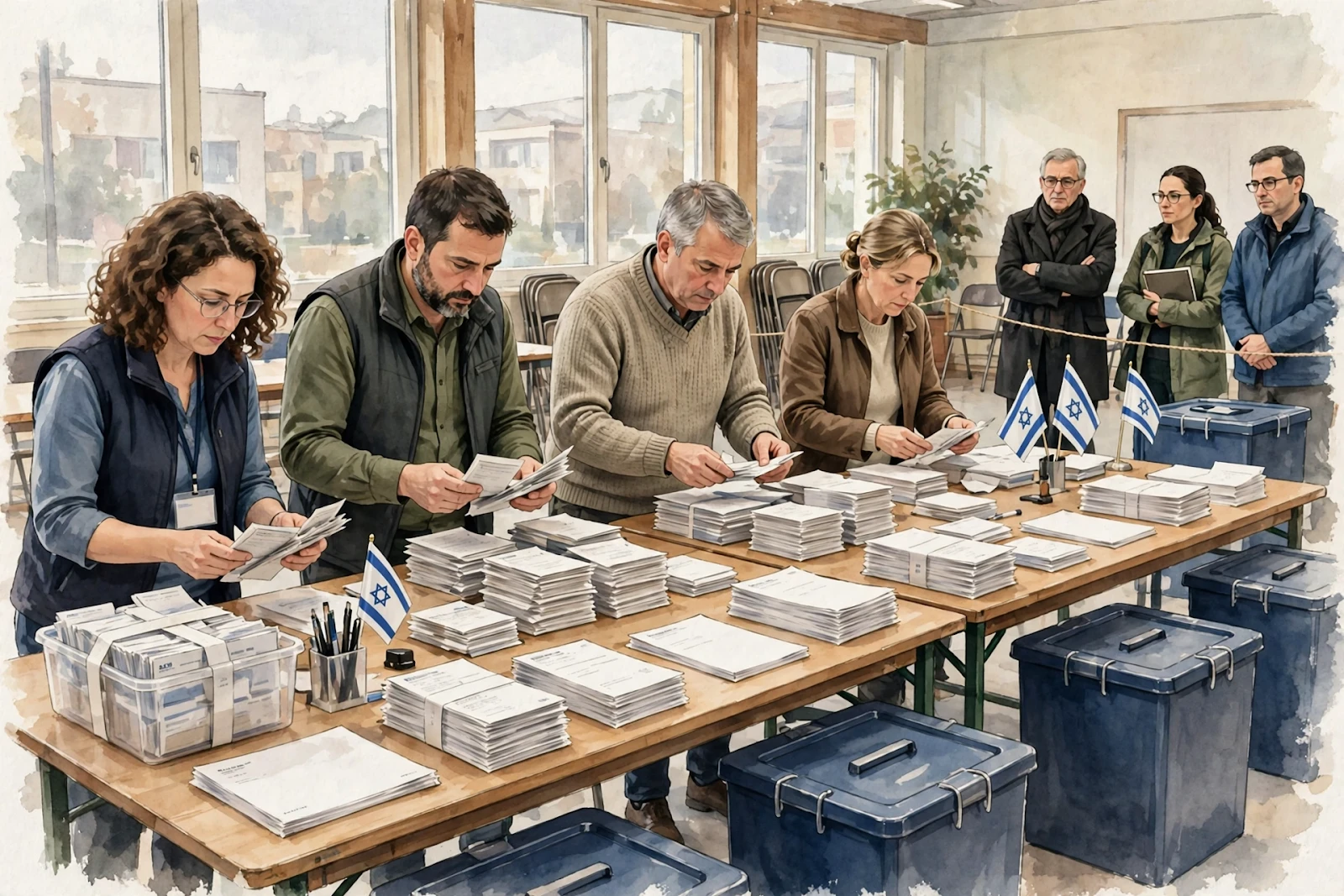
Illustration: Election officials count paper ballots; the committee reviewed 9,069 polling stations and found no irregularities that changed the result.
Sponsored: explore today's featured sponsored offers
FAQ
What did Israel's election commission decide?
On November 4, 2026, the Central Elections Committee certified the final results of the October 27 general election, finding no evidence of fraud. A review of 9,069 polling stations found no irregularities that compromised the integrity of the vote or changed its outcome, and every complaint was examined individually, according to the committee.
Who won the most seats in the election?
Prime Minister Benjamin Netanyahu's bloc won 53 seats, Gadi Eisenkot's opposition bloc won 48, and the Arab-led Ra'am and Joint List parties won a record combined 19 seats. None reached the 61 seats needed for a majority in the 120-seat Knesset.
What happens next in forming a government?
President Isaac Herzog is holding two days of consultations with party leaders. He will then give one candidate 28 days to form a government, with a possible 14-day extension. The Guardian reported he is expected to name Eisenkot, with an announcement possible as early as Thursday evening.
Why did Netanyahu claim the election was fraudulent?
Netanyahu and his allies repeatedly claimed, without evidence, that Arab-led parties had "stolen" the election, possibly with foreign help. The elections committee rejected those claims after its review, and Qatar rejected allegations that it funded Arab-led parties, calling them "disinformation". The Shin Bet is continuing to investigate suspicions of foreign influence, though officials say any findings would not change the certified result.
Could Israel face another election?
Yes. If no candidate can assemble a coalition of 61 seats, Israel would hold another election early next year. The country held five elections between 2019 and 2022 after repeated deadlocks, and Herzog has urged both sides to show "originality and creativity" to avoid a new vote.
Sources
Al Jazeera, "Israel's election commission rejects Likud's fraud claims, confirms results," November 5, 2026; The Guardian (Emma Graham-Harrison and Quique Kierszenbaum), "Israel's election commission rejects Netanyahu claims of voting fraud," November 4, 2026; Daily Guardian, "Israel's election commission says no fraud found in last week's vote," November 5, 2026; The Times of Israel, reporting on President Herzog's consultation schedule and the Shin Bet briefing, as cited by Al Jazeera, November 5, 2026.
Comments
Post a Comment