
EVANSTON, Ill. — A new way of cleaning up the James Webb Space Telescope's images has pulled a giant planet out of glare where conventional processing could not see it at all. The result, published on November 4, 2026, does not announce a brand-new world. It shows that worlds already suspected — or already known from other telescopes — may be hiding in data astronomers already own, waiting for a better way to look.
The technique is called FLIP, short for Physics-based Learning for Imaging Planets. Developed by a team led by Northwestern University, it improved the telescope's sensitivity to faint planets by two to 15 times in tests on three star systems. In one of those tests, it recovered the giant planet 51 Eridani b from two-year-old Webb observations at a wavelength where the planet had previously been invisible to the space telescope.
That wavelength matters. At about 4.3 microns in the infrared, carbon dioxide in a planet's atmosphere strongly absorbs light. A planet can therefore look even fainter there than elsewhere — but the same absorption can also reveal clues about what its atmosphere contains. Recovering a planet at that wavelength is not just a sharper picture; it is a step toward reading atmospheres that were previously out of reach.
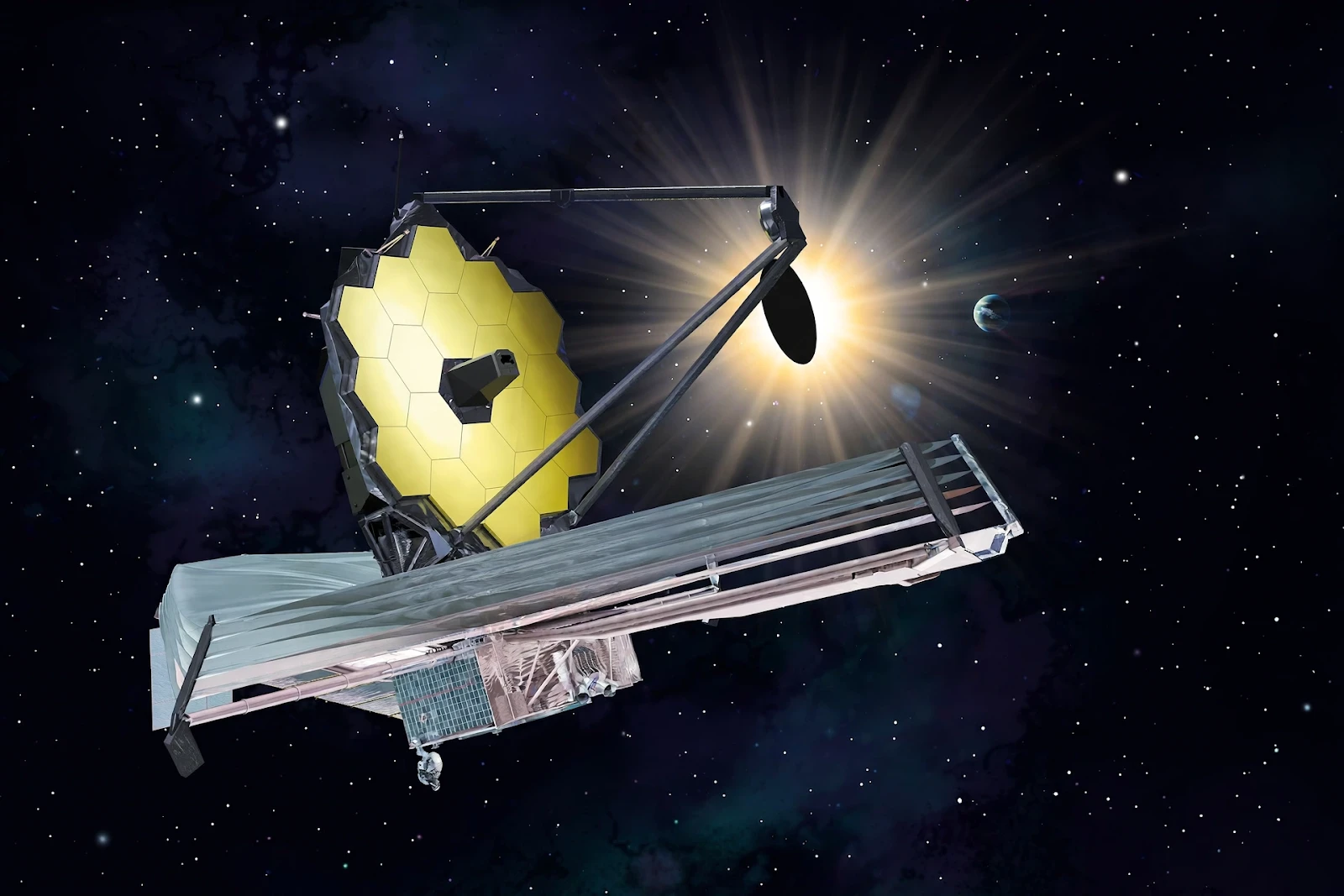
Illustration: The James Webb Space Telescope observing a bright star, with a faint planet emerging from the star's glare after glare-removal processing.
What Happened
The study, led by Northwestern doctoral student Rodrigo Ferrer-Chavez and published in the journal Nature, tackles one of the oldest frustrations in direct exoplanet imaging: stars are overwhelmingly brighter than the planets around them. Ferrer-Chavez put the scale bluntly, saying that planets can be a million times fainter than their stars. Even relatively bright, young giant planets can be about 100,000 times fainter than their host stars, according to the Northwestern report on the study.
Webb already carries coronagraphs, instruments designed to block most of a star's light so that fainter objects nearby can be seen. But blocking the star is not enough. Some starlight still leaks through, forming a hazy pattern that can swallow a planet's signal. Astronomers then use image-processing techniques to subtract the leftover glare.
For about 20 years, the standard approach has relied on a reference star. Astronomers observe a different, planet-free star, use its image as a template for the glare, and subtract that template from the target observation. The problem, as co-author Jason Wang explained, is that no telescope stays perfectly still. Tiny shifts in its structure change the pattern of scattered starlight, so the reference never matches the real observation exactly. Even a small mismatch can leave behind enough glare to hide a planet.
FLIP takes a different route. Instead of depending mainly on a reference photograph, it builds a "digital twin" of the telescope — a virtual replica that simulates how starlight travels through Webb's mirrors and reaches its detectors. Using optimization tools similar to those used to train artificial-intelligence models, the team fine-tuned millions of parameters in that digital twin to account for tiny imperfections, including subtle shifts in position and distortions in the optics.
Wang was careful about what that does and does not mean. The team used the same computational tools researchers use to train AI models, he said, but did not actually use AI to identify planets. Because the physics of the telescope is already understood, the model could be built from that physics and then adjusted until its simulated starlight matched the real observation closely. The simulated glare was then subtracted from the image.
To test the method, the researchers reanalysed Webb observations of three stars: HIP 65426 and 51 Eridani, both already known to host planets, and TYC 5899, which has no known planetary companions. Across those observations, FLIP consistently outperformed conventional techniques, improving sensitivity by a factor of two to 15. The headline result came from 51 Eridani, where the method produced a detection of 51 Eridani b at greater than five-sigma significance — a strong statistical signal — at its expected location.
It is important to be precise about what was found. Astronomers had previously discovered 51 Eridani b using ground-based telescopes. Conventional Webb processing, using the established KLIP method, could not distinguish the planet from residual glare at the wavelength Webb uses to study carbon dioxide. When Ferrer-Chavez applied FLIP to the same observations, the planet emerged. As Wang put it, the team showed it could recover a planet that people previously could not see in that data — science that had, in his words, been left on the table because the right analysis tools did not yet exist.
Background
Direct imaging is one of the hardest ways to study exoplanets, and also one of the most rewarding. Most exoplanets are found indirectly, through the tiny dip in starlight when a planet passes in front of its star, or through the slight wobble a planet induces in its star's motion. Direct imaging, by contrast, tries to photograph the planet itself. That makes it possible, in principle, to study a planet's light directly and to learn about its atmosphere and composition.
The difficulty is not only brightness. It is stability. Webb's mirrors and instruments operate at extremely cold temperatures, and even minute thermal changes can cause a mirror to expand or contract by picometers — trillionths of a metre. The telescope's cryocoolers, which keep instruments super cold, have small motors that can cause mirrors to vibrate. There are also causes of instability that researchers say they do not yet fully understand, as they continue to learn how such complex telescopes behave in space.
Those tiny movements matter because they change the glare pattern by amounts that sound negligible but are large compared with a planet's faint signal. A shift of just a few nanometres can alter how light spreads through the telescope. That is why a reference image taken at a different time, under slightly different conditions, cannot perfectly predict the glare in a science image.
51 Eridani b is a useful test case precisely because it is both known and difficult. The planet is a young giant, the kind of world that should be among the easier targets for direct imaging. Yet at the infrared wavelength where carbon dioxide absorbs light, its signal was too faint for conventional processing to separate from Webb's residual glare. That combination — a known planet, a scientifically interesting wavelength, and a previous non-detection in Webb data — makes the FLIP recovery a convincing demonstration rather than a claim that rests on an unfamiliar object.

Illustration: A giant exoplanet appears as a faint dot beside its host star, illustrating how starlight can overwhelm a planet's signal.
Why It Matters
The most immediate implication is archival. Webb has been observing since 2022, and its archive already contains observations in which faint planets may be present but unresolved. If a software technique can improve sensitivity by up to 15 times without changing the telescope at all, reprocessing old data could yield results that would otherwise require new, expensive observing time. The 51 Eridani b recovery is a proof of that idea on real data, not only on simulations.
The second implication concerns atmospheres. Planets are not equally visible at all wavelengths, and the wavelengths where they are hardest to see are sometimes the most informative. At 4.3 microns, carbon dioxide absorption can tell astronomers about a planet's atmospheric chemistry. A method that recovers planets at such wavelengths could therefore open new lines of inquiry into giant planets' compositions, and eventually into how their planets formed and evolved.
The third implication reaches beyond Webb. NASA's proposed Habitable Worlds Observatory, planned for the 2040s, aims to directly photograph Earth-like planets around Sun-like stars. Those planets would be far smaller and fainter than 51 Eridani b. To find them, such a telescope may need to maintain optical stability at the picometer scale — roughly 100 to 1,000 times more stable than Webb, according to the Northwestern report. That is an extreme engineering challenge.
FLIP suggests a complementary path. Rather than relying only on engineering to keep a telescope perfectly stable, astronomers might correct for its tiny imperfections in software, using a detailed physical model of the instrument. That does not remove the need for a stable telescope, but it could relax some requirements, or make a future observatory more capable than its hardware stability alone would allow. For a mission that will not launch for years, a technique demonstrated on Webb today could shape design choices made long before launch.
There is also a broader lesson about how planetary systems are counted. Ferrer-Chavez noted that no planets like those in our own solar system are yet known around other stars — not necessarily because they do not exist, but because astronomers cannot yet see them. Every improvement in technique, he said, has revealed new types of planets, and finding more planets helps researchers understand how planetary systems form and evolve, and how typical our own solar system truly is. FLIP is, in that sense, less about one giant planet than about lowering the threshold for what counts as visible.
What Happens Next
The next step is likely to be archival reanalysis. Astronomers with Webb data on stars suspected of hosting planets — or stars where a planet's signal sits just below the detection threshold — now have a tested method to revisit those observations. If FLIP recovers additional planets from existing data, it could change target lists for follow-up observations and help prioritise which systems deserve deeper study.
Researchers will also want to test the method more widely. The published tests covered three star systems, which is a strong demonstration but not yet a broad survey. Applying FLIP to more Webb observations, at more wavelengths and under different observing conditions, will show how robust the digital-twin approach is, and where its limits lie. Independent groups reproducing the 51 Eridani b recovery and applying the technique to their own data will be an important part of that validation.
Atmospheric studies are another likely direction. Now that 51 Eridani b can be seen at a carbon-dioxide-sensitive wavelength, astronomers can study what that detection implies about the planet's atmosphere in more detail, and can attempt similar recoveries for other giant planets whose atmospheric signals have been masked by glare. Over time, that could build a clearer picture of how giant planets differ from one another, and how their atmospheres relate to their formation histories.
For future telescopes, the work feeds into planning for the Habitable Worlds Observatory and other planet-imaging missions. Engineers and astronomers will weigh how much stability can be built into hardware against how much can be corrected in software. A method that models a telescope's imperfections rather than assuming perfect stability could become part of the standard toolkit for direct imaging, alongside coronagraphs and reference-star subtraction.
None of that means Earth-like planets are suddenly within easy reach. The gap between a young giant planet and a small, rocky world around a Sun-like star remains enormous, and FLIP's demonstrated gain — up to 15 times — does not close it on its own. What it does is move the frontier. Planets that were just below the threshold of visibility are now above it, and the archive of a telescope already in space has become, in effect, a little larger.
Illustration: A future observatory concept searching for small, Earth-like planets around Sun-like stars, a goal that will require far greater stability than Webb.
Sponsored: explore today's featured sponsored offers
FAQ
What is FLIP?
FLIP stands for Physics-based Learning for Imaging Planets. It is a computational technique that builds a digital twin of the James Webb Space Telescope, simulates how starlight travels through it, and subtracts that simulated glare from observations to reveal faint planets nearby.
Did FLIP discover a new planet?
No. It recovered 51 Eridani b, a giant planet already discovered with ground-based telescopes, from Webb data at a wavelength where conventional processing could not see it. The advance is the recovery method and the wavelength, not a first discovery of the planet itself.
How much better is FLIP than older methods?
In tests on three star systems, FLIP improved sensitivity to faint planets by two to 15 times compared with conventional image-processing techniques, according to the study team.
Why is imaging exoplanets so difficult?
Planets are vastly fainter than their stars — by factors of about 100,000 for young giants and up to a million in general terms cited by the study's lead author. Even after a coronagraph blocks most starlight, leaked glare and tiny telescope movements can hide a planet's signal.
Could this help find Earth-like planets?
Potentially, as part of a longer path. FLIP could inform the design of NASA's proposed Habitable Worlds Observatory, which aims to photograph Earth-like planets, by showing that software correction of telescope imperfections can complement extreme hardware stability. It does not by itself make Earth-like planets detectable with Webb.
Sources
Northwestern University / phys.org, "Giant planet emerges from two-year-old JWST data thanks to glare-removal technique," November 4, 2026; Scientific American, "NASA's James Webb Space Telescope is wobbly — scientists have a fix that could reveal new alien worlds," November 4, 2026; Ferrer-Chavez et al., "Imaging exoplanets below the telescope stability limit," Nature (2026), DOI: 10.1038/s41586-026-11213-z.
Comments
Post a Comment