
WASHINGTON — NASA's Neil Gehrels Swift Observatory, a space telescope that spent 22 years studying some of the most violent explosions in the universe, is expected to fall back to Earth on Wednesday, 4 November 2026. According to a prediction by the U.S. Space Force cited by NASA on Monday, 2 November, the roughly 1.5-tonne spacecraft is expected to re-enter Earth's atmosphere at approximately 3:30 a.m. EST on 4 November, with an uncertainty of about 11 hours on either side of that time. Most of the observatory should burn up as it plunges through the atmosphere, NASA said, although a small number of dense parts could survive the descent. NASA has assessed the individual risk of harm from falling debris at roughly 1 in 2,100, and surviving debris is most likely to fall into the ocean, far from any populated area.
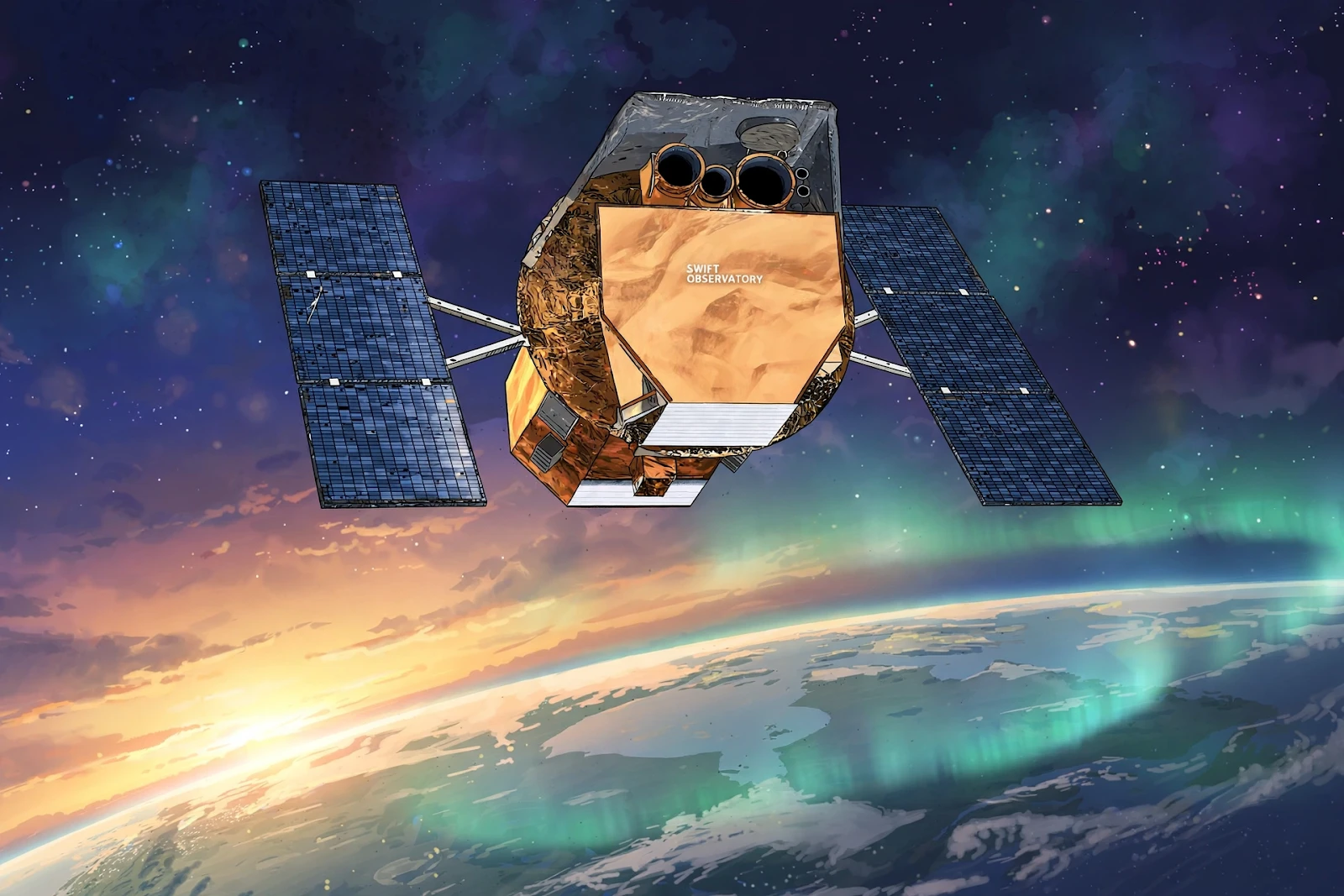
Illustration: The Swift Observatory in low Earth orbit above Earth's glowing atmosphere. This is an illustration, not a photograph of the real spacecraft.
The reentry marks the final chapter of a mission that outlived every expectation placed on it when it launched in 2004, and it comes just days after Swift ended its science operations in late October 2026. Its fall is uncontrolled, meaning engineers cannot steer it to a precise splashdown point, but it is also the kind of reentry that happens regularly as ageing satellites reach the end of their lives.
What Happened
According to NASA, the U.S. Space Force predicted that Swift would re-enter Earth's atmosphere at approximately 3:30 a.m. EST on Wednesday, 4 November 2026, with an uncertainty window of about 11 hours. That window means the actual reentry could occur hours earlier or later than the central estimate, and the predicted time was expected to be refined as the spacecraft descended and tracking data improved. The reentry band — the zone over which the spacecraft could come down — lies within about 21 degrees of the equator, crossing parts of Africa, Australia, India, Southeast Asia, and Central and South America.
Most of the spacecraft, which weighs about 1.5 tonnes (around 3,200 pounds), is expected to burn up during reentry, according to NASA. However, a small number of dense tungsten parts and some mirror pieces could survive the descent, NASA mission chief scientist Brad Cenko said. Tungsten is exceptionally dense and heat-resistant, which is why such components are among the most likely to reach the ground intact. NASA assessed the individual risk of harm from surviving debris at roughly 1 in 2,100. Because so much of Earth's surface is ocean, surviving debris is most likely to fall into the sea.
Dean Sladen, of the precision engineering firm Accu Components, put the event in perspective: "Only a handful of small, scorched fragments" would be expected to reach the ground, he said. "Satellites this size re-enter regularly," Sladen added, "no one has ever been killed by falling space debris." That record, spanning decades of spaceflight, is one reason space agencies treat uncontrolled reentries of spacecraft of this size as a low-risk, if closely watched, event — while still tracking the descent and updating predictions as new data arrives.
Swift's final descent follows a rapid drop in its orbit. By 20 October 2026, the observatory was orbiting at only about 171 miles (275 kilometres) — below the International Space Station, which orbits at roughly 250 miles. Swift briefly resumed observations after its rescue attempt failed, but it ended operations in late October as its orbit decayed beyond the point at which useful science could continue.
Background
Swift — formally the Neil Gehrels Swift Observatory, named after the late NASA astrophysicist Neil Gehrels — launched on 20 November 2004. Its mission was to study gamma-ray bursts, the most powerful explosions known in the universe, which are thought to mark the births of black holes and the collisions of neutron stars. These bursts can outshine entire galaxies for a few seconds, then fade rapidly, so catching them requires a telescope that can react fast. Swift was built for exactly that: it could detect a burst, pinpoint its location, and swing its telescopes onto the target within minutes, then alert observatories on the ground and in space.
Over 22 years, Swift detected more than 2,000 gamma-ray bursts and observed more than 1,400 exploding stars, or supernovae, along with comets, asteroids, and black holes. It carried three telescopes working together: one for visible and ultraviolet light, one for X-rays, and one for gamma rays. Its rapid alerts made it an essential partner for larger observatories, including the Hubble Space Telescope and the James Webb Space Telescope, which could then turn their far more powerful instruments onto the most interesting targets.

Illustration: A satellite breaking apart and burning up as it re-enters Earth's atmosphere. This is an illustration, not a photograph of the real spacecraft.
Swift's longevity was itself remarkable. The mission was originally planned for a much shorter life, but it kept delivering science year after year. NASA Astrophysics Division director Shawn Domagal-Goldman summed up that contribution, saying that "Swift played a major role" in advancing the field, according to USA Today.
The beginning of the end came not from any instrument failure, but from the Sun. Increased solar activity since autumn 2024 heated and expanded Earth's upper atmosphere, increasing the drag on satellites in low orbit and dragging Swift lower faster than expected. Mission planners had anticipated a gradual orbital decay, but the pace quickened, and by 2026 it was clear the observatory's days were numbered. That urgency prompted an extraordinary rescue attempt — one that, had it worked, would have been a first in the history of spaceflight.
In July 2026, NASA's $30 million Katalyst Space LINK mission launched from the Marshall Islands aboard a Northrop Grumman rocket, aiming to rendezvous with Swift and boost it to a higher, safer orbit. Swift was never designed to be serviced — it has no docking port and no grappling fixture — so the attempt was always a gamble. LINK got no closer than about 7 to 9 miles from its target and was unable to close the gap. It fell back to Earth in September 2026, and NASA announced the failure of the rescue on 19 August 2026. The lessons from LINK's attempt are expected to inform future servicing and debris-removal missions, even though this particular rescue did not succeed.
Why It Matters
Swift's reentry matters first because of what the mission achieved. Few observatories have shaped a field as thoroughly as Swift shaped the study of transient astronomy — the science of things that appear, flare, and fade. Before Swift, gamma-ray bursts were mysterious flashes whose distances and origins were often unknown. Swift's rapid, precise positions allowed ground-based telescopes to find the fading afterglows, measure their distances, and identify their host galaxies, transforming bursts from curiosities into tools for studying the deaths of stars, the birth of black holes, and the expansion of the universe itself. Its catalogue of more than 2,000 bursts remains a foundation for the field.
Second, the reentry is a reminder of a growing challenge in low Earth orbit: what happens to satellites when they die. Thousands of satellites now circle the planet, and the number is rising fast. Most are designed to burn up on reentry, but larger spacecraft can leave surviving fragments, and the risk — while small for any individual — is a subject of active work among space agencies.
What Happens Next
In the hours around the predicted reentry time, tracking agencies were expected to refine their predictions as Swift descended. Reentry predictions typically narrow sharply in the final hours, as radar and optical tracking data pin down the spacecraft's position, speed, and rate of descent. NASA and the U.S. Space Force were expected to issue updates, and organisations such as the Aerospace Corporation, which publishes independent reentry predictions, were also tracking the event.

Illustration: Scientists tracking a satellite's reentry path on a world map. This is an illustration, not a photograph of the real spacecraft.
If any debris does survive to the ground, space agencies have standard procedures: members of the public are advised not to touch suspected spacecraft debris, which may be sharp, hot, or contaminated, and to report it to local authorities so it can be identified and recovered safely. In practice, given that most of the reentry band is ocean and that only a handful of small fragments are expected to survive, the most likely outcome is that Swift's remains will splash down unnoticed, far from land. Historically, that is how most uncontrolled reentries end.
Sponsored: explore today's featured sponsored offers
FAQ
When is NASA's Swift Observatory expected to re-enter Earth's atmosphere?
According to a U.S. Space Force prediction cited by NASA on 2 November 2026, Swift is expected to re-enter at approximately 3:30 a.m. EST on Wednesday, 4 November 2026, with an uncertainty of about 11 hours. Predictions are typically refined in the final hours of descent as tracking data improves.
Is Swift's reentry dangerous to people on the ground?
NASA assessed the individual risk of harm at roughly 1 in 2,100, and most of the spacecraft is expected to burn up. Only a small number of dense tungsten parts and some mirror pieces could survive, according to NASA mission chief scientist Brad Cenko, and surviving debris is most likely to fall into the ocean. No one has ever been killed by falling space debris, according to Dean Sladen of Accu Components.
Where could Swift's debris fall?
The reentry band lies within about 21 degrees of the equator, crossing parts of Africa, Australia, India, Southeast Asia, and Central and South America. Because much of that band is ocean, surviving fragments are most likely to splash down at sea rather than on land.
Why is Swift falling to Earth now?
Increased solar activity since autumn 2024 expanded Earth's upper atmosphere and increased drag on Swift, pulling it lower faster than expected. By 20 October 2026 it was orbiting at only about 171 miles (275 kilometres), below the International Space Station. A $30 million rescue mission, Katalyst Space LINK, launched in July 2026 but got no closer than 7 to 9 miles to Swift and fell back to Earth in September; NASA announced the failure on 19 August 2026.
What did Swift discover during its 22-year mission?
Launched on 20 November 2004, Swift detected more than 2,000 gamma-ray bursts and observed more than 1,400 exploding stars, or supernovae, as well as comets, asteroids, and black holes. With three telescopes covering visible, ultraviolet, X-ray, and gamma-ray light, it pinpointed cosmic explosions within minutes and alerted other observatories, including Hubble and the James Webb Space Telescope, to follow up.
Sources
- Associated Press reporting, 2–3 November 2026
- NASA Swift mission update, 23 October 2026
- USA Today, 2 November 2026
- Aerospace Corporation reentry prediction
Comments
Post a Comment