
CAPE CANAVERAL — NASA has unveiled its newest experimental aircraft, the X-70 Fractal, a crewed research jet designed to test advanced flight-control systems and aircraft manoeuvrability in ways the agency says have never before been demonstrated in crewed flight. The aircraft was revealed on Wednesday, November 4, 2026, during the UP.Summit at NASA's Kennedy Space Center in Florida.
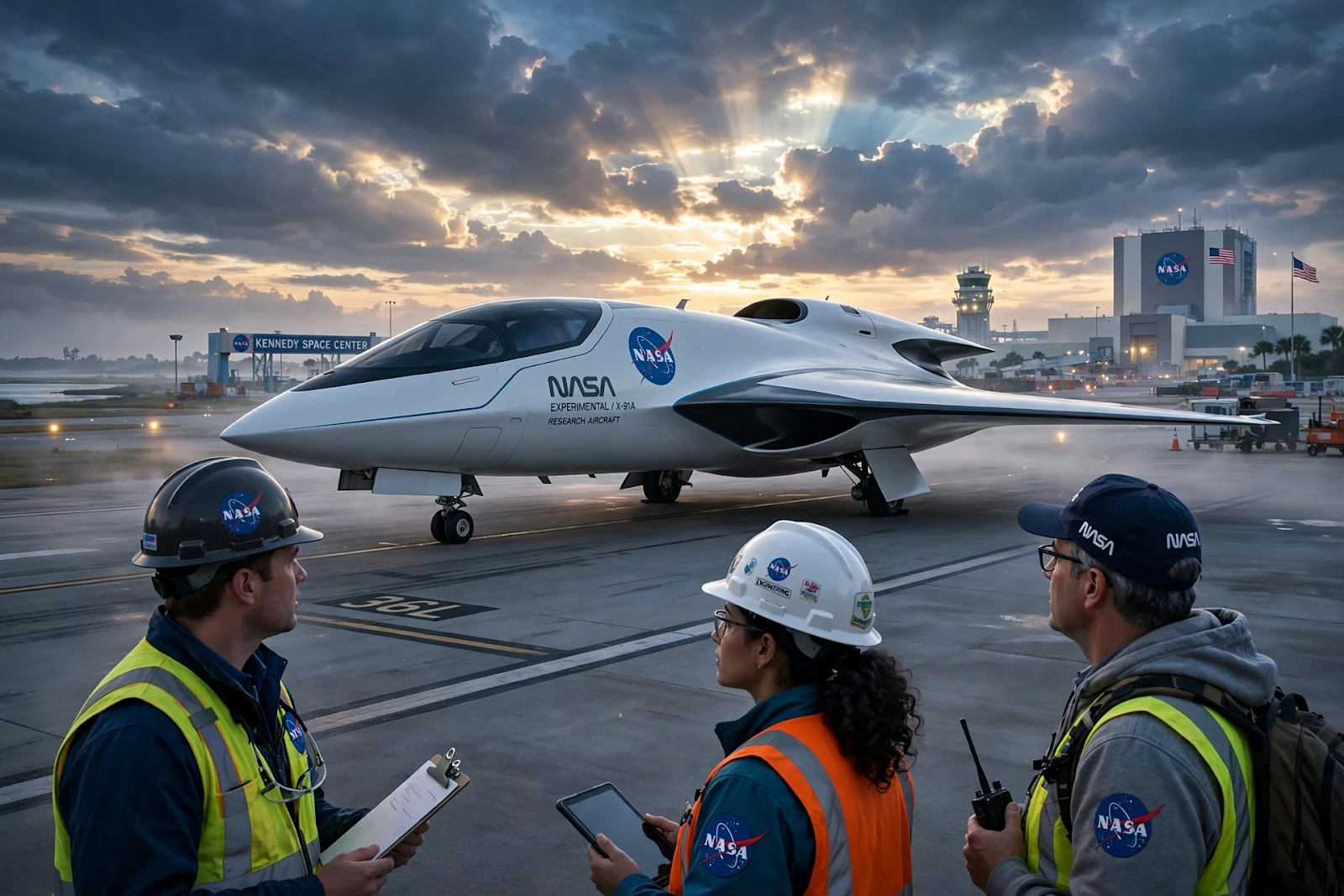
Illustration: A futuristic NASA experimental research aircraft on the runway at Kennedy Space Center at dawn, with engineers in the foreground.
The X-70 is a high-performance, highly adaptable platform built to speed up how new aviation technologies move from the drawing board to real flight testing. NASA says the aircraft can carry up to 2,000 pounds of experimental payloads in internal and external locations, allowing different instruments and systems to be swapped quickly between test campaigns. It is designed for a takeoff weight of 10,000 pounds, a cruise speed of Mach 0.75, a ceiling of up to 45,000 feet, and an operational range exceeding about 1,726 miles (1,500 nautical miles).
NASA Administrator Jared Isaacman said the aircraft gives the agency a crewed, high-performance platform to test advanced flight-control, manoeuvrability, and other cutting-edge technologies in real flight. "We expect her first flight under the NASA banner within the next two years, and X-70 is just one part of this new beginning for aeronautics," Isaacman said, according to NASA's announcement.
What Happened
NASA announced the X-70 Fractal on November 4, 2026, at the UP.Summit, an invitation-only technology showcase held at Kennedy Space Center. The unveiling came days before NASA's inaugural Max Power aerospace exposition at the same site, which runs from November 6 to 8 and combines an air show headlined by the U.S. Air Force Thunderbirds, exhibits at the Kennedy Space Center Visitor Complex, and the UP.Summit technology expo at NASA's former shuttle landing strip.
The defining feature of the X-70, according to NASA, is its advanced, rapidly reconfigurable flight-control technology. Rather than being built around a single fixed set of handling characteristics, the aircraft is designed so engineers can change how it flies — its control responses and manoeuvring behaviour — between test campaigns. That flexibility is the point: instead of building a new aircraft for each research question, NASA can reconfigure one airframe to explore many.
The aircraft is crewed, which matters for the kind of research NASA has in mind. Some flight-control and handling qualities can only be judged with a pilot in the loop, feeling how the aircraft responds in real air. A crewed research platform also lets NASA test systems that will eventually fly on aircraft carrying people, under the same conditions those systems will face in service.

Illustration: The cockpit of an experimental aircraft fitted with advanced reconfigurable flight controls and test instruments.
Reporting on the announcement notes that NASA's release did not publicly name the company that built the Fractal, and that more details are expected as the Max Power exposition unfolds. The agency's announcement focused on what the aircraft is designed to do, not on its industrial pedigree — a gap that aviation watchers expect to be filled in the coming days.
Background
The X-70 joins one of the most storied lineages in aviation: the X-plane series, experimental aircraft built to answer questions that no production aircraft could. The Bell X-1 broke the sound barrier in 1947 with Chuck Yeager at the controls. The rocket-powered X-15 flew to the edge of space in the 1960s, reaching hypersonic speeds and altitudes that informed both aviation and the early space programme. Each X-plane existed to test an idea in flight, accept risk that a commercial programme could not, and hand its lessons to the aircraft that followed.
NASA's current X-plane fleet shows how that tradition has evolved. The X-59, the quiet supersonic demonstrator built by Lockheed Martin's Skunk Works, has flown more than 40 test flights since October 2025 and reached speeds of Mach 1.53 at altitudes above 56,000 feet. It is on display at Max Power, and NASA has said it will take delivery of the X-59 after the show before moving it to Edwards Air Force Base in California for acoustic testing — the quiet-boom research that could one day reopen the door to supersonic flight over land. The X-62A, a modified F-16 Viper flown by the Air Force at Edwards, serves as an autonomy and artificial-intelligence testbed.
The X-70 announcement also fits a broader push under Isaacman, who had teased a new X-plane in advance and used a podcast appearance in late October to promise that more X-planes were coming. He also moved to dampen speculation that the new aircraft would be the retired SR-71 Blackbird, telling listeners the new design was "not the one you're thinking about." The SR-71, the last flying Blackbird, had been displayed at NASA's Armstrong Flight Research Center in California after its retirement in 1999, and its disappearance from public display earlier this year fuelled rumours of a return that Isaacman has now effectively closed off.
Why It Matters
Flight research is slow and expensive when every new idea needs its own aircraft. A rapidly reconfigurable platform attacks that bottleneck directly. If engineers can change an aircraft's flight-control behaviour and payload fit quickly, they can test more ideas per year, compare results on the same airframe, and retire bad ideas before they become expensive programmes. For an agency trying to accelerate aviation technology — from advanced controls to new payload concepts — that speed is the whole argument for the X-70.
The crewed element matters too. Autonomous and remotely piloted test aircraft have their place, but handling qualities, pilot workload, and the feel of a new control system are still best judged by a pilot flying the real aircraft. A crewed research jet keeps NASA's test-pilot expertise sharp and ensures that technologies meant for piloted aircraft are proven in piloted flight, not only in simulation or on uncrewed surrogates.
There is also a signal in the timing. The unveiling anchors NASA's Max Power exposition, the agency's first attempt at a large-scale aerospace showcase at Kennedy Space Center, drawing industry, investors, and the public to the Space Coast. Presenting a new X-plane at the event frames the exposition as more than an air show: it is a statement that NASA intends its aeronautics work — long overshadowed by its space programmes — to move faster and more visibly.

Illustration: Historic experimental X-planes lined up on a desert airfield at sunset, from early rocket planes to a modern research jet.
The X-70's specifications also tell a story about its intended role. A Mach 0.75 cruise speed and 45,000-foot ceiling place it firmly in the subsonic research regime — the world of airliners, business jets, and future advanced air mobility concepts — rather than the hypersonic frontier of the X-15 or the supersonic focus of the X-59. Its 2,000-pound payload capacity, split between internal and external locations, suggests a workhorse: an aircraft that can carry sensors, experimental systems, and instruments for many different research teams, not a single-purpose speed machine.
What Happens Next
NASA expects the X-70's first flight under its banner within the next two years, which points to a debut around 2028. Before then, watch for the details the initial announcement left open: who built the aircraft, where it will be based for flight testing, and which research campaigns will fly first. The Max Power exposition, running November 6 to 8, is the most likely venue for some of those answers, with the X-59 also on display and a media session scheduled for Sunday, November 8.
The longer test will be whether the reconfigurable flight-control concept delivers on its promise. If the X-70 can indeed be reconfigured quickly between campaigns, it could become one of NASA's most heavily used research assets, hosting a rolling programme of experiments rather than a single headline mission. If reconfiguration proves slower or costlier than advertised, the aircraft will still be a capable research jet — but the "new beginning for aeronautics" that Isaacman described will rest on the results it produces in flight, not on the unveiling alone.
For now, the X-70 Fractal restores something aviation enthusiasts have missed: a new X-plane with a name, a mission, and a flight date on the horizon. From the X-1's sonic boom in 1947 to the X-59's quiet supersonic flights today, the series has always been NASA's way of flying the future before it arrives. The X-70 is the next entry in that logbook.
Sponsored: explore today's featured sponsored offers
FAQ
What is NASA's X-70 Fractal?
It is a new crewed experimental aircraft unveiled by NASA on November 4, 2026, designed as a rapidly reconfigurable flight research platform for testing advanced flight-control systems, manoeuvrability, and experimental payloads.
When will the X-70 first fly?
NASA expects its first flight under the NASA banner within the next two years from the announcement, pointing to a debut around 2028.
What are the X-70's key specifications?
A takeoff weight of 10,000 pounds, a cruise speed of Mach 0.75, a ceiling of up to 45,000 feet, a range exceeding about 1,726 miles (1,500 nautical miles), and up to 2,000 pounds of experimental payloads in internal and external locations.
How does the X-70 differ from the X-59?
The X-59 is a quiet supersonic demonstrator focused on reducing sonic booms, having flown more than 40 test flights at up to Mach 1.53. The X-70 is a subsonic, reconfigurable research platform meant to test many different flight-control ideas and payloads on one airframe.
What is the X-plane series?
A lineage of US experimental aircraft built to test new aviation ideas in flight, from the Bell X-1, which broke the sound barrier in 1947, through the hypersonic X-15 to today's X-59 and X-70.
Sources
NASA, "NASA Announces X-70 Experimental Aircraft to Advance Flight Research," November 4, 2026; The War Zone, "NASA Announces X-70 'Fractal' Experimental Aircraft," November 4, 2026; Space and Defense, "NASA announces X-70 experimental aircraft to advance flight research," November 5, 2026; Florida Today, "Will NASA's Max Power put Florida's Space Coast on global aerospace expo map?" November 4, 2026.
Comments
Post a Comment