
KATHMANDU, 1 November 2026 — Nepal and Bhutan have jointly proposed a dedicated Himalayan agenda item at the upcoming United Nations climate summit, COP31, arguing that mountain regions face climate risks distinct enough to deserve their own place in global negotiations, according to a statement from Nepal's environment ministry secretariat reported on 31 October 2026.
The proposal, titled "1.5-Degree Temperature Rise in the Himalayan Region", was submitted on behalf of both countries by Nepal's Minister for Agriculture, Forests and Environment, Geeta Chaudhary, under Rule 12 of the conference's draft rules of procedure. COP31 is scheduled to take place in Antalya, Turkey, from 9 to 20 November 2026. If accepted, the item would put Himalayan warming, glacier loss and mountain disasters on the formal negotiating agenda rather than leaving them scattered across broader talks on adaptation, finance and loss and damage.

Illustration: Snow-capped Himalayan peaks above a valley village, with glacier streams running below — an artist's illustration of the Himalayan region, not a photograph of a specific place or event.
What Happened
According to the statement issued on Saturday by the secretariat of Nepal's Minister for Agriculture, Forests and Environment, Nepal and Bhutan have jointly called for greater international attention to the mounting climate risks facing mountain ecosystems and communities. The Indo-Asian News Service (IANS), reporting from Kathmandu on 31 October, said the two countries had submitted the joint proposal ahead of COP31, and the story was subsequently carried by several outlets on 1 November.
The proposal makes three central asks. First, it calls for comprehensive scientific studies on temperature rise in the Himalayan region and on the consequences of exceeding global temperature targets. Second, it proposes an annual high-level dialogue on mountains and climate change, so that mountain concerns receive sustained attention rather than appearing only when a disaster makes headlines. Third, it seeks the start of a process to develop a dedicated action plan for Himalayan ecosystems under the United Nations Framework Convention on Climate Change (UNFCCC).
The two countries also want mountain-specific priorities written into global discussions on climate adaptation, climate finance and loss and damage — the three areas where, in practice, vulnerable countries seek support for coping with impacts they did not primarily cause. For Nepal and Bhutan, that means recognition that a warming mountain range creates costs — from washed-out roads and hydropower infrastructure to threatened water supplies — that existing climate finance does not always reach.
Background
The Himalayas are warming, and the consequences are already visible in the form of accelerating glacier melt, glacial lake outburst floods, extreme weather and growing water insecurity, according to the proposal as reported by IANS. The region's rivers provide water, food and energy to more than two billion people living downstream, the proposal notes, while the region is home to nearly half of the world's important biodiversity areas — a claim that underlines why its protection is presented not as a local concern but as a matter of global ecological stability.
Two recent disasters give the proposal its urgency. In Nepal, devastating floods in the Bhotekoshi and Trishuli river systems on 26 August 2026 caused extensive destruction after an avalanche temporarily dammed a river, according to the reports. A Rapid Disaster Needs Assessment prepared by the Nepalese government estimated the damage at approximately 2.7 billion US dollars, while recovery and reconstruction requirements were projected at 4.7 billion dollars.
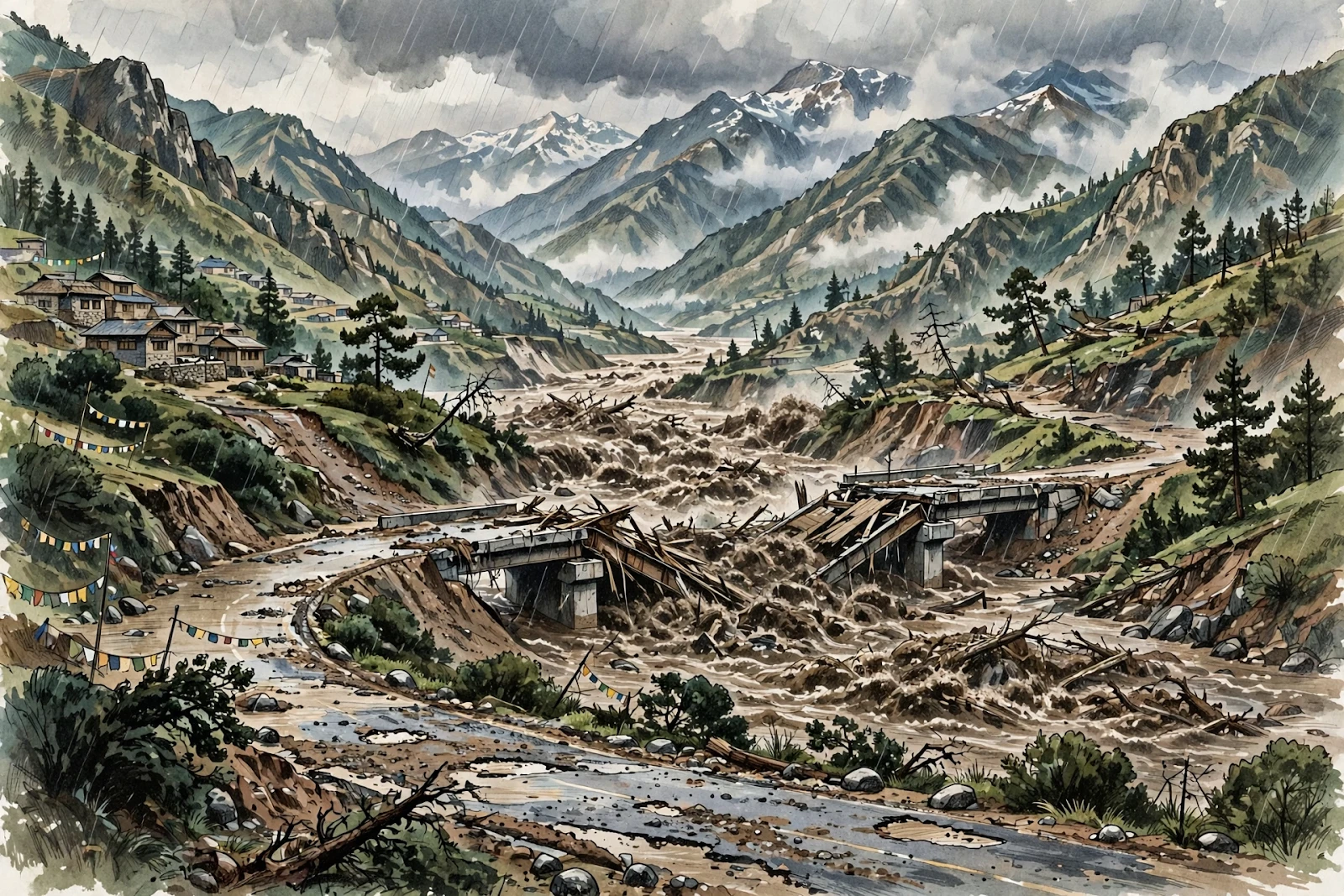
Illustration: A swollen river flooding a Himalayan valley road and a damaged bridge — an artist's illustration of flood damage in mountain regions, not a photograph of the August 2026 floods.
In Bhutan, a flash flood on Thursday night, reportedly triggered by the bursting of the Shintaphu glacial lake, washed away infrastructure at the Gasa Tshachu natural hot springs. No casualties had been reported as of Friday, according to the reports. The two events, weeks apart and in different countries, are cited by the proposal as evidence of a shared, region-wide exposure that national responses alone cannot address.
COP31 itself arrives at a crowded moment for climate diplomacy. Turkey holds the presidency of this year's summit, while Australia will lead the formal negotiations, according to COP31 preview reporting. A meeting of heads of state is scheduled for 11–12 November. The Himalayan proposal will therefore compete for attention with the summit's headline agenda on finance, clean energy and implementation of national climate commitments — which is precisely why its backers are seeking a dedicated agenda item rather than relying on general debate.
Why It Matters
Mountain regions warm faster than the global average in many assessments, and the Himalayas combine that exposure with extraordinary downstream dependence. When glaciers retreat, the timing and volume of meltwater change; when a glacial lake bursts, the damage is sudden and local but the repair bill is national. A dedicated agenda item would, in theory, force negotiators to confront those dynamics as a coherent problem — science, finance and adaptation together — instead of treating each flood as an isolated national misfortune.
The proposal also matters as a test of how COP treats smaller, highly exposed states. Nepal and Bhutan are not major emitters, yet they argue they bear disproportionate consequences. Their joint approach — two neighbours filing together, with one minister submitting on behalf of both — is designed to carry more weight than either country could muster alone, and to invite other mountain nations to join the call.
For the wider negotiations, the Himalayan item illustrates a recurring tension at climate summits: the agenda is already full, and every new item must justify displacing something else. Supporters argue that mountain systems are a blind spot; sceptics may counter that adaptation and loss-and-damage talks already cover these impacts. The proposal's emphasis on a scientific assessment first — studies on what Himalayan warming actually means if global targets are exceeded — is an attempt to answer that objection with evidence before asking for money.
What Happens Next
The immediate question is procedural: whether the proposed agenda item is accepted for COP31 in Antalya. Submissions under the draft rules of procedure are considered by the conference, and acceptance would give the Himalayan item formal standing in the 9–20 November talks. Rejection would not kill the idea — the proposed annual high-level dialogue and UNFCCC action-plan process could still be pursued through other channels — but it would deny the proposal its most visible platform.

Illustration: Delegates gathered in a large climate conference hall — an artist's illustration of international climate negotiations, not a photograph of COP31.
Watch also for whether other mountain countries — from the Andes to the Hindu Kush and the Alps — endorse the proposal in Antalya, and whether the scientific studies it calls for are commissioned with clear terms and deadlines. The strongest signal of success would not be a mention in a closing statement but a funded work programme: a Himalayan action plan under the UNFCCC, with mountain priorities reflected in adaptation and finance decisions.
For the communities downstream, the stakes are practical. The proposal's supporters point to water, food and energy for more than two billion people, to biodiversity, and to the multi-billion-dollar cost of a single flood season in Nepal. Whether COP31 answers with a dedicated agenda, a dialogue, or only sympathy will be one of the early measures of whether this year's summit treats mountain regions as a distinct front in the climate crisis — or as a footnote to it.
Sponsored: explore today's featured sponsored offers
FAQ
What have Nepal and Bhutan proposed at COP31?
They have jointly proposed a dedicated agenda item titled "1.5-Degree Temperature Rise in the Himalayan Region" for COP31 in Antalya, Turkey, from 9 to 20 November 2026.
Who submitted the proposal?
Nepal's Minister for Agriculture, Forests and Environment, Geeta Chaudhary, submitted it on behalf of both countries under Rule 12 of the conference's draft rules of procedure, according to her ministry's secretariat.
What does the proposal ask for?
Scientific studies on Himalayan temperature rise and the consequences of exceeding temperature targets, an annual high-level dialogue on mountains and climate change, and a process to develop a dedicated Himalayan action plan under the UNFCCC, with mountain priorities included in adaptation, finance and loss-and-damage discussions.
Why do Nepal and Bhutan say the Himalayas need special attention?
They cite accelerating glacier melt, glacial lake outburst floods, extreme weather and water insecurity, and warn of irreversible damage to fragile ecosystems and the livelihoods of communities dependent on them — with Himalayan rivers supplying water, food and energy to more than two billion people downstream.
What disasters are cited in support of the proposal?
The floods in Nepal's Bhotekoshi and Trishuli river systems on 26 August 2026, estimated at 2.7 billion dollars in damage with 4.7 billion dollars in recovery needs, and the Shintaphu glacial lake flood in Bhutan that washed away infrastructure at the Gasa Tshachu hot springs, with no casualties reported as of Friday.
Sources
IANS, "Nepal, Bhutan seek dedicated Himalayan climate agenda at COP31", Kathmandu, 31 October 2026; Asian Lite, "Himalayan Heat Heads to COP31", 31 October–1 November 2026; The 9th Estate, "Nepal, Bhutan Push for Special Himalayan Climate Agenda at COP31 Amid Rising Disaster Risks", 1 November 2026.
Comments
Post a Comment