
BASEL — Novartis said on Friday, 6 November 2026, that two cases of tumours in children showed evidence of being linked to Zolgensma, its one-time gene therapy for spinal muscular atrophy (SMA), in a disclosure that has raised fresh questions about the long-term safety of a treatment given to more than 6,000 children around the world.
The Swiss drugmaker said it had received nine reports in total of tumours in patients previously treated with Zolgensma since the therapy was first approved in 2019. In two of those cases, doctors found evidence that the carrier used to deliver the treatment — a modified virus known as a vector — had inserted its genetic material into the patients' own DNA, pointing to a possible link between the tumours and the therapy itself.

Illustration: A scientist holds a vial in a gene therapy research laboratory.
What Happened
According to Reuters, Novartis confirmed the two linked cases in a statement on Friday, 6 November 2026. The company said the potential risk of tumours caused by vector integration was already included in Zolgensma's prescribing information, and that it had notified health authorities in a timely and appropriate manner in both cases.
The picture is more detailed than the headline numbers alone suggest. England's National Multidisciplinary Team for Zolgensma, which has coordinated access to the treatment in England for the past five years, said Novartis had informed healthcare professionals of nine reports worldwide of tumours diagnosed in children who had previously received Zolgensma. So far, pathology testing has been completed on the tumours of three of the nine children. That testing showed that two of those tumours were specifically related to Zolgensma treatment, while one appeared to be unrelated. Information about the remaining six cases is still limited, and further details are awaited from the regulatory authorities.
According to STAT, seven of the nine cases had not previously been made public. The news outlet reported that Novartis had disclosed the information to neurologists earlier in the week, and that the cases were then publicised on Thursday by an advocacy group and on a Facebook page. SMA Europe said regulatory authorities were now examining the cases and urged Novartis to explain what is known, what remains uncertain, and what the findings could mean for children already treated.
Novartis shared a formal statement with SMA Europe on 5 November 2026. In it, the company said: "More than 6,000 patients have been treated with Zolgensma across clinical trials, managed access programs and commercial treatment. Since first approval in 2019, Novartis has received 9 reports of tumors in patients previously treated with Zolgensma. Of those, two cases to date have shown evidence of vector DNA integration into the DNA of the patients. In both cases, the patients underwent treatment and continue to be monitored. The potential risk of tumors due to vector integration is currently included in the Zolgensma prescribing information."
The company added: "Patient safety is our priority. In each case, we timely and appropriately notified health authorities and will continue to work with them on next steps."
Novartis did not provide details on where the two linked cases occurred, according to Reuters. The European Medicines Agency (EMA) and the U.S. Food and Drug Administration (FDA) did not immediately respond to Reuters' request for comment. The disclosure follows complaints from patient advocates that Novartis was slow to share information about the cases, Reuters reported.

Illustration: A paediatric hospital ward, where children receiving advanced treatments are cared for.
Background
Spinal muscular atrophy is a rare genetic condition that weakens the muscles used for movement, breathing and swallowing. It is caused by a fault in a gene called SMN1, which carries the instructions for making a protein — survival motor neuron (SMN) — that motor neurons need to survive and function. Without enough of that protein, motor neurons in the spinal cord gradually die, and the muscles they control waste away. SMA is the leading genetic cause of death in infants.
Zolgensma, known generically as onasemnogene abeparvovec, was designed as a one-time treatment for children under the age of two with SMA. It uses a modified adeno-associated virus, or AAV, as a delivery vehicle. The virus has been stripped of its ability to cause disease and loaded with a working copy of the SMN1 gene. A single intravenous infusion carries that working gene into the patient's cells, where it is intended to produce the missing SMN protein. Because the treatment is given once, rather than as a repeated dose, it was presented at its launch as a potentially transformative option for families facing a devastating diagnosis.
The therapy was approved in the United States in May 2019 for children under two with SMA, and it has since been approved in dozens of countries, including across Europe. More than 6,000 patients have received it through clinical trials, managed access programmes and commercial treatment, according to Novartis. At its launch, Zolgensma was reported to be priced at about $2.1 million per patient in the United States, among the most expensive medicines in the world.
The idea that a gene therapy vector could insert itself into a patient's DNA and disturb the normal control of cell growth is not a new concern. Scientists have long recognised that when foreign genetic material integrates into a genome, there is a theoretical risk that it could land near a gene that regulates cell division and trigger uncontrolled growth — a tumour. That is why Zolgensma's prescribing information already described the risk of tumour formation from the integration of AAV vector DNA as theoretical, and why regulators required long-term follow-up of treated children.
It is important to be precise about what has and has not been established. Nine tumours have been reported in children previously treated with Zolgensma; pathology testing has been completed in three cases, of which two were found to be specifically related to the treatment and one appeared unrelated. The other six cases have not yet been fully assessed, and Novartis has said the information available about these children is currently limited. Tumours can and do occur in children for reasons unrelated to any treatment, so linking a particular tumour to a therapy requires detailed laboratory work showing that the vector's genetic material is present in the tumour cells in a way that plausibly disrupted normal cell control — the kind of evidence Novartis says was found in the two cases.
Why It Matters
For the families of the more than 6,000 children who have received Zolgensma, the news is frightening, and patient groups have been quick to say so. SMA Europe urged Novartis to share what is known and what is uncertain, and what the findings could mean for children already treated.
At the same time, the organisations involved have tried to keep the numbers in perspective. More than 6,000 children worldwide have received Zolgensma, and the number of reported and confirmed tumour cases is small. England's National Multidisciplinary Team said that, based on the information currently available, no changes to a child's routine care or follow-up are recommended, and no additional scans, tests or monitoring are needed at this time. Families with questions or concerns have been advised to contact their child's neuromuscular team.
The case also matters beyond Zolgensma itself. Gene therapies that use AAV vectors are now a growing part of modern medicine, with similar delivery systems used or tested in treatments for other rare diseases. A confirmed case of vector integration leading to a tumour in a treated child is therefore not only a question for one drug: it is a finding that regulators, researchers and other drugmakers will study closely as they weigh the long-term safety of the whole class of treatments.
There is also a question of trust. The fact that seven of the nine cases had not previously been made public, and that the information reached families through advocacy groups and social media before the company's public statement, has drawn criticism from patient advocates. Novartis has said it notified health authorities in a timely and appropriate manner and that the potential risk was already described in the prescribing information. How quickly companies should disclose emerging safety signals — and to whom — is a long-running debate in medicine, and this episode is likely to add to it.
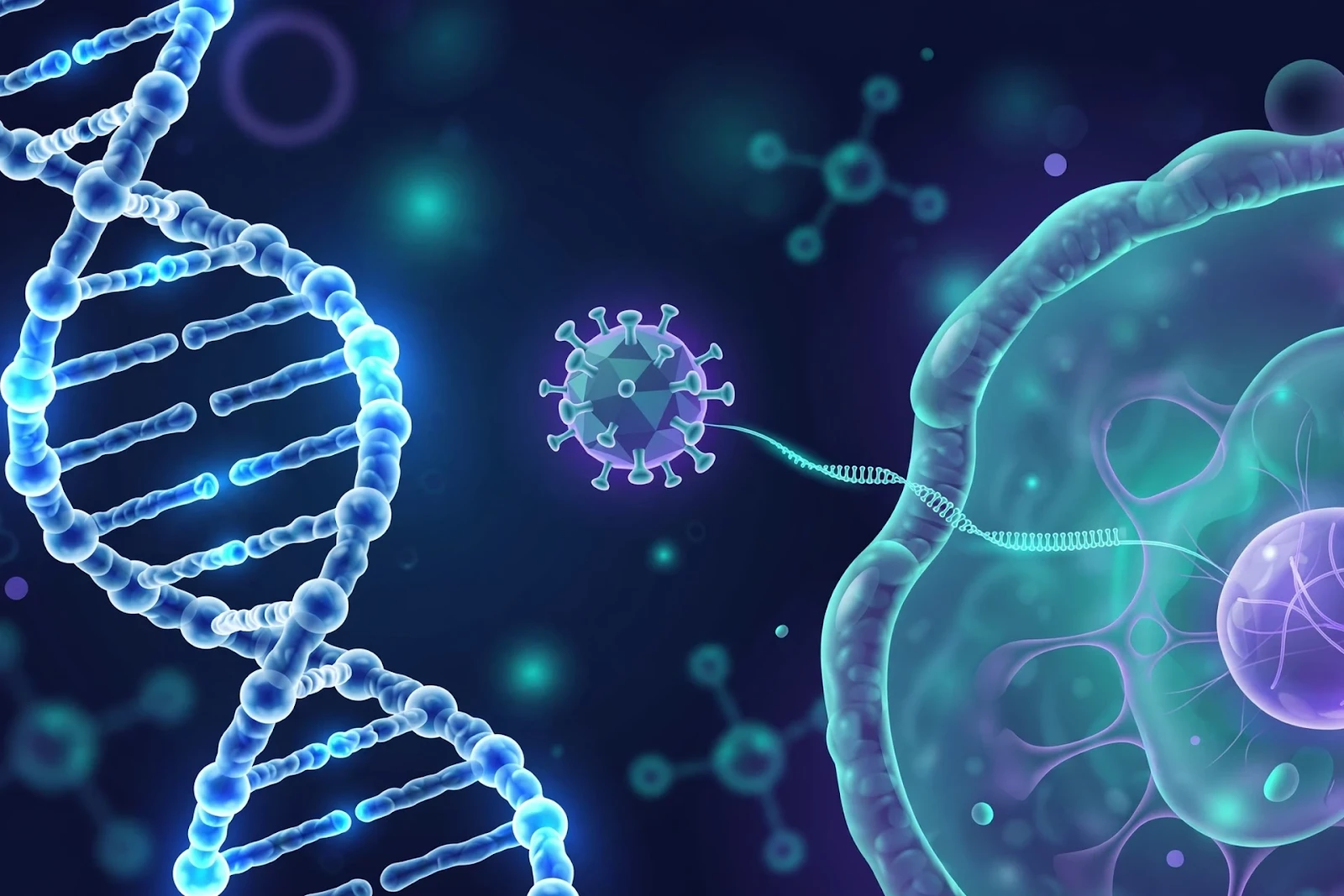
Illustration: A DNA double helix and a virus vector delivering genetic material into a cell.
What Happens Next
Several strands of work are now under way. England's National Multidisciplinary Team for Zolgensma said it was reviewing all available information and would continue to monitor the situation closely, and that it would share further information as soon as it became available. Novartis said it would continue to work with health authorities on next steps, and that it would keep evaluating new safety information and assessing all reported cases.
The most important outstanding evidence is the pathology testing for the six remaining cases. Those results will determine whether the number of tumours linked to Zolgensma stays at two, or grows, and whether there is a pattern — in the type of tumour, the age at which it appeared, or the time between treatment and diagnosis — that could guide future monitoring. Regulatory agencies will also be watched closely: either the EMA or the FDA could issue a statement, request additional information from Novartis, or update the prescribing information.
For families, the practical advice at present is unchanged: continue routine care and follow-up, and speak to your child's neuromuscular team if you have questions or concerns. This article is general news reporting, not medical advice, and no family should change a child's care on the basis of a news report alone. Any decision about monitoring or treatment should be made with the clinicians who know the child's history.
Sponsored: explore today's featured sponsored offers
Frequently Asked Questions
What is Zolgensma?
Zolgensma, known generically as onasemnogene abeparvovec, is a one-time gene therapy for spinal muscular atrophy (SMA), a rare genetic condition that weakens the muscles used for movement, breathing and swallowing. It is given as a single intravenous infusion to children under the age of two, and it uses a modified adeno-associated virus (AAV) to deliver a working copy of the SMN1 gene into the patient's cells, so they can produce the survival motor neuron protein that children with SMA cannot make in sufficient quantities. It was first approved in the United States in May 2019.
How many tumour cases have been reported?
Novartis has said it has received nine reports of tumours in patients previously treated with Zolgensma since the therapy was first approved in 2019. Pathology testing has been completed on three of those nine tumours so far: two were found to be specifically related to Zolgensma treatment, and one appeared to be unrelated.
What does "vector DNA integration" mean?
Zolgensma works by using a modified virus, called a vector, to carry a working gene into a patient's cells. In most cases, that delivered gene is expected to remain separate from the patient's own DNA. In the two linked cases, doctors found evidence that the vector's genetic material had inserted itself into the patients' own DNA. Scientists have long recognised that such integration carries a theoretical risk: if the inserted material lands near a gene that controls cell growth, it could disrupt that control and lead to a tumour.
Should families of treated children be worried?
It is understandable that families are concerned, and patient groups have acknowledged that worry. At the same time, the organisations involved have urged perspective: more than 6,000 children worldwide have received Zolgensma, and the number of reported and confirmed tumour cases is small. England's National Multidisciplinary Team has said that, based on the information currently available, no changes to a child's routine care or follow-up are recommended, and no additional scans, tests or monitoring are needed at this time. Families with questions should contact their child's neuromuscular team. This article is general news, not medical advice.
What happens now?
Novartis says it has notified health authorities and will continue to work with them on next steps. England's National Multidisciplinary Team is reviewing all available information and monitoring the situation closely. The key outstanding evidence is the pathology testing for the six remaining reported cases, which will show whether more tumours are linked to the treatment. The European Medicines Agency and the U.S. Food and Drug Administration have not yet commented publicly.
Sources
- Reuters, "Two tumour cases in children linked to SMA drug, Novartis says", 6 November 2026 — reuters.com
- Muscular Dystrophy UK, "Statement on recent Zolgensma safety reports", 6 November 2026 (including the statement shared by Novartis with SMA Europe on 5 November 2026 and the update from England's National Multidisciplinary Team for Zolgensma) — musculardystrophyuk.org
- SMA UK, "Zolgensma / onasemnogene abeparvovec / AVXS-101" — smauk.org.uk
- STAT, "Novartis cites previously unknown tumor cases possibly tied to gene therapy", 5 November 2026 — statnews.com
- Bloomberg Tax, "Novartis Says Tumors Found in Children Given SMA Gene Therapy", 6 November 2026 — news.bloombergtax.com
- Voice of Healthcare, "Novartis Reports Nine Tumour Cases Linked to Zolgensma", 6 November 2026 — vohnetwork.com
Comments
Post a Comment