
Extreme Heat Days Have More Than Doubled Since the 1980s, OECD Warns as Drought Threatens Food and Energy
PARIS — The number of days with above-average temperatures around the world has more than doubled since the early 1980s, and the heat and drought that now arrive with them are becoming a direct threat to economies, food production and energy systems, the OECD warned on 5 November 2026 in its new Climate Action Monitor.
The report, published on Wednesday and presented at the COP31 virtual pavilion the same day, finds that the global number of days with above-average temperatures has risen by 126 percent since the early 1980s. In Latin America and the Caribbean, Sub-Saharan Africa, and the Middle East and North Africa, the number has more than tripled.
About half of the population in OECD countries is now exposed to hot days — temperatures above 35 degrees Celsius — every year. Between 2021 and 2025, people in OECD countries experienced 35 percent more heat stress days than during the 1981–2010 climate baseline, equivalent to an additional 17 days of heat stress per year on average.
The findings land four days before COP31, the UN climate summit, opens in Antalya, Turkey, on 9 November, where governments will be pressed to show that adaptation — preparing for the warming already under way — is keeping pace with the pledges to cut emissions.
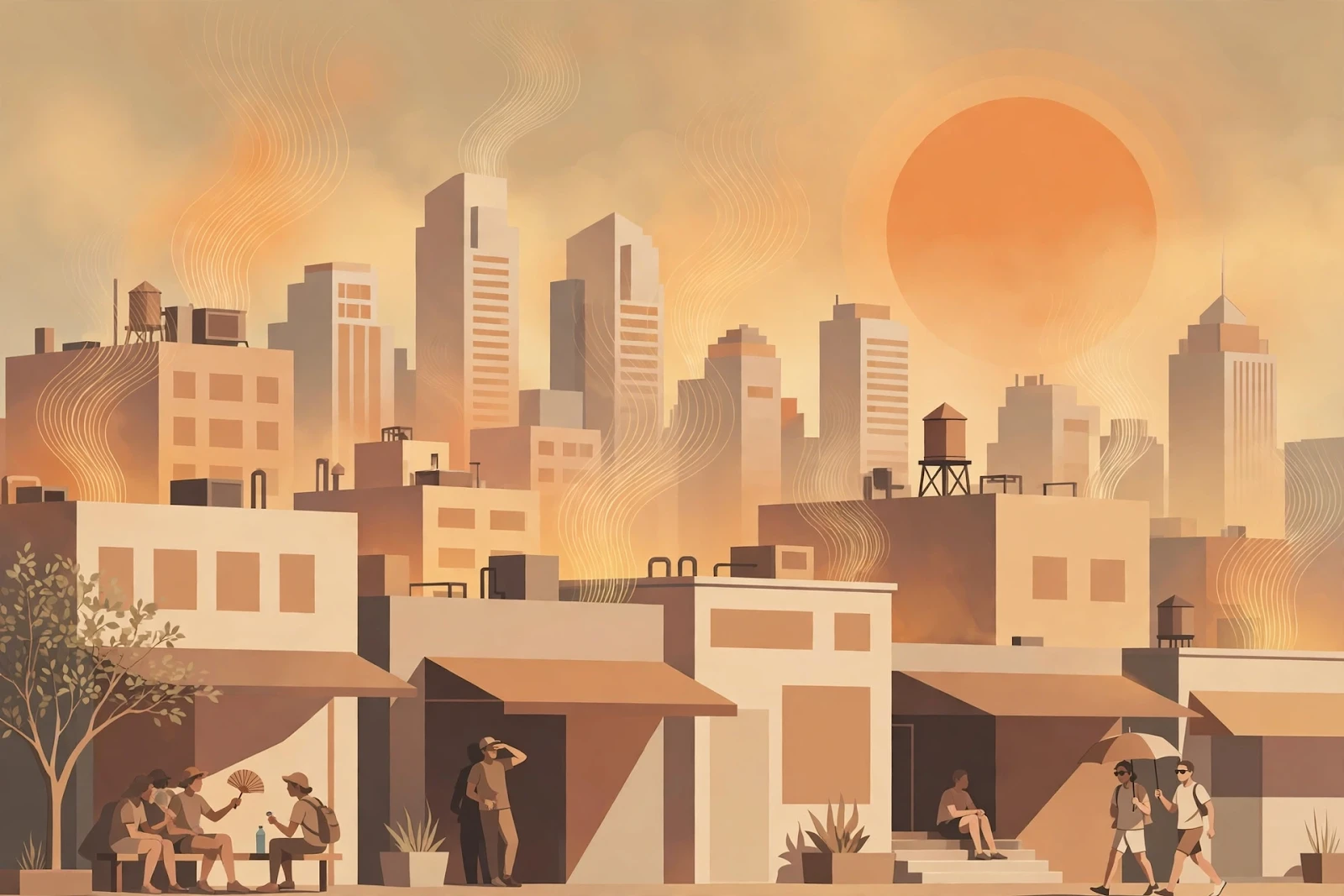
Illustration: A city shimmering under extreme heat during a heatwave.
What Happened
The OECD's Climate Action Monitor 2026 tracks how climate change is already reshaping the conditions economies operate in, rather than only how fast emissions are falling. Its headline finding is the scale and speed of the shift in heat: days that would once have counted as unusually warm are now routine, and the regions warming fastest are among the most exposed.
The report links that heat directly to water. Cropland soil moisture across OECD member and partner countries was 2.6 percent lower on average in 2021–2025 than in 1981–2010, the OECD said, highlighting growing risks to agricultural water availability. Declining soil moisture affects major agricultural producers and exporters, with potential consequences for food security and global supply chains.
Drought, the report warns, does not stop at the farm gate. Low river flows and high water temperatures can constrain nuclear power generation, while reduced water availability can affect hydropower output. Low river levels can also restrict inland navigation and major shipping routes, increasing transport costs and disrupting trade.
"These extreme weather events affect livelihoods, ecosystems and economic activity with adverse health impacts, loss of life, displacement and disruptions to transport, energy, water and agricultural systems," the OECD said in its summary of the findings.
The report adds that drought severity is projected to increase by 2100, and says businesses and governments are already taking steps to strengthen resilience — companies are diversifying transport options and strengthening supply chains to cope with drought-related disruption, while heat action plans are being developed to reduce risks to human health.

Illustration: Drought-cracked farmland, where low soil moisture threatens crops.
Background
The Monitor arrives at the end of a year in which heat and drought have repeatedly made the news on their own terms. Europe endured a scorching summer of heatwaves, droughts and wildfires, and the European Central Bank's president, Christine Lagarde, warned on 4 November that the season should serve as a warning.
"As extreme weather becomes a regular feature of our summers, Europe must proactively prepare and be better protected against its financial fallout," Lagarde said in a blog post reported by Reuters. She urged Europe to boost climate-related insurance, invest more in power infrastructure and help companies generate their own electricity, arguing that the latest heatwaves, droughts and wildfires had exposed vulnerabilities in Europe's economy and energy system that would become more acute as the climate warms.
Lagarde called on the European Union to work on a public-private reinsurance scheme against climate disasters, noting that only about a quarter of catastrophe losses in Europe have historically been covered by insurance. Citing industry research, she said each euro invested in upgrading the grid saves more than two euros in other system costs, while better storage would help carry cheap solar power into the evenings, when heatwaves strain supply the most.
The same pressures are visible far beyond Europe. Indonesia is suffering its most intense wildfires in 11 years, with haze sickening more than 400,000 people, and Australia has joined the waterbombing effort this week. The fires are burning through an El Niño event that scientists expect to peak in December 2026. In Bolivia, the government has declared a nationwide state of emergency as drought affects 78,000 families and has cost more than 75,000 cattle, according to Al Jazeera.
The adaptation gap the OECD describes is also a financing gap. The UN Environment Programme's Adaptation Gap Report 2026, published this week, found that international adaptation finance reached 28.2 billion dollars in 2024, against needs estimated at 305 billion dollars a year by 2035 — a gap that COP31 in Antalya is expected to put under fresh scrutiny.
Why It Matters
The OECD's figures matter because they translate a familiar climate statistic — a warming planet — into the language governments and businesses plan around: days lost, crops stressed, rivers too low to cool power stations or carry barges, and insurance that does not cover the damage.
The 126 percent rise in above-average-temperature days is not a forecast for the distant future. It is a measure of what has already happened since the early 1980s, and the 35 percent increase in heat stress days over the last five years shows the trend accelerating within the working lifetime of today's infrastructure. Power grids, transport networks and farming systems built for the climate of the 1981–2010 baseline are now operating in conditions measurably hotter and drier than they were designed for.
The soil moisture finding carries particular weight for food security. A 2.6 percent average decline sounds modest, but it is an average across many countries and many crops, and the OECD warns it affects major agricultural producers and exporters. When the world's breadbaskets dry together, the consequences travel through global supply chains as higher prices and tighter supplies — the same dynamic visible this year in the wildfire haze and drought emergencies across the tropics.
The energy findings point to a less obvious vulnerability. Nuclear and hydropower plants depend on water for cooling and generation, and the OECD's warning that low river flows and high water temperatures can constrain output arrives as Europe is trying to electrify more of its economy. A grid that leans harder on electricity while its rivers run lower is a grid with a new kind of reliability risk — one reason Lagarde's call for grid investment and storage is framed in economic as well as climate terms.
There is also an equity dimension the OECD's regional breakdown makes plain. The sharpest increases in above-average-temperature days — more than tripling — are in Latin America and the Caribbean, Sub-Saharan Africa, and the Middle East and North Africa, regions with less fiscal room to adapt and less insurance coverage when disasters strike. The adaptation finance gap the UN has quantified is, in large part, a gap between who is warming fastest and who can afford to respond.

Illustration: Climate adaptation measures protecting infrastructure from extreme weather.
What Happens Next
The immediate test comes at COP31, which opens in Antalya on 9 November and runs to 20 November. The European Union plans to use the summit to push for agreement on a package of measures to cut greenhouse gas emissions, according to an internal EU document seen by Reuters, and the OECD presented its Monitor at the COP31 virtual pavilion on 5 November, placing adaptation evidence directly in front of negotiators before they arrive.
Adaptation finance will be one of the summit's central arguments. The UN's Adaptation Gap Report puts the need at 305 billion dollars a year by 2035; the question in Antalya is whether governments will commit to closing more of the gap between that figure and the 28.2 billion dollars delivered in 2024, and how much of it will reach the regions the OECD identifies as warming fastest.
In Europe, Lagarde's proposals — a public-private reinsurance scheme, grid upgrades, storage, and faster grid connections for firms with their own generators and batteries — will be debated in the coming months. Lagarde, who steps down as ECB president on 7 February, said much of the investment would have to come from the private sector, and did not mention any ECB involvement in financing it.
Beyond the summit, the OECD says the adaptation work already under way — heat action plans, diversified transport, stronger supply chains — will need to scale up, because drought severity is projected to keep rising toward 2100. The Monitor's message is that the costs of inaction are no longer abstract: they are already measurable in hotter days, drier soils, and the disruption they bring to food, energy and trade.
Sponsored: explore today's featured sponsored offers
FAQ
What did the OECD's Climate Action Monitor 2026 find?
The report, published on 5 November 2026, finds that the global number of days with above-average temperatures has increased by 126 percent since the early 1980s, more than tripling in Latin America and the Caribbean, Sub-Saharan Africa, and the Middle East and North Africa. It also finds cropland soil moisture 2.6 percent lower on average in 2021–2025 than in 1981–2010, and warns that heat and drought are increasingly disrupting food production, energy and transport.
How much hotter have recent years been for people in OECD countries?
Between 2021 and 2025, populations in OECD countries experienced 35 percent more heat stress days than during the 1981–2010 baseline, equivalent to an additional 17 days per year on average. About half of the population in OECD countries is exposed to hot days above 35 degrees Celsius annually.
How does drought threaten energy and trade?
According to the OECD, low river flows and high water temperatures can constrain nuclear power generation, reduced water availability can affect hydropower output, and low river levels can restrict inland navigation and major shipping routes, increasing transport costs and disrupting trade.
What is COP31, and when does it start?
COP31 is the UN climate summit opening in Antalya, Turkey, on 9 November 2026 and running to 20 November. The EU plans to push for agreement on a package of measures to reduce greenhouse gas emissions, and adaptation finance is expected to be a central issue. The OECD presented its Climate Action Monitor at the COP31 virtual pavilion on 5 November.
What did Christine Lagarde propose on climate resilience?
The European Central Bank president urged Europe on 4 November to boost climate-related insurance, invest in power infrastructure and help companies generate their own electricity. She called for an EU public-private reinsurance scheme against climate disasters, noting only about a quarter of catastrophe losses in Europe have historically been covered by insurance, and said each euro invested in grid upgrades saves more than two euros in other system costs.
Sources
- OECD press release, "Rising exposure to extreme heat and droughts poses growing risks to economies, OECD finds," 5 November 2026 — primary source for the Climate Action Monitor 2026 findings: the 126 percent rise in above-average-temperature days, the tripling in three regions, 35 percent more heat stress days and 17 extra days a year, the 2.6 percent fall in cropland soil moisture, and the energy and transport warnings.
- Reuters, 4 November 2026 — ECB President Christine Lagarde urges a climate resilience drive after a scorching summer: the reinsurance proposal, the quarter of losses covered by insurance, grid investment saving more than two euros per euro, and the COP31 emissions package.
- Reuters, 5 November 2026 — Indonesia wildfires: Australia joins the waterbombing effort, the most intense fires in 11 years, and more than 400,000 acute respiratory infection cases.
- Al Jazeera, 5 November 2026 — Bolivia declares a nationwide state of emergency over El Niño: drought affecting 78,000 families and more than 75,000 cattle lost.
- UN Environment Programme, Adaptation Gap Report 2026, 4 November 2026 — adaptation finance of 28.2 billion dollars in 2024 against needs of 305 billion dollars a year by 2035.
Comments
Post a Comment