
OpenAI Promises to Pay Its Own Power Bills and Drop Secret Deals as Voters Push Back on AI Data Centers
SAN FRANCISCO — OpenAI promised on Thursday, 5 November 2026, to pay the full cost of the electricity its future artificial intelligence data centers use, to end secrecy agreements with public officials over new sites, and to publish each campus's water use, noise and hiring figures. The package came two days after voters in the 3 November 2026 midterm elections backed limits on data centers or rejected pro-development measures in 40 of 41 local ballot measures across 10 states, according to a Ballotpedia analysis cited by CNBC — although OpenAI says they were months in development, not a response to the elections.
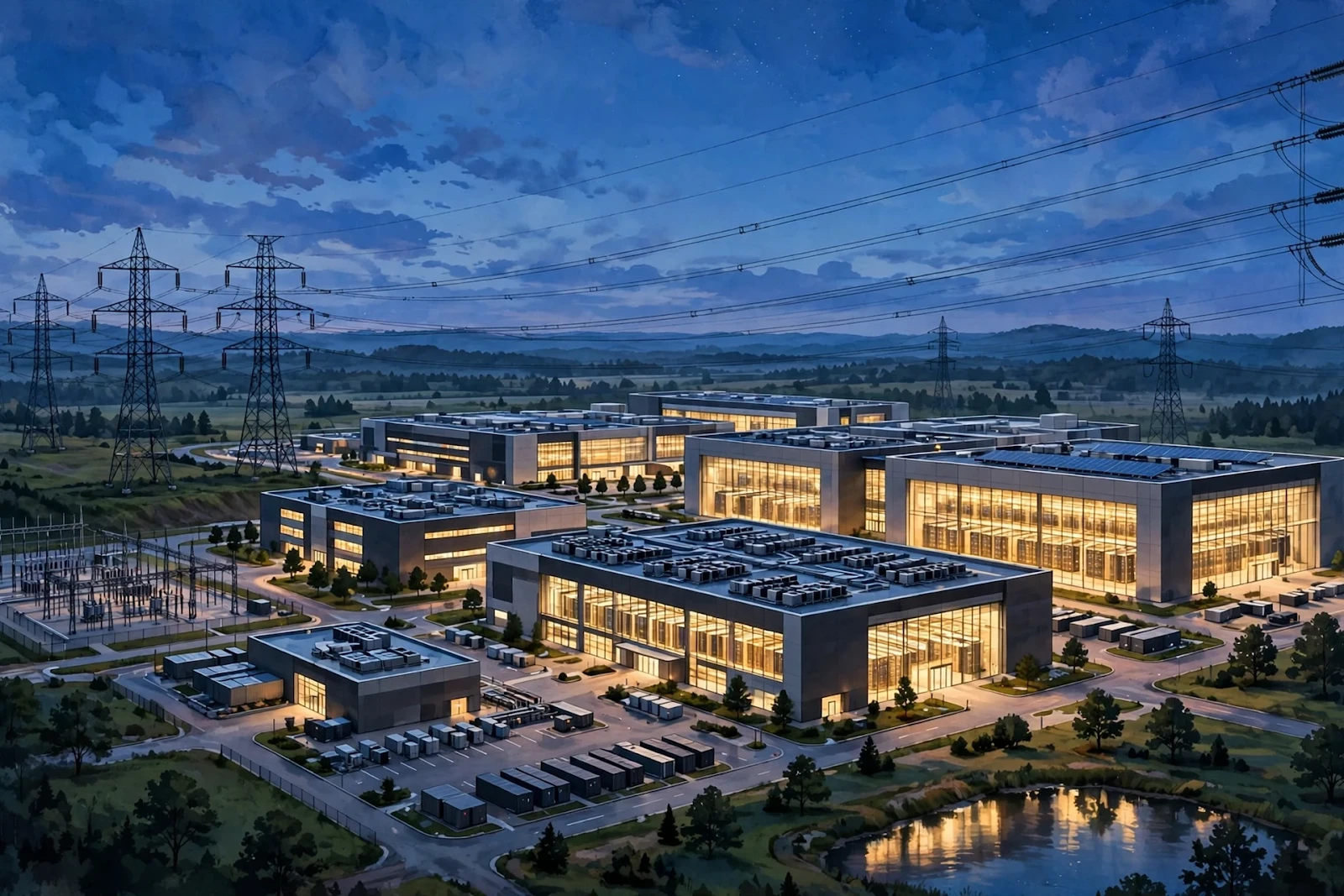
Illustration: A large AI data center beside high-voltage power lines at dusk.
What Happened
OpenAI published the two documents on 5 November 2026, titled "Setting a new standard for responsible AI infrastructure," according to the company. The National Community Compact sets out the commitments OpenAI says it will apply to the large AI facilities it calls "compute campuses" — the data centers it owns and operates in the future. Each campus will also get its own local compact, drawn up with the residents who live near it, so the promises reflect local priorities.
The central pledge is about money. OpenAI said it will pay the full cost of the electricity it uses and of the infrastructure needed to serve it, including the grid equipment a campus requires, according to the company and reporting by CNBC and Seoul Economic Daily. The company also said it will provide financial assurances before major spending begins, so that other electricity customers are protected if a project is delayed, reduced or cancelled.
The second headline commitment is about secrecy. OpenAI said it will not sign non-disclosure agreements with public officials when negotiating or discussing future sites, with narrow exceptions only for legitimate security information, trade secrets, and proprietary or competitively sensitive information. The change matters because secrecy agreements have angered communities that learn about a data center only after key decisions are made.
The compact also promises far more public information about each site. OpenAI said it will publish construction plans and independent noise studies before operations begin and annually afterward, and will publish site-level water and electricity use. Each campus will have a water plan favouring closed-loop or low-water cooling systems. The company said it will report publicly each year on hiring and apprenticeships, publish the number of jobs it expects a campus to create, and work with unions and training providers on local employment.
Alongside the compact, OpenAI published a Compute Campus Policy Blueprint that asks policymakers to turn similar rules into binding requirements for the whole industry. According to the blueprint, state utility commissions should require large electricity customers to cover the grid costs they add and to protect other customers if a project falls through. Congress, the blueprint argues, should speed up transmission upgrades and restore and expand tax incentives for clean electricity, and the terms of any tax incentives should be public, with measurable commitments and a clawback if a developer falls short.
OpenAI's chief global affairs officer, Chris Lehane, told reporters the blueprint had been in development since August and that he had consulted dozens of lawmakers and candidates, according to CNBC and Reuters.
Background
The new commitments build on promises OpenAI made in January 2026, when it announced its Stargate Community commitments and said it would "pay our own way on energy" at the sites in that programme. The November package extends that idea into a national framework and asks lawmakers to make the same standards mandatory for other developers.

Illustration: Residents at a community meeting about a proposed AI data center.
The timing is striking, even though OpenAI disputes any causal link. On 3 November 2026, voters in the United States midterm elections delivered a striking verdict on data center expansion at the local level. According to a Ballotpedia analysis cited by CNBC, voters backed limits on data centers or rejected measures favouring development in 40 of 41 local ballot measures across 10 states. Democrats also flipped the governorships of Texas, Georgia and Ohio with candidates who had promised to pause new data center permits and tighten construction rules, according to Reuters.
Public concern about the facilities has been building for months. Residents near proposed sites complain that the facilities push up household electricity bills, consume large volumes of water, and are agreed behind closed doors. An NBC News Election Day poll found that 76 percent of voters opposed data centers in their communities, according to reporting by The Verge.
On the same day as the compact, Google announced a $17 billion data center in Wyoming, pledging to cover 100 percent of its electricity costs — a story this blog covered separately.
The scale explains why the politics matter so much. OpenAI told investors in February 2026 that it is targeting $600 billion in total compute spending by 2030, according to CNBC. Its expansion already includes the Stargate data centers being built with Oracle and SoftBank in Shackelford County, Texas; Doña Ana County, New Mexico; and Milam County, Texas, according to Reuters. Projects on that scale need local permits and political consent in dozens of communities — and the ballot results suggest that consent can no longer be assumed.
There is an important limit. By its own terms, the compact covers future campuses that OpenAI owns and operates; it is not clear how the commitments would apply to capacity built and owned by partners, such as much of the Stargate infrastructure, which Reuters reported is built and owned by partners such as Oracle. The compact also does not set out penalties if a commitment is missed.

Illustration: A school cafeteria serving free meals to students in Georgia.
Why It Matters
For the communities that host these campuses, the most concrete parts of the announcement are the local deals OpenAI pointed to as models of what a compact should deliver. In Effingham County, Georgia, the site of its Project Camellia campus, OpenAI has provided a $4.8 million grant funding free school meals for all 14,000 students in the county, part of an $80 million local commitment, according to the company. The county's agreement with Georgia Power also lets the utility cut power deliveries to the campus by up to 1,000 megawatts during periods of high demand, freeing power for homes and businesses when the grid is under strain.
In Pike County, Ohio, OpenAI and SB Energy have made a joint $6 million commitment for childcare, after families in the area named childcare as a priority, according to the company. The point of a local compact is that each community names its own needs rather than accepting a standard package.
For households, the promise that matters most is the one about electricity bills. Data centers are among the largest new electricity customers a grid can gain, and residents in several states have seen bills rise as utilities build new generation and transmission to serve them. OpenAI's pledge to pay the full cost of its power and infrastructure, backed by financial assurances before major spending begins, is designed to answer the fear that ordinary customers will be left paying for grid upgrades built for a single giant customer. Whether that promise holds in practice will depend on regulators — which is why the blueprint asks utility commissions to write the same requirement into tariffs for every large customer.
The end of secrecy agreements matters in a different way. When local officials sign non-disclosure agreements, residents often learn about a data center only when construction is about to begin, too late to influence where it goes or what it must provide. Publishing plans, noise studies and site-level water and electricity use before operations begin gives communities information while decisions can still be changed — and annual reporting on hiring, with unions and training providers involved, addresses the complaint that data centers bring a burst of construction work and then very few permanent jobs.
For the wider AI industry, the announcement sets a benchmark rivals will now be measured against when they seek permits in the same counties — and by asking policymakers to make the rules binding, OpenAI is inviting regulation that would raise costs for smaller competitors.
What Happens Next
The test of the compact will come site by site. Each future campus is supposed to get its own local compact, with annual public reporting on hiring and apprenticeships. Residents near proposed sites — including the Stargate locations in Texas and New Mexico — will watch whether the promised plans, studies and jobs actually appear.
The political fight is also moving to Washington. Democrats plan a flood of AI bills when they take control of Congress in January, Reuters reported on 6 November 2026, including bills shielding consumers from data-centre-linked electricity costs, requiring independent testing of advanced AI systems, and clarifying AI-company liability. Senator Chuck Schumer, who is expected to become majority leader, said on Thursday at an event in Washington that protecting consumers from higher energy costs linked to the rapid expansion of data centers would be among his priorities next year, according to Reuters.
Any such legislation faces steep odds while President Donald Trump remains in office, Reuters noted, as he has repeatedly dismissed calls to write mandatory rules for AI technology. OpenAI's blueprint is aimed at the new Congress when it returns in late January. For now, the compact remains a set of voluntary company commitments rather than law — but it concedes that the companies building the largest machines in the world cannot expect communities to absorb the costs, the water and the noise without a public say.
Sponsored: explore today's featured sponsored offers
FAQ
What is OpenAI's National Community Compact?
It is a set of commitments OpenAI published on 5 November 2026 for the future AI data centers — which the company calls "compute campuses" — that it owns and operates. It promises OpenAI will pay the full cost of the electricity its campuses use and the infrastructure needed to serve them, end non-disclosure agreements with public officials over new sites, publish construction plans, noise studies and site-level water and electricity use, and report annually on hiring and apprenticeships. Each campus will also have its own local compact, and a companion blueprint asks policymakers to make similar rules binding.
Will the compact lower my electricity bill?
Not directly. The compact promises that OpenAI's campuses will not raise other customers' bills, by making the company pay the full cost of its power and grid infrastructure and providing financial assurances before major spending begins. Whether household bills actually stay flat will depend on how utility regulators apply those principles in each state.
Does the compact cover every OpenAI data center?
No. By its own terms it covers future campuses that OpenAI owns and operates. It is unclear how the commitments apply to capacity built and owned by partners, such as much of the Stargate infrastructure, and the announcement describes no penalties if a commitment is missed.
Why did OpenAI announce this right after the midterm elections?
It came two days after the 3 November 2026 midterm elections, in which voters backed limits on data centers or rejected pro-development measures in 40 of 41 local ballot measures across 10 states, according to a Ballotpedia analysis cited by CNBC. OpenAI says the commitments were in development since August, not in response to the elections. The timing shows the announcement followed the votes; it does not prove the votes caused the policy.
Will these rules become law?
Not automatically. The blueprint is a proposal: it asks state utility commissions to require large electricity customers to cover the grid costs they add, asks utilities to ease connections for campuses that can cut demand when power is scarce, and asks Congress to speed transmission upgrades and restore clean-electricity tax incentives. Democrats plan AI bills when they take control of Congress in January, Reuters reported — but any legislation faces steep odds while President Donald Trump remains in office.
Sources
1. OpenAI — "Setting a new standard for responsible AI infrastructure," 5 November 2026. https://openai.com/index/setting-new-standard-responsible-ai-infrastructure/
2. CNBC — "OpenAI releases new data center policy proposal after election rebuke," 5 November 2026.
3. Reuters — "OpenAI kicks off charm offensive to change voters' view of data centers," by Deepa Seetharaman, 5 November 2026.
4. Reuters — "Democrats planning flood of AI bills when they take control of Congress," 6 November 2026. https://www.reuters.com/business/media-telecom/democrats-planning-flood-ai-bills-when-they-take-control-congress-2026-11-06/
5. Ballotpedia analysis of local data center ballot measures, cited by CNBC and Reuters, November 2026.
6. Seoul Economic Daily — reporting on OpenAI's community compact and grid-infrastructure commitments, November 2026.
Comments
Post a Comment