
SYDNEY and LONDON — Two of the world's major central banks face rate decisions in the coming days, and markets expect both to raise borrowing costs: Australia's Reserve Bank announces its decision on Tuesday, November 3, 2026, and the Bank of England follows on Thursday, November 5, with a quarter-point increase priced in from each as higher fuel prices push inflation further above target.
The back-to-back decisions cap a fortnight in which the world's biggest central banks have moved in different directions. The US Federal Reserve, the European Central Bank and the Bank of Japan all held rates steady in the final week of October, while the Bank of Canada raised its rate. Now attention turns to Sydney and London, where the latest inflation figures have strengthened the case for tightening — and where borrowers are bracing for higher repayments within weeks.
In Australia, the case for a move hardened after the Australian Bureau of Statistics reported on October 28 that annual consumer price inflation rose to 4.3 percent in September, up from 4.0 percent in August and above the market consensus of 4.2 percent. The Reserve Bank's preferred gauge of underlying inflation, the trimmed mean, rose 1.0 percent in the September quarter — above the 0.8 percent the bank had forecast — and 3.6 percent over the year, well above the bank's 2 to 3 percent target band, which headline inflation has now exceeded for 14 consecutive months.
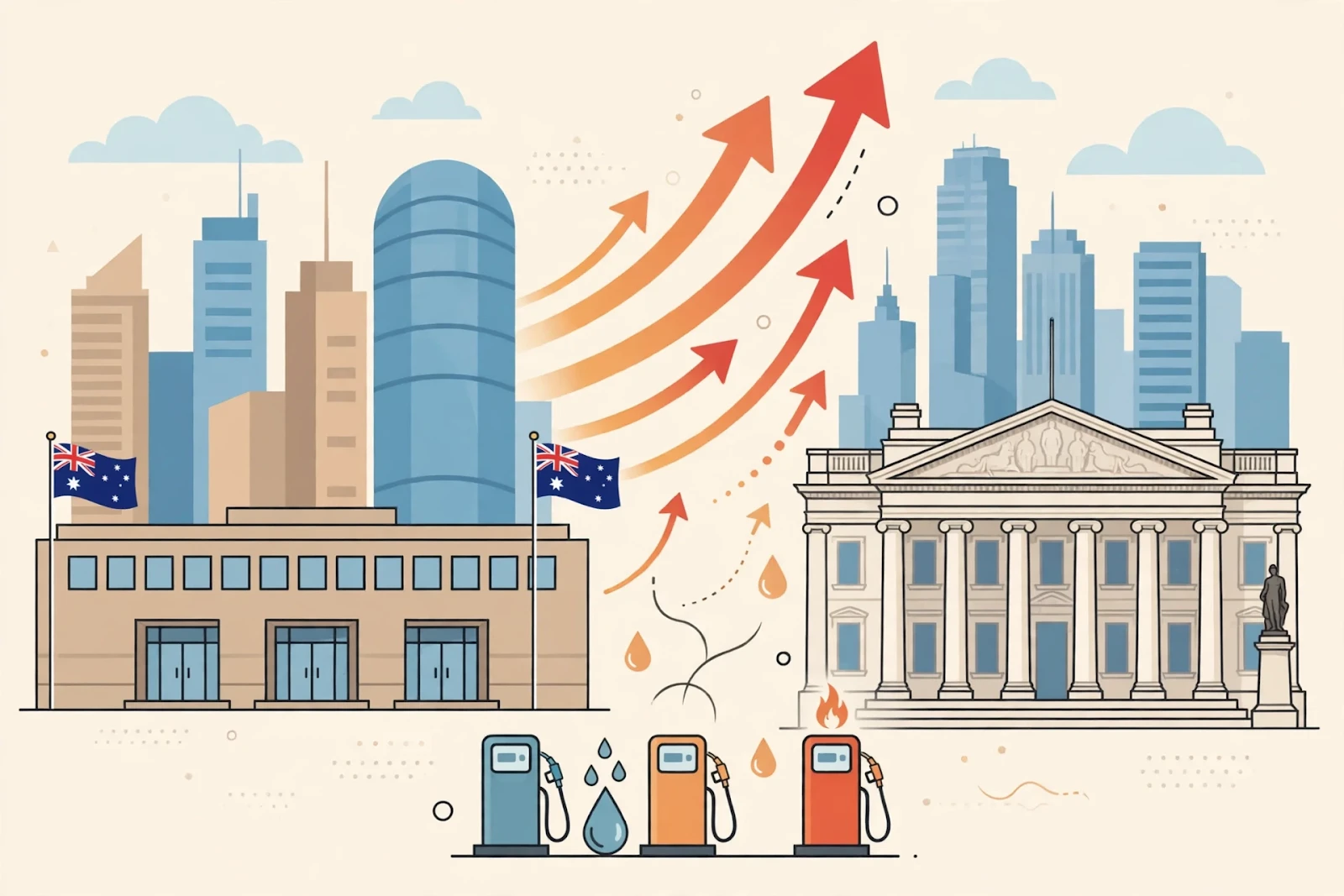
Illustration: The Reserve Bank of Australia and the Bank of England both face rate decisions this week, with markets pricing a quarter-point increase from each.
What Happened
According to market reporting ahead of the meetings, the Reserve Bank of Australia's Monetary Policy Board meets on November 2–3, with its decision due at 2:30 p.m. Australian Eastern Daylight Time on Tuesday. The cash rate currently stands at 4.60 percent after a quarter-point increase on September 29, the fourth hike of 2026 following moves in February, March and May that lifted the rate from 3.60 percent at the start of the year to its highest level since 2011.
Financial markets raised the implied probability of another 25-basis-point increase to about 85 percent after the September inflation release, according to Bloomberg data cited by ABC News, while Commonwealth Bank economists put market pricing at around 90 percent. All four of Australia's major banks now expect a hike on Tuesday, taking the cash rate to 4.85 percent — a level not seen since about 2008, and the fifth increase of the year. ING's analysts said they expect the bank to deliver the hike next week rather than wait until December, citing firmer-than-expected inflation data and broader pass-through from higher fuel costs.
Fuel is central to the story. Fuel prices rose 9.4 percent in the month covered by the September data, according to ABC News reporting, and almost all of the 0.9 percentage point increase in headline inflation between July and September can be traced to higher transport costs, largely reflecting elevated fuel prices, according to ING. Brent crude ended October at about $117.64 a barrel, its highest level in about six months, after Middle East supply risks intensified — a backdrop that has complicated every central bank's calculations this autumn.
In the United Kingdom, the Bank of England's Monetary Policy Committee announces its decision on Thursday, November 5, alongside its quarterly Monetary Policy Report. Markets widely expect Bank Rate to rise from 3.75 percent to 4.00 percent, which would be the first increase in borrowing costs since August 2023. The Office for National Statistics reported that consumer price inflation rose to 3.5 percent in the 12 months to September, up from 3.1 percent in August and the highest level in 11 months, while the CPIH measure, which includes owner-occupiers' housing costs, rose to 3.6 percent.
The Bank's September meeting already showed the direction of travel: the vote was 6–3, with three members preferring an increase. Forecasters expect the November vote to swing much more decisively toward a hike, with the updated projections and Governor Andrew Bailey's press conference watched as closely as the decision itself.

Illustration: Fuel prices rose 9.4 percent in the month covered by Australia's September inflation data, sharpening the case for another rate rise.
Background
Both banks are wrestling with the same uncomfortable combination: inflation that refuses to settle back to target, energy prices that keep pushing it higher, and economies that are not obviously strong enough to absorb much more tightening.
In Australia, the Reserve Bank has been unusually blunt about the problem. Deputy Governor Andrew Hauser said on October 21 that the inflation outlook looks "materially worse" than the bank had anticipated in August. The September-quarter inflation report was the last major release before the November meeting, and it disappointed on every front: headline inflation of 4.3 percent, trimmed mean inflation of 3.6 percent over the year, and quarterly price rises of 1.3 percent. Goods and services inflation have both picked up and are now running above 4 percent a year, according to ING, suggesting higher energy costs are feeding more broadly through the economy rather than remaining a one-off shock.
At the same time, the labour market has softened. Unemployment rose to 4.7 percent in September in Australia, and the Reserve Bank has signalled a willingness to tolerate some additional labour market softening to return inflation to target. That trade-off — tighter policy to fight inflation, at the cost of slower growth and softer hiring — is the central tension in Tuesday's decision, and it is why the bank's post-meeting statement and its new Statement on Monetary Policy, with updated forecasts, may matter as much as the rate call itself.
Britain's picture is similar but with its own twists. The economy unexpectedly grew by 0.1 percent in August, suggesting some resilience despite pressure on consumer spending, and unemployment fell to 4.7 percent in the three months to August, the lowest level in more than a year. But the inflation outlook is deteriorating: the energy regulator Ofgem's price cap rose by 3.6 percent for a typical household on October 1 and is forecast to jump by a further 22 percent in January, which is expected to push inflation higher this winter. Suren Thiru, chief economist for the Institute of Chartered Accountants in England and Wales, said the Bank's updated forecasts are likely to show slightly stronger growth this year overshadowed by weaker growth further out, as rising inflation and higher energy costs bite, keeping further rate rises on the table.
The global context sharpens the dilemma. The Federal Reserve held its target range at 3.75–4.00 percent on October 28, the European Central Bank held its deposit rate at 2.50 percent on October 29, and the Bank of Japan held at 1.25 percent on October 30 — each pausing while warning that inflation risks remain tilted upward. If Sydney and London both hike this week, they will be moving against the grain of that pause, underlining how much of the renewed inflation pressure is being driven by energy rather than domestic demand.
Why It Matters
For households, the decisions translate quickly into monthly bills. In Australia, all four major banks passed September's hike on in full from October 9, ending sub-6 percent variable mortgage rates among the big four. Another quarter-point rise would flow through to variable-rate borrowers within weeks, at a time when the cost of living is already the dominant political issue. Commonwealth Bank economists have described a November increase as an "insurance hike" to guard against inflation staying higher for longer — protection for the economy's price stability, paid for by borrowers.
In Britain, the squeeze works through mortgages and energy bills together. A rise in Bank Rate to 4 percent would lift borrowing costs for the first time in more than three years, just as households face a winter of higher energy prices under the Ofgem cap. For renters and homeowners on variable or tracker deals, the effect is near-immediate; for those on fixed deals, it arrives at remortgage. The Bank's dilemma is that holding rates risks letting inflation expectations drift higher, while hiking risks squeezing an economy that is barely growing.
For markets, the week is a test of whether the world's central banks are truly turning hawkish again, or whether the October pauses were the norm and Sydney and London are exceptions driven by local energy shocks. Currency traders are already positioning: the Australian dollar climbed after the September inflation release, and ING raised its near-term target for the currency against the US dollar, citing the front-end rate support a hike would provide. A surprise hold from either bank would likely reverse those moves sharply.

Illustration: British households face higher borrowing costs and energy bills this winter, with the Ofgem price cap forecast to jump again in January.
What Happens Next
The calendar is crowded. On Tuesday, the Reserve Bank announces its decision and publishes its Statement on Monetary Policy, with the governor's press conference an hour later — the forecasts will show whether the bank thinks one more hike settles the matter or more tightening is coming. Also on Tuesday, Americans vote in the midterm elections, and US job openings data are released.
On Thursday, the Bank of England announces its decision with its Monetary Policy Report and policy summary, followed by Governor Bailey's remarks. The vote split will be scrutinised: a decisive majority for a hike would signal a committee that has moved together, while a close vote would leave December wide open.
Friday closes the week with the US October jobs report and Canadian employment data — the numbers that will shape the Federal Reserve's December thinking and, with it, the global rate outlook. If the US labour market cools while Australian and British inflation stays hot, the divergence between the world's central banks will only widen.
Neither decision is a foregone conclusion. A hold in Australia would leave the cash rate at 4.60 percent while the bank assesses how the economy is responding to September's hike, and some analysts have warned that further increases next year would raise the risk of recession. But with markets pricing a hike at around 85 to 90 percent, and all four major Australian banks forecasting one, a hold would be the week's biggest surprise. In London, too, the expectation is set: after three years without an increase, the Bank of England is expected to move — and households on both sides of the world will feel it.
Sponsored: explore today's featured sponsored offers
FAQ
When do the Reserve Bank of Australia and the Bank of England announce their decisions?
The Reserve Bank of Australia announces its decision on Tuesday, November 3, 2026, at 2:30 p.m. Australian Eastern Daylight Time, with its Statement on Monetary Policy and updated forecasts published alongside it. The Bank of England announces its decision on Thursday, November 5, 2026, together with its quarterly Monetary Policy Report.
What rate rises are markets expecting?
Markets are pricing a quarter-point increase from each bank: the Reserve Bank's cash rate from 4.60 percent to 4.85 percent, and the Bank of England's Bank Rate from 3.75 percent to 4.00 percent. Market pricing put the probability of an Australian hike at about 85 to 90 percent after the September inflation data, according to Bloomberg data cited by ABC News and Commonwealth Bank analysis.
Why is inflation rising in Australia and Britain?
In both countries, higher fuel and energy costs are the main driver. In Australia, fuel prices rose 9.4 percent in the month covered by the September data, and annual inflation reached 4.3 percent. In Britain, consumer price inflation rose to 3.5 percent in September, and the Ofgem energy price cap rose 3.6 percent on October 1, with a further 22 percent rise forecast for January.
What would a hike mean for borrowers?
In Australia, the major banks passed September's hike on in full within weeks, and another increase would raise variable mortgage rates further. In Britain, a rise to 4 percent — the first increase since August 2023 — would lift costs for variable and tracker mortgage holders and feed through to other borrowing.
What else is on the economic calendar this week?
Tuesday also brings US midterm elections and job openings data, Wednesday brings New Zealand employment figures, and Friday closes the week with the US October jobs report and Canadian employment data — the numbers that will shape the Federal Reserve's December decision.
Sources
- Stockvolt, "RBA and Bank of England Both Expected to Raise Rates This Week as Fuel Costs Lift Inflation," November 1, 2026, citing ABC News and Yahoo Finance UK.
- Australian Bureau of Statistics, Consumer Price Index, September 2026, released October 28, 2026, as reported by ABC News, AICD and ING.
- ING Think, "RBA set to hike as inflation proves more persistent," October 29, 2026.
- Gazette & Herald, "Bank of England expected to raise interest rates for first time since 2023," November 1, 2026.
- Elliott Wave Monitor, "Jobs, Inflation and Central Banks: November 2–6 Market Outlook," November 2026; InvestingLive week-ahead calendar, November 2026.
Comments
Post a Comment