
BELFAST — Astronomers have finally found the missing half of Neptune's Trojan asteroid family. Using early data from the Vera C. Rubin Observatory in Chile, a team led by Queen's University Belfast has confirmed two long-term stable asteroids trailing behind Neptune — and spotted a third possible member — doubling the known population of a cloud that had stayed hidden behind the Milky Way's crowded star fields for more than a decade.
The discovery, reported in The Astrophysical Journal Letters, resolves a puzzle that has lingered since Neptune's Trojan swarms were first mapped: why did astronomers keep finding objects ahead of the planet, but almost none behind it? The answer, the researchers say, was not that the trailing cloud was empty. It was simply in the worst possible place to look.
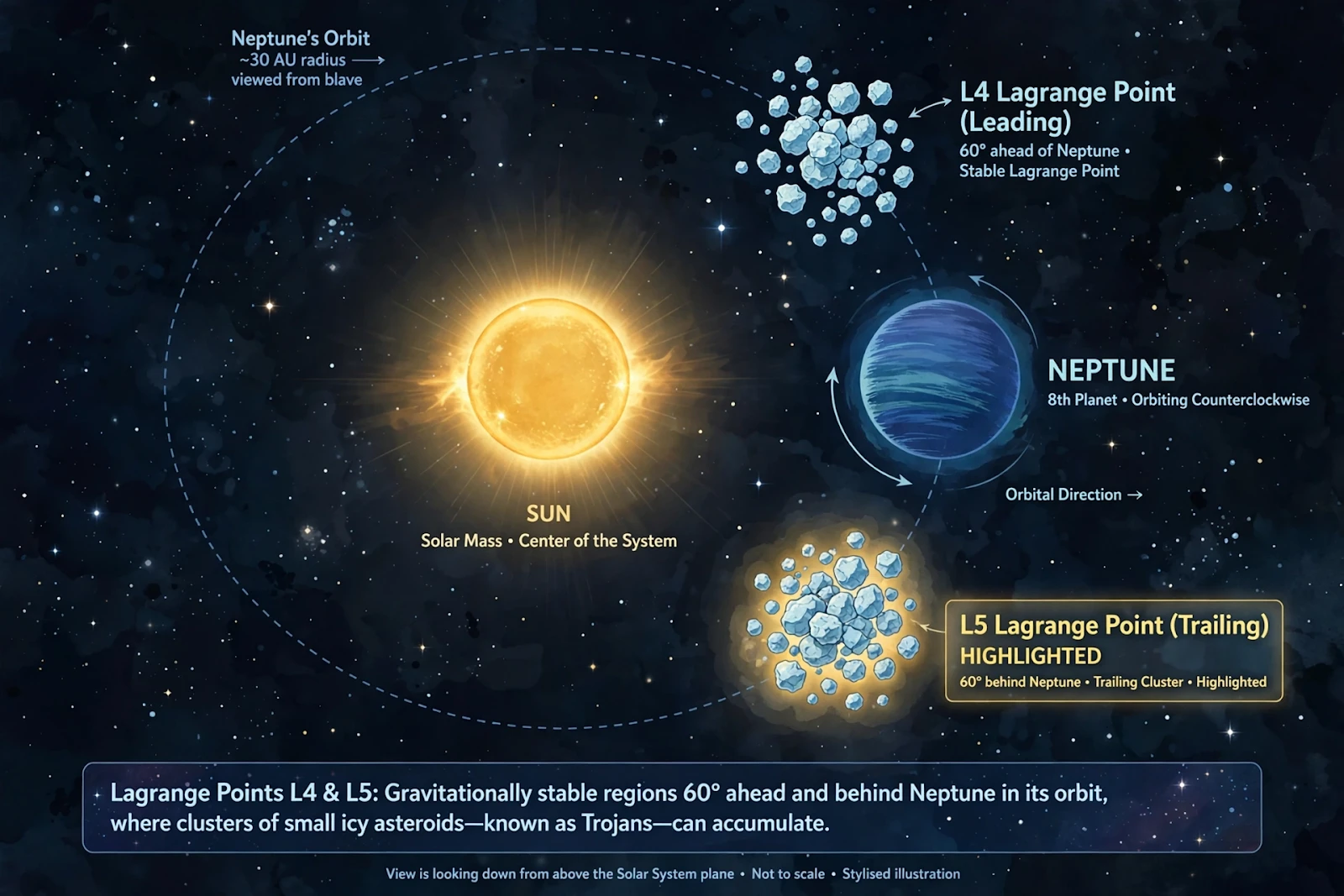
Illustration: Neptune's orbit with its leading and trailing Trojan asteroid clusters, the trailing cloud highlighted behind the planet.
What Happened
The team, led by Dr. Meg Schwamb, an astronomer and lecturer at Queen's University Belfast's Astrophysics Research Centre, analysed data from Rubin's early test and commissioning observations — data gathered before the observatory's decade-long Legacy Survey of Space and Time (LSST) was fully under way. In that early haul, they identified two asteroids, designated 2025 MH348 and 2025 NN80, as permanent, long-term stable members of Neptune's trailing Trojan cloud, known as the L5 cloud. A third object, 2025 MD138, was found as a candidate trailing Trojan, but needs a longer observed arc before it can be fully characterised.
Trojan asteroids share a planet's orbit around the Sun, clustered around two gravitationally stable points 60 degrees ahead of and behind the planet — the L4 (leading) and L5 (trailing) Lagrange points. Neptune's leading cloud was comparatively well populated: reporting from the American Astronomical Society's Division for Planetary Sciences meeting in Spokane, Washington, put the count at about 30 objects ahead of Neptune, but just two behind it. The two new confirmations therefore roughly double the known trailing sample — a point the paper itself stresses, correcting early characterisations that described the find as a tripling.
Dynamical analysis reported for the two confirmed objects indicates they have occupied their orbits for billions of years, making them primordial members of the Solar System rather than temporary visitors passing through the region. That longevity is what makes them valuable: objects that have stayed in the same gravitational pocket since the Solar System's early days preserve clues about how the giant planets moved and settled into their present orbits.
"Early data from Rubin Observatory is already expanding our knowledge of the solar system's 'small bodies,' including asteroids, comets and other minor planets," Schwamb said in a Queen's University Belfast press release. "And these early observations have provided our clearest view yet of Neptune's trailing Trojan cloud."
Background
The Trojan story began in 1906, when telescope observations revealed populations of asteroids leading and trailing Jupiter. Similar families have since been found around Saturn and Uranus, and around Neptune — but Neptune's trailing side proved stubbornly elusive. For roughly the past 10 to 15 years, the trailing cloud has sat, from Earth's perspective, in front of the centre of the Milky Way: an extremely dense, bright part of the night sky where countless background stars drown out the faint, slow-moving light of a distant icy body.
"Astronomers have long struggled to spot Neptune's trailing Trojans because for over a decade they have been in a crowded region of the night sky where the sheer number of background stars from the centre of our Milky Way make it difficult to spot moving Solar System objects in astronomical images," Schwamb said in a statement reported by IFLScience.
Two things changed at once. The trailing cloud has begun to move out of that crowded region of sky, and Rubin — with its 8.4-metre Simonyi Survey Telescope and the LSST Camera, described as the largest digital camera ever built, at about 3,200 megapixels — can survey the sky faster and deeper than any previous ground-based telescope. Combining that depth and sky coverage with the cloud's improving position, Schwamb said, let the team "double the number of known objects in this population on long-lived orbits."
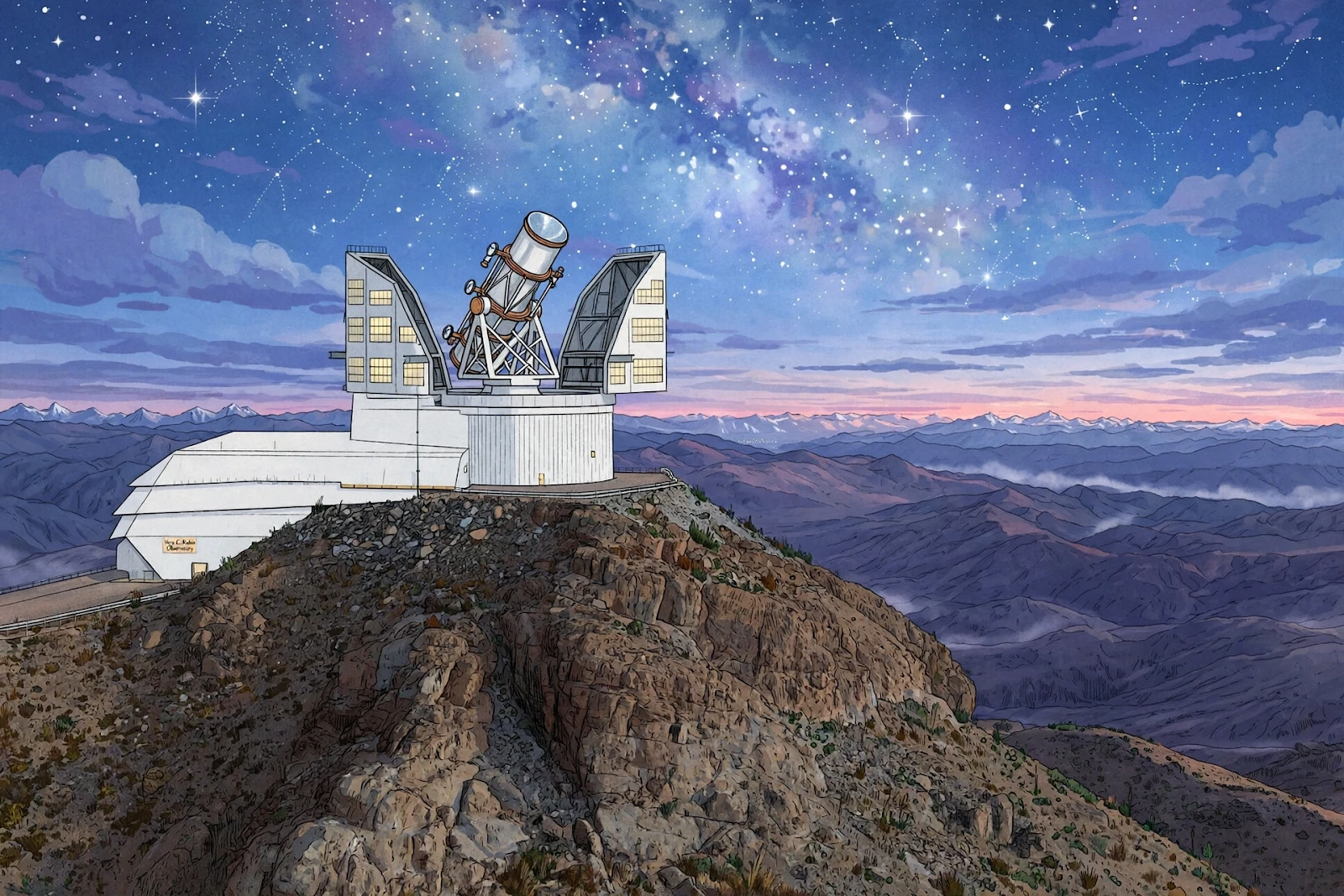
Illustration: The Vera C. Rubin Observatory on its mountaintop site in the Chilean Andes, surveying the southern sky.
Rubin took its first images in June 2025 and, according to Science News, officially began its decade-long survey in June 2026. The Trojan finds come from its earliest data — a reminder, the team says, of how much the full survey may still reveal. The observatory is jointly funded by the United States National Science Foundation and the Department of Energy, and its survey is designed to create a census of Solar System objects alongside its work on dark matter, dark energy and the Milky Way.
The team also used Rubin's images taken through different filters to compare the surfaces of the leading and trailing Trojans, finding that the two clouds have similar surfaces. That similarity is consistent with the idea that both swarms formed from the same population of icy bodies, rather than being assembled from unrelated material — although the researchers present it as a surface comparison, not as proof of a single birthplace.
Why It Matters
The imbalance between Neptune's two Trojan clouds has long bothered planetary scientists. If the leading and trailing swarms formed by the same process, they should be roughly symmetric in numbers — yet observers counted about 30 ahead of Neptune and only two behind it. "We would expect these [groups of Trojans] to be symmetric in numbers, so you have to get more than two," Schwamb said at the Spokane meeting, as reported by Science News. Finding two more trailing objects does not close the gap, but it shows the gap was at least partly an observational blind spot, not a real absence.
That matters for models of the early Solar System. Trojan populations are thought to be survivors from the era when the giant planets migrated, scattering icy bodies across the outer Solar System and capturing some into stable Lagrange-point orbits. A fuller census of both clouds — their numbers, sizes, orbits and surface properties — lets researchers test which migration histories can produce the populations we see today, and which cannot.

Illustration: A small icy Trojan asteroid drifting against the dense star fields of the Milky Way that long hid Neptune's trailing cloud.
The discovery also serves as an early demonstration of Rubin's survey power. If commissioning-era data alone can double a known population, the full ten-year LSST — mapping the southern sky every few nights — is expected to transform the outer Solar System census. The Queen's-led team expects Rubin to discover tens to hundreds of Neptune Trojans across both clouds over the coming years, plus tens of thousands of icy bodies in the trans-Neptunian region and the Kuiper Belt.
What Happens Next
The immediate next step is confirming the candidate, 2025 MD138. That requires a longer arc of observations — more sightings spread over time — so that its orbit can be pinned down well enough for the same billion-year stability tests that the two confirmed objects passed. Further observations will also refine the physical characteristics of all three objects, including their sizes and surface properties.
Beyond this one cloud, the Rubin survey will keep sweeping up faint outer Solar System bodies night after night. Each new Trojan, Kuiper Belt object and distant dwarf-planet candidate adds a data point to the census, and the trailing cloud — now emerging from the Milky Way's glare — is expected to keep growing as the survey continues. Schwamb's own assessment, quoted in the Queen's release, is that "even more exciting findings" should be expected in the years ahead.
For now, the headline is simple: a cloud astronomers could barely see has doubled in size, not because Neptune gained new companions, but because a new telescope finally looked in the right place at the right time — and found that the missing Trojans were there all along.
Sponsored: explore today's featured sponsored offers
FAQ
What is a Trojan asteroid?
A Trojan asteroid shares a planet's orbit around the Sun, clustered around the L4 point 60 degrees ahead of the planet or the L5 point 60 degrees behind it, where the combined gravity of the Sun and the planet holds objects in a stable pocket.
What did the Rubin team actually find?
Two confirmed long-term stable trailing Trojans of Neptune, 2025 MH348 and 2025 NN80, plus a third candidate, 2025 MD138, which still needs a longer observed arc to confirm. The two confirmations roughly double the previously known trailing sample.
Why were Neptune's trailing Trojans so hard to find?
For roughly the past 10 to 15 years the trailing cloud has appeared, from Earth, in front of the Milky Way's centre — a dense, bright star field that obscures faint moving objects. The cloud is now moving out of that region, and Rubin's depth and sky coverage made the faint objects detectable.
Are the new Trojans ancient?
According to the reported dynamical analysis, yes: the two confirmed objects passed billion-year stability tests, indicating they have occupied their orbits for billions of years and are primordial members of the Solar System.
What comes next for this research?
Confirmation of the candidate 2025 MD138, further physical characterisation of all three objects, and a much larger census as Rubin's ten-year Legacy Survey of Space and Time continues — with tens to hundreds of Neptune Trojans expected in total.
Sources
Queen's University Belfast via Phys.org, "Queen's University Belfast students find Neptune's elusive Trojan asteroids," November 2, 2026. Megan E. Schwamb et al., "NSF-DOE Vera C. Rubin Observatory's First View of the Neptune Trojan L5 (Trailing) Cloud: Two New Long-term Stable Trojans," The Astrophysical Journal Letters (2026), DOI: 10.3847/2041-8213/aead9a. Science News, "This Halloween, amateur astronomers may be in for a dwarf planet treat," November 2026 (Division for Planetary Sciences meeting reporting). TechTimes, "Rubin More Than Doubles Neptune Trojan Count: Two Trailing Relics Emerge From Milky Way's Shadow," October 31, 2026.
Comments
Post a Comment