
SEOUL — SK Hynix's plans for major new memory-chip plants in New York have run into a complication in Washington, where United States officials have held up approval for American chipmaking equipment the South Korean company wants for its existing plant in China, according to a Reuters report published on 4 November 2026. The standoff links two very different factories — one that already exists in Dalian, China, and two that are still only planned in Marcy, New York — and it has become a test of how far the Trump administration is willing to go to bring chipmaking home without loosening the export controls meant to limit China's access to advanced technology.
The report, based on people familiar with the matter, says SK Hynix is seeking United States export licences to equip its Dalian plant, arguing that increased production there would help fund its planned American expansion. The Commerce Department has yet to approve the new licences, the people said, and negotiations are continuing, with approval for the Dalian expansion central to the company's plans in New York.
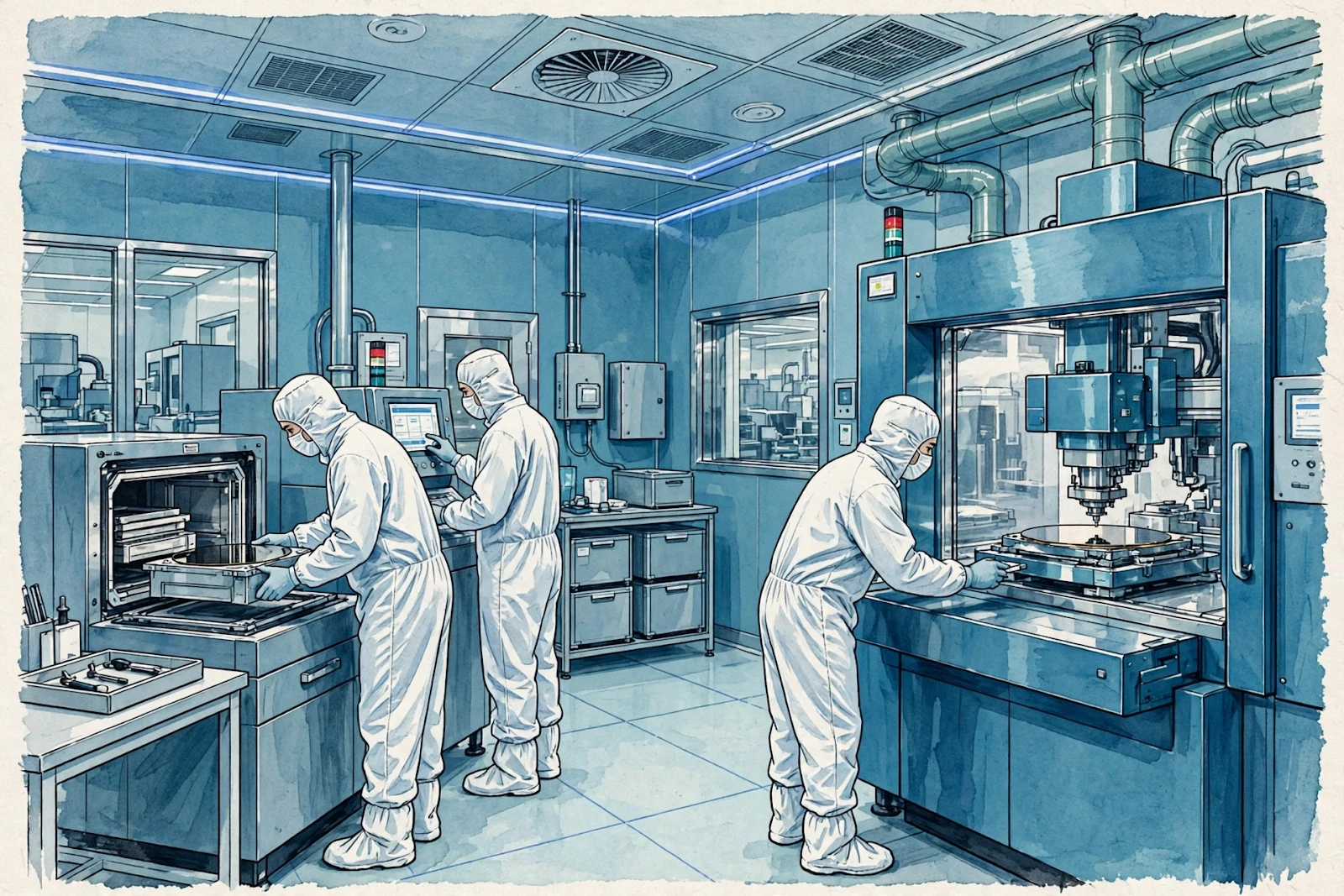
Illustration: Engineers at work inside a semiconductor fabrication cleanroom.
What Happened
According to Reuters, United States officials have held up approval for American chipmaking equipment needed by SK Hynix to expand production in China, complicating the company's plans for new memory-chip plants in New York. The company is seeking export licences to equip its Dalian plant, and the Commerce Department has yet to approve them, people familiar with the matter said.
Executives from Solidigm, SK Hynix's United States-based NAND flash memory subsidiary, have met nearly 10 times with Commerce Department officials since late August, one of the people said. In a meeting last week, Commerce Under Secretary Jeffrey Kessler held to his position that the United States did not want to allow more American chipmaking tools into China to upgrade or expand capacity, the person said, although the department has not formally denied a licence to export American equipment to fill empty clean space in Dalian.
The two sides are also negotiating a separate licence for 2027 for equipment to keep up the Dalian facility, according to the report. At a meeting in late August, Solidigm co-chief executive Richard Chin and other executives met Commerce Secretary Howard Lutnick and Kessler, one of the people said. The administration officials appeared excited about the possible investment and NAND facility in the United States and eager to work things out, the person said. Since then, the company has drafted multiple versions of licence applications as it refines the requests in collaboration with the department.
Company representatives have also met officials at the United States Treasury Department, which would have to waive outbound investment restrictions for SK Hynix to purchase tools for China, the people said. Treasury's response was that it would wait and see what the Commerce Department does, one of the people said. The Treasury Department did not immediately respond to a request for comment, Reuters reported, and a Commerce Department spokesperson also did not immediately respond.
The New York Plan
Solidigm plans to invest about $45 billion and build two NAND plants in Marcy, New York, two people familiar with the matter told Reuters, with investment potentially reaching about $100 billion over time. NAND is a type of memory that retains data even when power is switched off, and it is used for storage in data centres — the vast facilities now expanding rapidly to serve artificial intelligence workloads.
That scale is what makes the New York proposal significant. Memory chips are among the most strategically important components in the AI era: every data centre that trains or runs large AI models needs enormous amounts of fast, reliable storage, and demand for NAND has risen alongside the AI boom. A $45 billion investment would place Marcy among the largest semiconductor projects in the United States, with the potential for far more if the longer-term figure is reached.
Local officials remain hopeful. Anthony Picente, county executive for New York's Oneida County, where the proposed facility would be located, told Reuters: "Hopefully we'll have an answer in the next couple of weeks," adding that a federal investment tax credit expires at the end of the year. That deadline adds urgency to talks that might otherwise drift: tax credits can materially change the economics of a fab, and their expiry gives both sides a reason to seek clarity soon.

Illustration: NAND memory chips and silicon wafers, the storage building blocks used in data centres.
Why Dalian Matters to New York
The connection between Dalian and Marcy is financial as much as technical. According to the people familiar with the matter, the company needs to ramp up production and develop more sophisticated NAND chipmaking in China to generate revenue to build a United States facility and to stay competitive. In other words, SK Hynix argues, the cash flow from its existing Chinese operation would help pay for the American one.
SK Hynix agreed to acquire Intel's NAND factory in Dalian for $9 billion in 2020, and took control of the facility and its solid-state drive storage business shortly before the United States instituted sweeping export controls on American chipmaking equipment to what it deemed advanced chip factories in China. At first, the United States waived the restrictions on foreign-owned chipmaking facilities in China. But last year, the Commerce Department revoked authorisations for foreign chipmakers in China to receive United States equipment, deeming them a "Biden-era loophole," and replaced them with annual licences that allow suppliers to ship certain equipment and technology to the facilities with quantity limits.
SK Hynix has said that installing equipment to fill empty space in Dalian would not expand capacity because it built the cleanroom in 2023, Reuters reported. It is also looking to produce more sophisticated NAND products at Dalian, Reuters reported last month. That distinction — filling existing clean space versus expanding capacity — is at the heart of the negotiation, and it is one Washington has so far been unwilling to accept as a basis for new licences.
What Washington Is Worried About
The negotiations raise questions about how far the Trump administration is willing to bend national security guardrails established to keep United States technology from aiding China's military, in order to bring foreign investment and chipmaking onshore, Reuters reported. "Ultimately, none of this is going to go forward without a green light from the White House," said Leland Miller, a member of the US-China Economic and Security Review Commission, a bipartisan panel created by the United States Congress. The White House did not immediately respond to a request for comment.
In an August 2025 statement, the Commerce Department said it did not intend to issue licences to upgrade technology or expand capacity at fabs in China. That stated policy is the backdrop to every meeting since: officials may welcome a $45 billion American investment, but the department's own framework points against granting the very licences SK Hynix says it needs to fund it.
The tension is not unique to SK Hynix. Across the semiconductor industry, companies with factories in China face the same bind — American equipment is often essential to modern chipmaking, American policy restricts its flow into China, and American industrial policy simultaneously seeks to lure those same companies to build at home. How Washington resolves this case could therefore signal to other chipmakers how much flexibility, if any, exists between those two goals.

Illustration: Officials discuss semiconductor export controls, where investment and national security goals meet.
The Company Responds
SK Hynix responded to the Reuters report on 4 November, saying it continues to bring United States-made semiconductor manufacturing equipment into its Dalian plant under an existing export licence, while negotiations for next year's authorisation remain underway, according to Aju Press. "We currently have a valid license and are bringing in equipment with approval from the U.S. government," the company said, adding that negotiations for next year's licence are underway as part of the usual process.
The company also said no specific plans had been finalised for new semiconductor manufacturing facilities in the United States, despite the Reuters report linking the export restrictions to a potential multibillion-dollar investment in New York. That caution matters: the New York figures reported by Reuters come from people familiar with the matter, not from a formal company announcement, and SK Hynix has not confirmed a final site decision.
In a statement last week, Solidigm said: "As a US-founded and headquartered company, Solidigm regularly evaluates strategic alternatives to best serve its customers and enhance its long-term competitiveness. The company is currently exploring options for building a NAND memory fab at potential locations around the world. No decision regarding any specific course of action has been made." The Rancho Cordova, California-based company stuck to that statement from last week, Reuters reported, and SK Hynix did not immediately respond to a request for comment outside business hours.
Solidigm had also explored an initial public offering to help finance production facilities in the United States and meet growing memory demand, but halted its review of the IPO options in light of recent market conditions and share price trends, SK Hynix said in an October 23 statement. "Expanding Solidigm's production capacity and strengthening its competitiveness remain important priorities," that statement said.
Background
SK Hynix is one of the world's largest memory-chip makers, and its fortunes are closely tied to the AI data-centre boom. Memory — both the DRAM used for fast working memory and the NAND used for storage — has become a bottleneck and a profit centre at once, as data-centre operators race to build capacity. That context helps explain both the size of the proposed New York investment and Washington's interest in securing more of that production on American soil.
United States chip policy since 2022 has tried to do two things at once: subsidise and attract domestic fabrication through incentives such as the federal investment tax credit, and restrict the flow of advanced chipmaking tools to China. The SK Hynix case sits exactly where those two aims collide. Granting licences for Dalian could be read as softening the China controls; refusing them could be read as jeopardising a major domestic investment.
Other chipmakers are watching for the same reason. The annual-licence system that replaced the earlier waivers gives Washington a recurring decision point — and recurring leverage — over foreign-owned fabs in China. Each year's licence round is therefore not only a technical ruling but a signal about the direction of United States policy.
Why It Matters
For the United States, the case tests whether industrial policy and export controls can be reconciled in practice rather than only in speeches. A green light for Dalian equipment, tied to a firm New York commitment, could become a template for bringing foreign chip investment home. A refusal could preserve the controls but push the investment elsewhere — or delay it — at a moment when AI infrastructure demand is surging.
For South Korea, one of America's closest allies in Asia and home to two of the world's biggest memory makers, the outcome matters diplomatically as well as commercially. Seoul has sought to balance its security alliance with Washington against its deep economic ties with China, and chip policy is where that balancing act is most visible.
For the wider chip market, the timing matters. Memory prices and availability ripple through everything from smartphones to servers, and any delay to a project of this size — or any tightening of supply from Dalian — can affect planning across the industry. Conversely, a resolution that unlocks both Dalian production and a New York build would add significant long-term capacity at a time when data-centre demand shows little sign of slowing.
What Happens Next
The most immediate signal to watch is the Oneida County timeline: local officials hope for an answer in the next couple of weeks, before the federal investment tax credit expires at the end of the year. A decision on the Dalian licences, or at least a clear framework for the 2027 licence, would be the first concrete step.
Next, watch for any formal company announcement. Until SK Hynix or Solidigm confirms a site, an investment figure, or a timetable, the New York plan remains a reported proposal rather than a committed project — a distinction the company's own 4 November response underlined.
Finally, watch Washington's language. If Commerce officials begin to distinguish more openly between filling existing clean space and expanding capacity, that could open a path to compromise. If they hold the August 2025 line without exception, SK Hynix will have to find another way to fund its American ambitions — or scale them back.
Sponsored: explore today's featured sponsored offers
FAQ
What is SK Hynix planning in New York?
According to people familiar with the matter cited by Reuters, its Solidigm unit plans to invest about $45 billion and build two NAND plants in Marcy, New York, with investment potentially reaching about $100 billion over time. The company itself has said no specific plans for new United States facilities have been finalised.
Why are United States licences for China holding up the plan?
SK Hynix is seeking export licences for American chipmaking equipment for its Dalian plant in China, arguing that production there would help fund the United States expansion. The Commerce Department has yet to approve the new licences, Reuters reported.
What is NAND memory?
NAND is a type of memory that retains data even when power is switched off. It is used for storage in data centres, smartphones and other devices, and demand has grown with the expansion of AI infrastructure.
What has SK Hynix said in response?
On 4 November, SK Hynix said it continues to bring United States-made equipment into Dalian under an existing, valid licence, that negotiations for next year's licence are underway as part of the usual process, and that no specific plans for new United States facilities have been finalised.
When could there be a decision?
Oneida County executive Anthony Picente said he hopes for an answer in the next couple of weeks, noting that a federal investment tax credit expires at the end of the year. No formal decision date has been announced by the Commerce Department.
Sources
Reuters, "SK Hynix's New York chip plans hit snag over US restrictions on China, sources say," 4 November 2026, via BusinessWorld Online; Aju Press, "SK hynix says US chip equipment license remains valid," 4 November 2026; Solidigm statement, as reported by Reuters, week of 27 October 2026; SK Hynix statement on Solidigm IPO review, 23 October 2026, as reported by Reuters; United States Commerce Department statement, August 2025, as reported by Reuters.
Comments
Post a Comment