
STOCKHOLM — Swedish construction giant Skanska is getting choosier about which artificial-intelligence data centres it builds, favouring big established technology clients and steering clear of newer developers whose financing looks fragile, its chief executive told Reuters on Thursday, 5 November 2026.
The caution comes even as demand smashes records. Skanska's third-quarter construction orders jumped 70 percent to 68 billion Swedish crowns, including an 11.2 billion-crown data-centre contract in the United States, lifting its order backlog to a record 328.3 billion crowns. "We don't see any slowdown," chief executive Anders Danielsson said — but the boom, he made clear, is no longer a build-it-and-they-will-come business.

Illustration: An AI data centre construction site at dusk, with tower cranes over long server halls.
What Happened
Danielsson told Reuters that Skanska's core customers are large, financially strong international technology groups, and that rather than postponing projects, those established customers are commissioning larger facilities. The wariness is aimed squarely at the wave of newer developers that has rushed into the sector. "There's a lot of new developers in that area that we are a bit more careful about to make sure we go for the right project," Danielsson said.
The numbers show why the builder can afford to be picky. Construction orders in the third quarter rose 70 percent to 68 billion crowns, helped by the 11.2 billion-crown US data-centre contract, and the order backlog reached a record 328.3 billion crowns. Skanska has also been able to pass substantial construction-cost increases on to customers without seeing projects cancelled. "The cost inflation has been quite big, especially in the U.S., but also in Europe," Danielsson said. "We don't see any pressure on our side on the margins." The construction operating margin rose to 5 percent from 4.2 percent a year earlier, helped by large projects nearing completion.
The wider market is just as hot. More than 80 percent of the record 7.5 gigawatts of data-centre capacity under construction in eight major US markets had already been preleased by mid-2026, according to property consultancy CBRE. But the boom has brought sharper scrutiny from lenders and investors. Ratings agency Moody's warned in October that weaker borrowers could struggle to refinance loans maturing between 2027 and 2029.
The financing tension was on display on Wednesday, when US developer TeraWulf said Google would backstop certain lease obligations for AI firm Anthropic at a data-centre project in Kentucky, helping secure financing. TeraWulf disclosed three credit support agreements with Google in a filing with the US Securities and Exchange Commission on 4 November, tied to about $19 billion of contracted lease commitments for Anthropic at its Justified Data Campus in Hawesville, Kentucky. The 20-year lease, signed in July 2026, covers roughly 401 megawatts of critical IT load across three buildings, with completions expected from late 2027 through the second quarter of 2028. TeraWulf also signed a definitive construction agreement with engineering firm Fluor for the three buildings.
Google is not lending the money. Under the agreements, Google promises to step in only if Anthropic fails to pay rent or becomes insolvent — either by paying what is owed and taking over the lease, or by paying a termination fee and taking an equity stake in Raylan Data, the TeraWulf subsidiary that owns the project. The backstop takes effect when the final data hall under each lease begins operating, and it ends once Anthropic holds investment-grade credit ratings for at least three months. TeraWulf chief financial officer Patrick Fleury said the investment-grade backing strengthens the project's financing profile and the company's ability to pursue competitive long-term debt.
There were fresh signs of caution elsewhere in the sector on Thursday. The Financial Times reported that Microsoft had rejected an option to more than double the size of its existing contract with British developer Nscale to rent computing power at a data-centre site in Texas, citing people familiar with the matter; Reuters said it could not immediately verify the report. Bloomberg News reported that Micron Technology had suspended plans for a $4.5 billion memory chip plant in Taiwan because of an extended labour dispute, again citing people familiar with the matter, and Reuters said it could not immediately verify that report either.

Illustration: A modern data centre balanced on gold coins and loan documents under storm clouds — the financing risk behind the AI building boom.
Background
The data-centre boom is the physical side of the AI race. Training and running large AI models needs enormous computing power, and the biggest technology companies and AI labs have responded by signing leases for warehouse-sized halls packed with servers, often for 15 or 20 years at a time. Developers have rushed to meet that demand, buying land, securing power connections and borrowing heavily to build ahead of tenants.
That model works well while credit is cheap and tenants are household names. It gets harder when interest rates stay high, construction costs climb and the tenant is a fast-growing but loss-making AI startup whose main asset is a long-dated promise to pay rent. Lenders then want a stronger name standing behind the lease — which is exactly what Google is providing at the Kentucky campus. The structure effectively lets TeraWulf borrow against Anthropic's rent at something closer to Alphabet-grade cost, because Google, Alphabet's subsidiary, carries high investment-grade ratings.
The pressure is visible across the supply chain. Memory chip prices have climbed so far on AI demand that Apple flagged pressure on its margins over the holiday quarter this week, according to Reuters, and Sony said on Thursday that its games business is grappling with higher memory prices even as it reported a 45 percent rise in second-quarter operating profit. The strain is one reason builders like Skanska are drawing a line between established customers and speculative newcomers: in a market this hot, the risk is no longer finding work, but picking the projects that will actually get paid for.
Why It Matters
Builders are an early-warning system for the AI boom. They see which projects have real money behind them months before the servers are switched on, and Skanska's message is that the market is splitting in two: rock-solid demand from the biggest technology groups, and growing doubt about the developers chasing them. That split matters because the boom is financed, not just built. If weaker borrowers cannot refinance the loans coming due between 2027 and 2029, as Moody's warned, some projects could stall half-finished, leaving lenders, contractors and local power grids holding the bill.
For the AI labs themselves, the lesson is that access to computing power now depends on someone else's balance sheet. Anthropic's Kentucky campus only became financeable on attractive terms once Google agreed to stand behind the lease. For investors, the message is that data-centre exposure is no longer a simple bet on AI demand: it is a credit decision, and the quality of the tenant and the guarantor matters as much as the megawatts.
For Skanska, selectivity is also a commercial strategy. With a record backlog and margins improving, it can turn down riskier work and still grow. The company's ability to pass on cost inflation without losing orders suggests that, for now, the strongest customers are willing to pay almost any price for capacity — a sign of confidence in AI demand, but also of how much of that demand is concentrated in a handful of very large buyers.
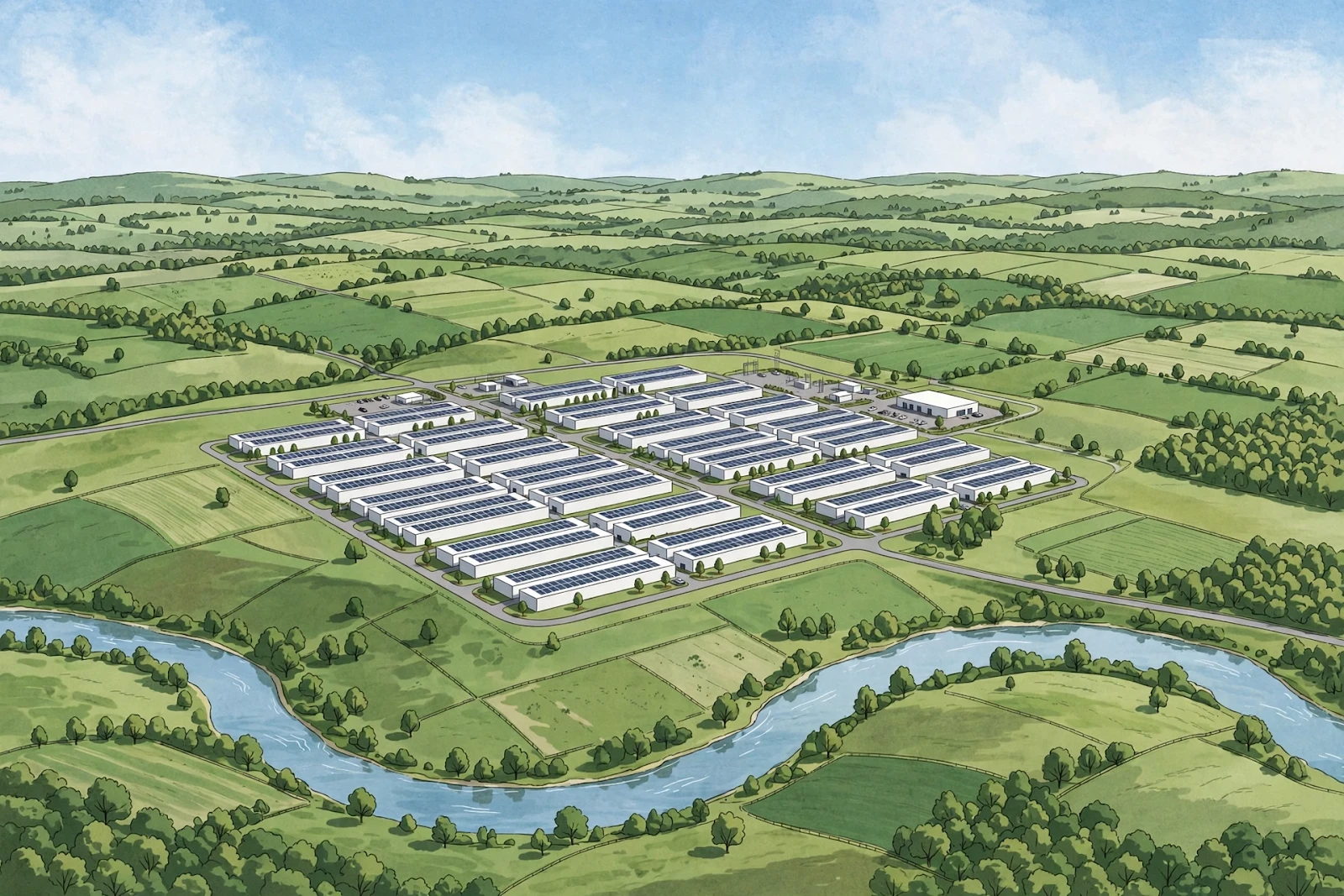
Illustration: A modern data centre campus in the Kentucky countryside, where Google is backstopping Anthropic's $19 billion lease.
What Happens Next
The next test is whether other builders and lenders follow Skanska's lead. If selectivity spreads, the developers most exposed will be the newer entrants with the thinnest balance sheets — the same group Moody's flagged over refinancing. Watch Skanska's order intake in the coming quarters: continued growth would confirm that established customers are still expanding, while a slowdown would suggest even the strongest buyers are pausing.
At the Kentucky campus, the milestones are concrete. Fluor's construction work runs toward phased completions from late 2027 through the second quarter of 2028, and TeraWulf still has to raise the debt the Google backstop is meant to support. The backstop itself only bites once the data halls are operating, so the next two years will show whether the project is delivered on time — and whether Anthropic earns the investment-grade ratings that would let Google step away.
Investors will also watch for confirmation of the two unconfirmed reports from Thursday: whether Microsoft really walked away from expanding its Nscale deal in Texas, and whether Micron's Taiwan plant stays on hold. Either would add to the picture of an AI infrastructure boom that is still expanding fast, but no longer without questions about who pays for it.
Sponsored: explore today's featured sponsored offers
FAQ
Why is Skanska being selective about AI data-centre projects?
Chief executive Anders Danielsson told Reuters the builder favours large, financially strong international technology groups and is more careful about newer developers, which face financing and execution risks. With a record order backlog, Skanska can choose the projects it considers safest.
How strong is demand for AI data centres?
Very strong: more than 80 percent of the record 7.5 gigawatts of capacity under construction in eight major US markets was already preleased by mid-2026, according to CBRE, and Skanska's third-quarter construction orders jumped 70 percent to 68 billion crowns.
What did Google agree to do for Anthropic's Kentucky campus?
Google agreed to backstop certain lease obligations for Anthropic at TeraWulf's Justified Data Campus in Hawesville, Kentucky — about $19 billion of contracted commitments over a 20-year lease for roughly 401 megawatts. Google is not lending the money; it would step in only if Anthropic fails to pay or becomes insolvent.
What financing risk did Moody's warn about?
Moody's warned in October that weaker borrowers in the data-centre boom could struggle to refinance loans maturing between 2027 and 2029, as lenders and investors scrutinise the sector more closely.
Is the AI data-centre boom slowing down?
Not according to Skanska: Danielsson said "we don't see any slowdown," with established customers commissioning larger facilities rather than postponing them. The company has passed on big cost increases without cancellations and lifted its construction margin to 5 percent.
Sources
- Reuters, 5 November 2026 — Skanska wary of newcomers as AI data centre boom gathers pace (Danielsson quotes, third-quarter orders of 68 billion crowns, record 328.3 billion-crown backlog, CBRE preleasing data, Moody's warning, TeraWulf-Google backstop).
- TeraWulf Form 8-K and company announcement, 4 November 2026, via TSN, Unite.ai and Minichart — three Google credit support agreements, about $19 billion of contracted Anthropic lease commitments, roughly 401 MW of critical IT load, 20-year lease signed July 2026, Fluor construction agreement, completions late 2027 to second quarter 2028.
- Reuters, 5 November 2026 — Microsoft rejects multibillion-dollar AI deal with UK's Nscale, FT reports (Reuters could not immediately verify the Financial Times report).
- Reuters, 5 November 2026 — Micron pauses work on $4.5 billion Taiwan plant, Bloomberg News reports (Reuters could not immediately verify the Bloomberg report).
- Reuters, 5 November 2026 — Sony posts 45% Q2 profit rise on movies, games boost (Apple flagged memory-price pressure on margins; Sony games business grappling with higher memory chip prices).
Comments
Post a Comment