
ST. JOHN'S, Antigua and Barbuda — Days before world leaders gather for the COP31 climate summit in Antalya, Türkiye, the leader of Antigua and Barbuda has set out a blunt message for negotiators: small island states do not need sympathy, they need investment.
In a comment piece published by Reuters on Monday, 2 November 2026, Antigua and Barbuda's leader argues that the decisive question at COP31 is no longer whether the world will overshoot the 1.5 degrees Celsius warming limit — which, in the piece's words, is now all but guaranteed — but how high temperatures peak, how long they stay there, and whether capital for the green transition is mobilised at scale and at speed.
The intervention lands as Antigua and Barbuda hosts the Commonwealth Heads of Government Meeting (CHOGM) in St. John's, the smallest nation ever to host the gathering, which brings together representatives of about a third of humanity. It also comes one week before COP31 opens in Antalya on 9 November 2026, with a World Leaders Climate Action Summit scheduled for 11–12 November, according to the Asian Development Bank.
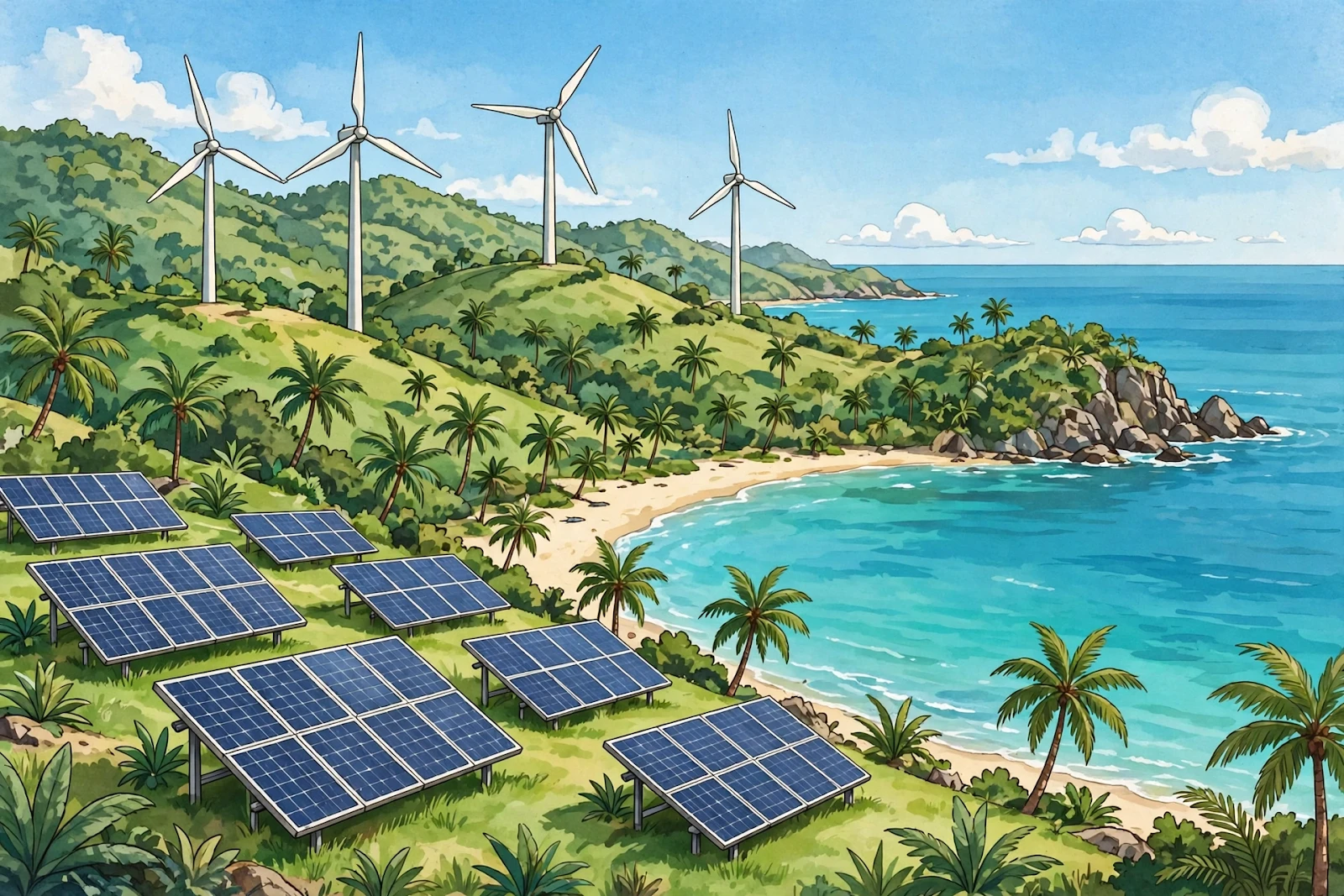
Illustration: Solar panels and wind turbines on a sunny Caribbean island coastline. This is an illustration, not a photograph of a real event.
What Happened
The Reuters piece reframes the familiar small-island story. Small island states, the author writes, are usually described in terms of what they lack: land, scale and fiscal room to manoeuvre. All of that is true, the piece concedes — but it is only half the story, and not the half Antigua and Barbuda intends to carry to Antalya.
The other half, according to the piece, is abundance. A recent regional analysis of Caribbean energy pathways, cited in the article, puts the region's technical potential for solar, wind and geothermal power well into the tens of thousands of megawatts — several times what the Caribbean actually needs to do its part in fulfilling the COP28 pledge to triple global renewable capacity by 2030. "The sun, like our ambition, has never been the constraint," the piece argues; the constraint has been financing, coordination and partnerships to turn potential into working power plants.
Antigua and Barbuda itself is working toward a target of 50% renewable electricity by 2030, the piece says. This year, the country began work on a new kind of solar project structured so that ordinary Antiguans and Barbudans can hold a stake in it directly. If people are being asked to change how they get their power, the argument runs, they should also be allowed to own a piece of the new economic system. A just transition, in the piece's framing, is measured as much by who holds equity as by how many megawatts a system produces.
The piece draws on analysis from Climate Analytics' report "Pathways to Implementing GST Recommendations in the Caribbean," which examines how the region can meet the Global Stocktake's call to triple renewable energy capacity by 2030.
Background
The timing matters. COP31, the 31st Conference of the Parties to the United Nations Framework Convention on Climate Change, runs from 9 to 20 November 2026 in Antalya, with Türkiye hosting and Australia leading the formal negotiations, according to the Asian Development Bank and COP31 organisers. The summit is being framed as an implementation conference: moving from dialogue and consensus to concrete action, with a particular focus on keeping the 1.5 degrees Celsius goal within reach and improving access to climate finance.
Finance is the central unresolved item. At COP29, countries agreed a climate finance goal of at least $300 billion a year for developing countries by 2035, with a broader ambition to mobilise at least $1.3 trillion a year by the same date, according to summaries of the COP31 agenda. Yet small island developing states receive only 0.2% of global climate finance despite their vulnerability to climate impacts, Australian Climate Minister Chris Bowen said on 25 October 2026, as reported in COP31 previews. That gap between agreed goals and money actually reaching small states is exactly what the Antigua and Barbuda piece targets.
The piece also points beyond electricity. For nations that import almost every drop of the fuel they burn, energy independence is protection from price shocks and conflicts far away, the author writes. The ocean itself, the piece adds, offers enormous opportunities for clean energy, blue carbon and coastal resilience. Cheaper, steadier power, in this argument, is what draws investment, sustains businesses and creates jobs — not an abstract environmental good.

Illustration: Delegates gathered in a large international climate summit hall. This is an illustration, not a photograph of a real event.
Why It Matters
The argument cuts against how small island states are usually heard at climate summits: as voices laying bare their vulnerability and appealing to the world's moral compass. The Reuters piece says that script is no longer enough. Overshooting 1.5 degrees Celsius, it argues, does not by itself push the needle on meaningful action; what decides the outcome is whether investment moves, at scale and at speed, into the projects that already exist on paper.
Three specific asks follow. First, de-risking the small-scale renewable projects that global investors currently dismiss as too small to bother with. Second, honouring the climate finance commitments already made to Small Island Developing States. Third, building joint mechanisms that let a dozen small markets negotiate as one, rather than each island approaching investors and lenders alone.
The piece is explicit that this is not special pleading. The asks, it says, are "the practical substance of what every COP claims to be about." The author has begun laying the groundwork with partners for a regional climate and clean energy initiative anchored in Antigua and Barbuda, and says there will be more to say on it in Antalya.
There is also a political edge aimed at larger countries, including fellow Commonwealth leaders meeting in St. John's. Smallness, the piece concludes, stops being an excuse anyone can hide behind — including small island states themselves — once hurricane-tested nations can show that an energy transition can be both real and equitably owned by its own people. The closing line is a pitch, not a plea: "Bet on us."
What Happens Next
- COP31 opens in Antalya on 9 November 2026 and runs to 20 November, with the World Leaders Climate Action Summit on 11–12 November.
- Negotiators will test whether the summit delivers predictable funding arrangements for the COP29 finance goal of at least $300 billion a year by 2035, and progress toward the $1.3 trillion mobilisation ambition.
- Small island finance access is expected to be a defining issue, including a planned COP Presidency session on the climate finance needs of Small Island Developing States and pledges to facilities such as the Pacific Resilience Facility.
- Antigua and Barbuda is expected to outline more detail in Antalya on its proposed regional climate and clean energy initiative, following groundwork discussions begun around CHOGM in St. John's.
- Whether investors respond to the de-risking and joint-negotiation proposals will be judged not by summit declarations, but by whether small-scale Caribbean renewable projects that are currently dismissed as too small begin to reach financial close.

Illustration: A small island community with solar rooftops, a harbour and sea defences in daylight. This is an illustration, not a photograph of a real event.
Sponsored: explore today's featured sponsored offers
FAQ
What did Antigua and Barbuda's leader argue ahead of COP31?
In a Reuters comment piece published 2 November 2026, Antigua and Barbuda's leader argued that small island states need investment, not sympathy, at COP31 — specifically de-risked finance for small renewable projects, honouring of existing climate finance commitments, and joint mechanisms for small markets to negotiate together.
When and where is COP31?
COP31 takes place in Antalya, Türkiye, from 9 to 20 November 2026, with Türkiye hosting and Australia leading the formal negotiations. The World Leaders Climate Action Summit is scheduled for 11–12 November.
How much renewable potential does the Caribbean have, according to the piece?
A regional analysis cited in the piece puts the Caribbean's technical potential for solar, wind and geothermal power well into the tens of thousands of megawatts — several times what the region needs to do its part toward tripling global renewable capacity by 2030.
What is Antigua and Barbuda's own renewable target?
Antigua and Barbuda is working toward 50% renewable electricity by 2030, and has begun work on a solar project structured so ordinary citizens can hold a direct stake in it, according to the Reuters piece.
How much climate finance do small island states currently receive?
Small island developing states receive 0.2% of global climate finance despite their vulnerability to climate impacts, Australian Climate Minister Chris Bowen said on 25 October 2026, as reported in COP31 previews — a gap the Antigua and Barbuda piece argues COP31 must close.
Sources
Reuters, "Small island states don't need sympathy at COP31. We need investment," 2 November 2026 (comment piece drawing on Climate Analytics, "Pathways to Implementing GST Recommendations in the Caribbean"); Asian Development Bank, "UNFCCC Climate Change Conference (COP31): ADB at COP31" (COP31 dates 9–20 November 2026, World Leaders Climate Action Summit 11–12 November, implementation focus); GKToday, "COP31 to Address the Global Climate Finance Gap" (COP29 goal of at least $300 billion a year by 2035, $1.3 trillion mobilisation ambition, Bowen 0.2% figure, 25 October 2026).
Comments
Post a Comment