
A new study of iron meteorites has pushed the story of planet formation back to the solar system's very first million years — and found that its earliest building blocks were made mostly of fire-forged rock, not ice. The earliest planetesimals in the outer solar system were built from 83 percent to 92 percent chondrules, tiny heat-formed rock grains, with only 8 percent to 17 percent of the cold, icy dust known as matrix, according to research published in Nature Astronomy and reported widely on 1 November 2026.
The result, led by Earth and planetary scientist Damanveer Grewal of Yale University with colleagues Zhongtian Zhang of Princeton University and Joanna Drążkowska of the Max Planck Institute for Solar System Research, is the first geochemical evidence of how the ingredients of planet formation were mixed in bodies born within the first million years of the solar system's history. Until now, clear evidence of this kind of sorting had only been documented in objects that formed two to four million years after the solar system began.
"These ubiquitous little beads of rock are the basic building blocks from which the planets themselves were eventually assembled," Grewal said. "And now we know they were already being sorted and incorporated into the first generation of solid bodies from the very start."

Illustration: A young star surrounded by a disk of gas and dust where the solar system's first solid bodies formed — an illustration, not a photograph of a real star system.
What Happened
The study, titled "Planetesimal compositions governed by aerodynamic sorting from the onset of Solar System formation" and published in Nature Astronomy on 18 September 2026, reconstructed the original recipe of planetesimals — the asteroid-scale bodies that eventually helped build planets and moons — from iron meteorites that fell to Earth. Those meteorites are fragments of the earliest planetesimals, but their parent bodies melted completely, erasing the original physical mixture of their ingredients.
To recover that lost recipe, the researchers used two independent chemical tracers linked to matrix, the fine-grained dust loaded with water ice and organic molecules. The first was sulfur, which is much more abundant in matrix than in chondrules. The second was the oxidation state of iron, which reveals how much water ice and oxidized dust a body took in. Both tracers pointed the same way: the parent bodies of the carbonaceous iron meteorites studied contained only about 8 percent to 17 percent matrix — less than in any known chondrites, the ancient meteorites in which chondrules are still preserved.
"Both tracers independently tell the same story: These early planetesimals were remarkably matrix-poor," Grewal said. "That convergence is what makes the result robust."
Subtracting the matrix fraction from the whole gives the headline figure: chondrules made up roughly 83 percent to 92 percent of the material in these earliest outer-solar-system bodies. The finding was reported by ScienceAlert on 1 November 2026 and covered the same weekend by other science outlets, which noted that the result extends evidence for selective planet building into roughly the solar system's first million years.
Background
Two ingredients were available when the first solid bodies began forming. Chondrules are millimetre-sized, usually rounded grains of rock formed in short bursts of intense heat. Matrix is the contrasting material: fine-grained, cold dust carrying water ice and organic molecules. How the two were mixed into planetesimals matters because it set the starting composition of the worlds that followed — including how much water and carbon-rich material they carried from the beginning.
Scientists already knew from earlier work that, from about two million years after the solar system started to take shape, chondrules were winning out over matrix in the formation of planetesimals, and that from about four million years onwards, the icy matrix elements started to win out. What was missing was evidence from the very first million years — a gap that existed for a physical reason. The earliest planetesimals contained large amounts of radioactive aluminium-26, which produced enough internal heat to melt them completely. That melting destroyed the original chondrules and with it the direct physical evidence of the original proportions.
That is also why there are so few early-formed chondrules in the meteorite record: the rocks they were part of later melted due to internal heat, erasing the evidence. Iron meteorites, which come from the metallic cores of those melted bodies, preserve chemical fingerprints of the original mixture even though the grains themselves are gone — and radioactive dating, together with the fact that their parent bodies melted completely, places these meteorites at the very start of the solar system.
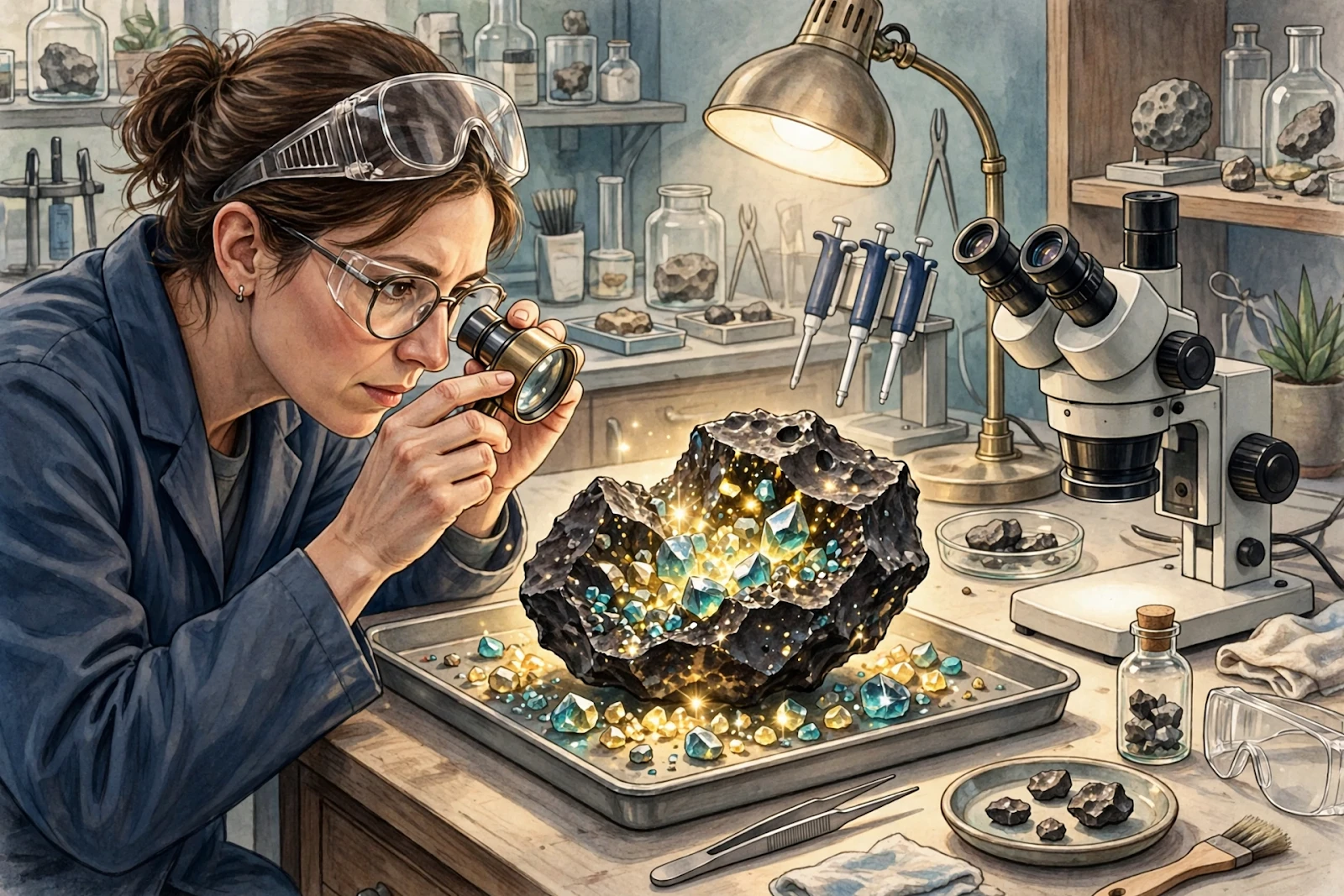
Illustration: A scientist examining an iron meteorite sample in a laboratory — an illustration, not a photograph of a real laboratory or sample.
Why It Matters
The result changes the picture of how choosy planet formation was, and how early that choosiness began. These objects were not simply a random mixture of whatever materials happened to be around. As Grewal put it, the assembly process was remarkably selective from the very beginning — a level of picking and choosing that was already operating in the first million years.
The researchers attribute the early dominance of chondrules to aerodynamic sorting. Chondrules are stronger and more compact than fluffy matrix dust, and those physical characteristics increased their chances of clumping together in the gas flowing through the young solar system, while much of the surrounding ice-rich dust was filtered out. Over the next few million years, something changed to affect that balance — though it is not yet entirely clear what — and matrix-rich material became more common in later-forming bodies.
The finding also helps explain a long-standing puzzle in the meteorite record: why early-formed chondrules are so scarce. They are not absent because they never existed in large numbers, but because the bodies that incorporated them melted and erased them. The chemical tracers recover a history that the rocks themselves no longer show.
Beyond our own solar system, the work offers a new lens on how other planetary systems form. If the first solid bodies elsewhere were also assembled selectively rather than as representative scoops of their surroundings, then the starting ingredients of exoplanets — including their water and organic content — may have been filtered in similar ways. Establishing what happened in our own solar system, the researchers note, could give experts a new perspective on the formation of other planets and moons elsewhere in the universe.
What Happens Next
Several questions remain open. First, researchers still need to pin down what changed after the first million years to let matrix-rich material gain ground — whether the gas flow through the young disk weakened, the chondrule supply faded, or the dynamics of the growing planets altered the sorting. Second, the result rests on a small set of carbonaceous iron-meteorite parent bodies, and broader sampling could test whether the same 83-to-92-percent pattern holds across more of the earliest population.
Third, the finding invites comparison with other new windows on the early solar system, from telescope surveys of the distant Kuiper Belt to laboratory studies of primitive meteorites that still preserve their chondrules. Each approach probes a different chapter of the same story: how dust and pebbles became planetesimals, and planetesimals became planets.
For now, the message of the study is simple and striking. The solar system's first worlds were not built from a balanced mix of fire and ice. They were built overwhelmingly from fire — heat-forged rock droplets, sorted and gathered within a million years of the beginning, long before Earth itself existed.

Illustration: A close-up of tiny round chondrule grains mixed with fine icy matrix dust — an illustration, not a microscope photograph of a real meteorite.
Sponsored: explore today's featured sponsored offers
FAQ
What did the new study find about the solar system's first planetesimals?
The earliest planetesimals in the outer solar system were built from 83 percent to 92 percent chondrules — tiny heat-formed rock grains — with only 8 percent to 17 percent of the cold, icy dust known as matrix, according to a Yale-led study published in Nature Astronomy.
What are chondrules and matrix?
Chondrules are millimetre-sized, usually rounded grains of rock formed in short bursts of intense heat. Matrix is fine-grained, cold dust loaded with water ice and organic molecules. Together they were the two main ingredients available when the first solid bodies formed.
How could researchers study bodies that melted billions of years ago?
The earliest planetesimals melted completely due to heat from radioactive aluminium-26, erasing their original grains. The team studied iron meteorites from those melted bodies and used two independent chemical tracers — sulfur levels and the oxidation state of iron — to reconstruct the original mixture.
Why were chondrules dominant in the first million years?
The researchers attribute it to aerodynamic sorting: chondrules are stronger and more compact than fluffy matrix dust, which increased their chances of clumping together in the gas of the young solar system, while much of the ice-rich dust was filtered out.
What does this mean for how planets formed?
It shows planet building was selective from the very beginning, not a random mix of available material. That filtering may have shaped how much water and organic material early worlds carried, and offers a new perspective on planet formation around other stars.
Sources
- ScienceAlert, "The Outer Solar System's First Building Blocks Were Mostly Fire, Not Ice", 1 November 2026 (updated 2 November 2026)
- Grewal, Zhang and Drążkowska, "Planetesimal compositions governed by aerodynamic sorting from the onset of Solar System formation", Nature Astronomy, 18 September 2026
- SpaceDaily, "During the Solar System's first million years, its earliest outer worlds formed from material that was up to 92 percent heat-forged rock", 2026
- Knowridge Science Report, "The Early Solar System Chose Fire-Forged Rocks Over Icy Dust", 19 September 2026
Comments
Post a Comment