
MADRID — Spain ground to a halt on Wednesday as millions of workers walked out in the country's first general strike in 14 years, turning a long-simmering housing crisis into the defining issue of a snap general election campaign that has barely begun. From picket lines at wholesale markets before dawn to shuttered shops on Madrid's Gran Vía and empty platforms at Atocha station, the 24-hour stoppage — called by Spain's two largest unions and the tenants' movement under the slogan "Salaries. Housing. Prices." — tested the strength of public anger over rents that have almost doubled in a decade and wages that no longer stretch far enough to pay them.
The strike, which began at midnight and was due to run until midnight on Wednesday, 11 November, is the first general strike jointly backed by the Unión General de Trabajadores (UGT) and Comisiones Obreras (CCOO) since 14 November 2012, when the two unions protested against the austerity measures of Mariano Rajoy's government during the eurozone debt crisis. This time the initiative came not from a labour reform or a budget, but from the tenants' movement — and its central demand is a place to live.

Illustration: A protest march through a Spanish city square during the general strike of 11 November 2026. (AI-generated illustration)
What Happened
The first pickets were in place before midnight. In Barcelona, striking workers set off fireworks as they gathered in public squares at the stroke of midnight, according to the Associated Press. In Madrid, the mobilisation moved from Puerta del Sol — where the union leaders Unai Sordo of CCOO and Pepe Álvarez of UGT had addressed supporters on Tuesday evening — to the waste collection service in Villaverde and to Mercamadrid, the capital's vast wholesale food market. Picket lines also formed overnight in industrial estates in Zaragoza and Murcia, in the centre of Málaga, and at Mercabarna, Barcelona's wholesale market.
Tensions flared early at Mercamadrid, where about 1,000 protesters gathered. CCOO's Madrid branch said on X that police fired pepper spray at pickets and arrested one of them, with 13 people requiring medical attention. A police spokesperson confirmed the arrest but not the use of pepper spray at that picket, although he said it was used to disperse a separate picket line in the Carabanchel district. The unions later said they would file a criminal complaint over what they described as a "disproportionate" police response that left 20 protesters injured. Minor incidents were also reported in the first hours, including roadblocks — some with burning tyres — in Barcelona.
Transport bore the brunt of the disruption. Airport operator Aena said airlines had cancelled 202 of the 4,529 flights scheduled across Spain's airport network by 08:30, about 4.4 per cent of the day's operations, after carriers rescheduled flights and moved passengers onto earlier ones. By 10:00, the number had risen to 234 cancellations, or 5.2 per cent. Spanish media reported a higher figure for the Iberia group — 444 flights cancelled, affecting more than 45,000 passengers — but that figure had not been independently confirmed by the airline or the airport operator at the time of writing. Minimum service levels set by the Transport Ministry ranged from 18 to 85 per cent of scheduled flights depending on the route.
On the railways, the government set minimum services of 75 per cent for Madrid's Cercanías commuter trains during peak hours and 50 per cent for the rest of the day, an average of 65 per cent for medium-distance services and 73 per cent for high-speed and long-distance trains. Renfe, the state rail operator, said about 20 per cent of its trains had been cancelled. Passengers described empty stations at Atocha and Chamartín in Madrid, and long queues at intercity bus stops. In Barcelona, the metro ran no trains outside peak commuting hours. Madrid's metro reduced its service by about 50 per cent for most of the day, rising to 80 per cent of normal service during peak hours, and said peak-hour usage was down 42 per cent compared with the same period the previous week.
Factories and workplaces also felt the stoppage. According to UGT and CCOO, early participation reached 90 per cent at ports and in the automotive sector, with what the unions called "total stoppages" at factories including Volkswagen's plant in Navarre and SEAT's in Barcelona. The unions put early turnout at 85 per cent in the meat industry, 82 per cent in waste collection and 75 per cent in the energy sector, with lower participation in healthcare and social services, at 38 per cent, and in the postal service, at 35 per cent. Those figures are the unions' own estimates, not an independent count, and no official nationwide turnout figure had been published at the time of writing. The unions also pointed to a 10 per cent drop in electricity demand as evidence of disruption across energy-intensive industries. Spain's main business lobby, the CEOE, countered that the drop in power demand was smaller than the fall of more than 14 per cent recorded during the last general strike.
Shops closed across the big cities. On Madrid's Gran Vía, stores including Primark, H&M and Pull & Bear drew their shutters amid a heavy riot police presence. Many shops in Barcelona were also closed and boarded up. Many schools and universities were reported closed or working at minimal capacity, according to the Associated Press. In Madrid, the strike added to an ongoing teachers' strike that began nearly a month ago.
The weather added a further complication. Two storms, Charles and Bruna, swept across the Iberian peninsula, and Spain's weather agency AEMET issued alerts for 14 regions over strong winds, rough seas and heavy rain. The afternoon marches were threatened by the storms, but the organisers pressed ahead. More than 150 events were planned across the country, with marches in more than 130 localities. In Madrid, a rally was held at noon in Cibeles, and the main march was due to set off at 18:00 from Atocha towards Plaza de España. In Barcelona, the main march was scheduled to start at 17:30 from the Jardinets de Gràcia.
Background
The road to 11 November began on 23 September, with the eviction of an 87-year-old woman in Madrid. Maricarmen Abascal was evicted from the flat in the Retiro district where she had lived for decades, after an investment fund bought her building and demanded a rent higher than her pension. The eviction, broadcast on national television, became a national symbol. Maricarmen died on 7 October in hospital, one day before the signing of a contract that was supposed to allow her to return to her home. Between the eviction and her death, the protest at her doorway gave way to encampments — including a sit-in at Puerta del Sol — and demonstrations in cities across Spain.
The tenants' movement, led by the Confederación de Sindicatos de Inquilinas, seized the moment and called for a general strike. The two big unions, UGT and CCOO, announced their support, and Prime Minister Pedro Sánchez called a snap general election for 29 November. Smaller unions including the CGT, CNT, Co.Bas, Intersindical and Solidaridad Obrera, as well as the actors' union, also joined, alongside regional unions such as Galicia's CIG and the Basque Country's ELA and LAB.
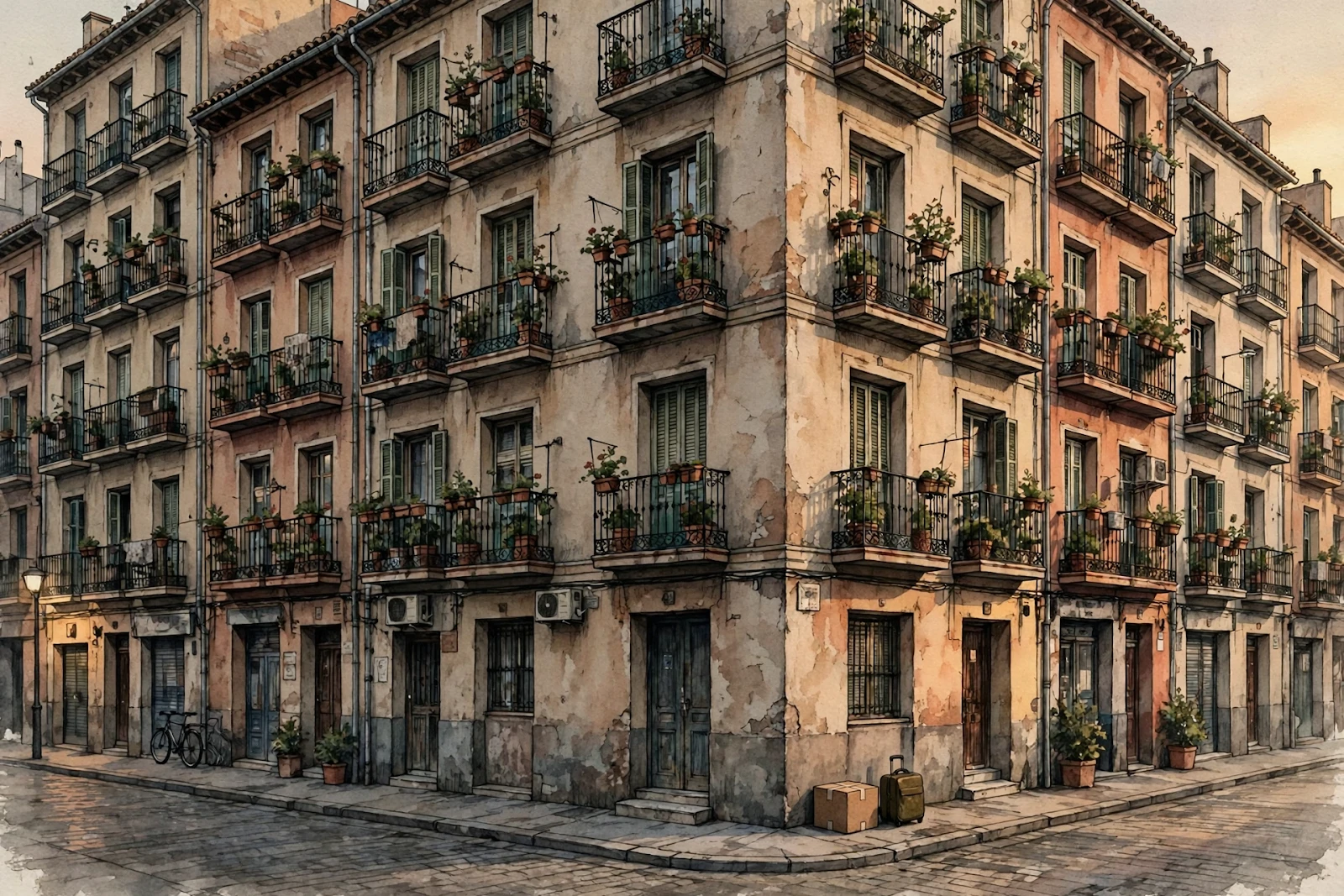
Illustration: Apartment blocks in a Spanish city, where soaring rents have outpaced wages for years. (AI-generated illustration)
The grievance behind the strike is stark. Spain has a deficit of about 750,000 homes, which is set to grow to more than a million by 2028, according to the Bank of Spain. The average rental price of €1,176 a month is equivalent to about 98.7 per cent of a young person's average monthly salary in Spain, according to the Youth Council of Spain. Average rents have almost doubled in the last 10 years, according to the Associated Press, while house prices rose 12.2 per cent year on year in the second quarter of 2026. Wages have not kept pace: salaries agreed in collective bargaining rose by 3.06 per cent up to October, compared with year-on-year inflation of 4.9 per cent anticipated by the National Statistics Institute (INE). "There is no salary that can withstand the price of housing," UGT leader Pepe Álvarez said at the Puerta del Sol picket on Tuesday evening. "I'm 36 years old and I still can't move out on my own," Madrid resident Jesús González, who works in a hospital IT department and supports the strike, told Reuters. "Rents just keep going up, house prices just keep going up, and it's simply impossible."
The unions' demands go well beyond a pay rise. They want action on housing speculation, rent controls, automatic renewal of leases and indefinite contracts, an end to evictions of vulnerable people, an end to tourist flats, and a crackdown on real-estate speculation — alongside higher wages, a shorter working week and better protection for public services, including health, education and dependency care. On pay, CCOO and UGT are seeking a minimum-wage rise of at least 7 per cent for 2027, from €1,221 to about €1,306.50 a month in 14 payments. The Labour Ministry, headed by Yolanda Díaz, has instead proposed a 5.3 per cent rise, to €1,286 a month, which exceeds the 4.9 per cent recommended by the government's own panel of experts. The unions are also seeking collectively bargained wage rises of between 4 and 7 per cent, depending on the sector.
The political trigger was parliament's rejection of the government's housing decrees. In September, Sánchez's government approved two emergency royal decree-laws: one capping annual rent rises at 2 per cent through the end of 2027, allowing tenants to request extraordinary two-year extensions, and suspending evictions of vulnerable households without housing alternatives until the end of 2030; the other establishing five-year renewals and compensation for tenants when an owner decides not to renew. On 2 October, Congress rejected both texts, with the PP, the far-right Vox, Junts and UPN voting against them. The government reissued the decrees on 6 October, and they now face a ratification vote on Thursday 12 November in the Diputación Permanente, the standing committee that acts while the Cortes are dissolved. With the Basque Nationalist Party (PNV) announcing its support for the broader decree and its rejection of the compensation decree, the first is expected to pass by 35 votes to 34, while the second lacks a majority. If the committee rejects them, the decrees lapse.
It was that parliamentary defeat that prompted Sánchez to call the election. He announced the snap vote on 5 October, hoping to earn four more years in power for his left-wing coalition by fighting the campaign on housing. The gamble has been complicated by events since: a series of corruption cases involving people in his inner circle, and a brutal high-speed train collision last month — Spain's second deadly rail disaster of the year, which killed 69 people. Train drivers walked out on Tuesday, the day before the general strike, to demand more investment in maintenance and safety. The opposition PP unveiled its own election manifesto on 10 November, the day before the strike — a separate story, covered in this blog's earlier report — promising tighter borders, slower climate goals, tax cuts and a million new homes.
Why It Matters
The strike matters because it has forced Spain's housing crisis — long a slow-burning grievance — onto the centre of the political stage, 18 days before voters decide the country's future. Housing is now, in the words of CCOO's Unai Sordo, "the one issue that is dividing the country: the struggle to access housing." For a generation of young Spaniards priced out of both renting and buying, the numbers explain the anger: an average rent that consumes almost an entire average young salary, a shortage of three-quarters of a million homes, and wages rising more slowly than prices.
It also matters because of who is striking, and who is not. This is the first general strike of Pedro Sánchez's eight years in power, and it is aimed at every level of government — central, regional and municipal — as well as at employers. Union leaders and many protesters have said they hold the central government responsible for the housing crisis too, not only the right-wing parties that run many regions and municipalities and that blocked the housing decrees. Sánchez has defended the right to strike and posted a long video on social media this week praising the workers' movement, saying past labour victories "changed Spain". His ministers cancelled their public events on Wednesday and worked from their offices, while Labour Minister Yolanda Díaz encouraged participation. But the government cannot claim the strike as its own: the unions' demands are addressed to it as much as to anyone else.
The economic stakes are real but, by most estimates, modest for a single day. Miguel Cardoso, chief economist at BBVA Research, estimated that the strike could shave 0.1 to 0.2 per cent off Spain's annual gross domestic product. He noted that with more people able to work remotely and services accounting for a growing share of the economy, the impact is likely to be less pronounced than in previous general strikes. The CEOE, Spain's main business lobby, called the strike counterproductive, arguing that small businesses were also hurt by the housing crisis because shortages of homes made recruitment harder. Its vice-president, Ángela de Miguel, said the solution was to build more homes and to lower taxes on construction and home-buying, which she said had helped increase the final price of buying a new home by 40 per cent over the past decade.
Above all, the strike matters because of what it reveals about the election. Sánchez's Socialist Party still trails in opinion polls, and months of polling have shown voters leaning towards the right. The strike is, in the assessment of political scientist Oriol Bartomeus of the Autonomous University of Barcelona, an opportunity for the Socialists and the other parties of the left that Sánchez will need to remain in power. "The Socialists need for the strike to be a success and for there not to be any violence so that the election campaign can swing back to being about housing," Bartomeus told the Associated Press. The opposition sees it the same way, in reverse. PP leader Alberto Núñez Feijóo called the strike "nonsense" because of its proximity to the election, and PP spokesperson Miguel Tellado dismissed it on Tuesday as "an electoral strike". Vox leader Santiago Abascal has questioned whether the strike should even be legal, and Junts also rejects the call. Both the PP and Vox argue that the unions are trying to help Sánchez stay in office — and both, Bartomeus warned, would benefit if the strike descended into violence.
What Happens Next
The first test comes within hours. On Thursday 12 November, the Diputación Permanente votes separately on the two reissued housing decrees, with the PNV holding the balance. The broader decree — the rent cap, the eviction suspension to 2030 and the limits on purchases by large holders and funds — is expected to pass narrowly, 35 votes to 34. The second decree, on compensation for tenants whose contracts are not renewed, is expected to fail. The official election campaign begins at midnight, a few hours after that double vote, and the result will set the tone for its opening days: a win on the main decree would let Sánchez claim that street pressure works; a defeat would hand the opposition a fresh argument that his housing policy cannot survive parliament.
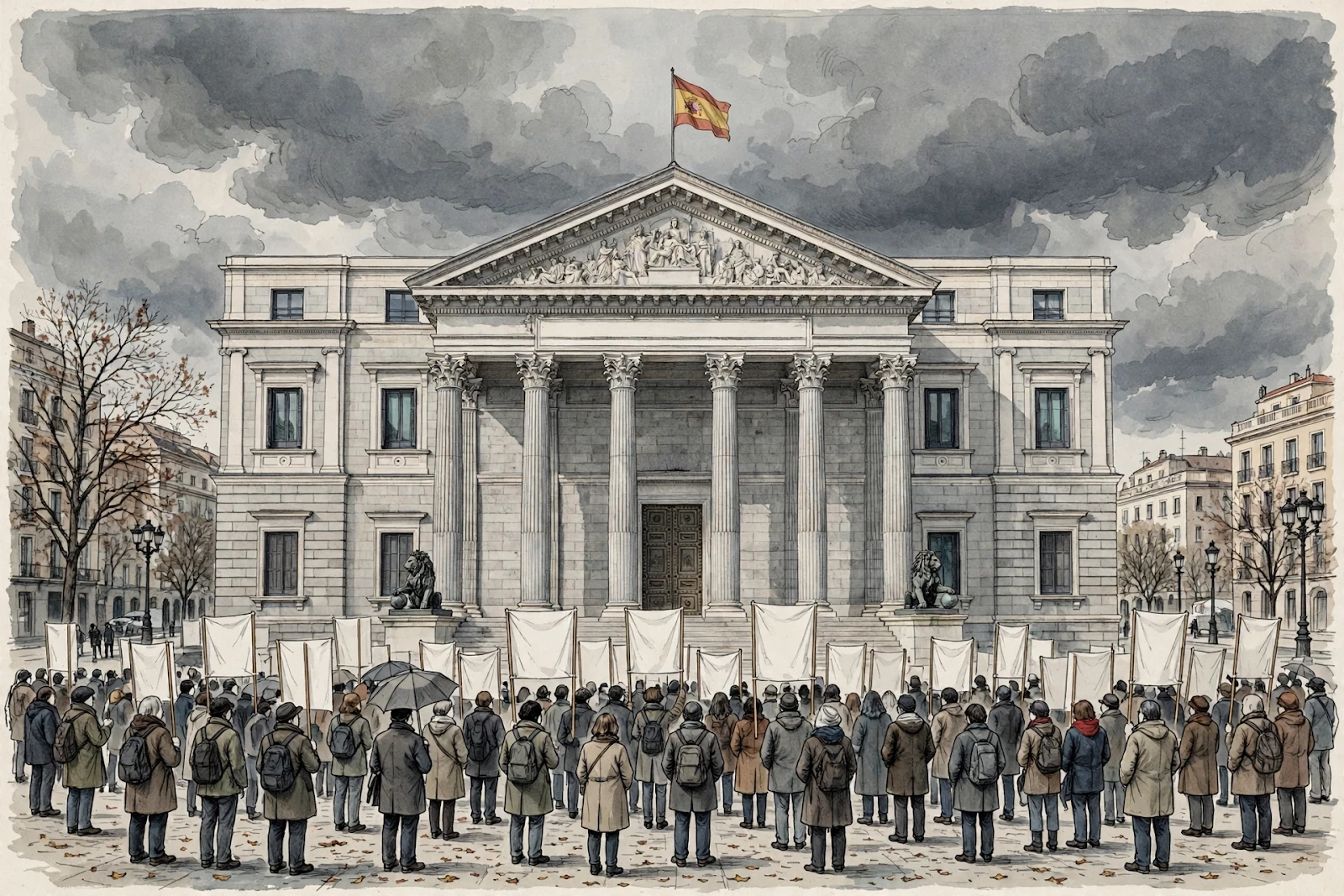
Illustration: The Spanish parliament in Madrid, where a standing committee votes on the government's housing decrees on 12 November 2026. (AI-generated illustration)
The minimum-wage argument will run in parallel. The Labour Ministry's draft decree proposing a 5.3 per cent rise to €1,286 a month remains open for public consultation until 16 November, and the government wants the 2027 minimum wage approved before the 29 November election. The unions, who want 7 per cent, have welcomed the proposal while insisting that the rise must not be offset against existing salary supplements.
Attention will then turn to the campaign itself, which runs from 13 November to the vote on 29 November. Sánchez will try to keep it about housing; the PP and Vox will try to drag it back to corruption, the train crash and the economy. The strike's organisers, for their part, have made clear that 11 November is not the end of the mobilisation: the tenants' unions have built a nationwide network of neighbourhood committees through the Maricarmen protests, and they have promised to keep the pressure on whichever government emerges on 30 November. The official turnout figures, when they are published, will be the first measure of how much pressure that network can actually bring to bear — and whether a day that stopped much of Spain can also move its politics.
For now, the day's balance sheet is mixed. The unions can point to halted factories, cancelled flights and trains, shuttered shops and marches in more than 130 localities. The employers' lobby can point to a smaller fall in electricity demand than in 2012, and to the many workplaces that carried on. But after 11 November, no party in Spain can pretend that housing is a secondary issue.
Sponsored: explore today's featured sponsored offers
FAQ
What was the 11 November general strike in Spain about?
The 24-hour general strike was called over Spain's housing affordability crisis and the cost of living. The unions and tenants' groups demanded rent controls, an end to evictions of vulnerable people, a crackdown on property speculation and tourist flats, automatic lease renewals, a minimum-wage rise of at least 7 per cent in 2027, a shorter working week and stronger public services. Its official slogan was "Salaries. Housing. Prices."
Who called the strike?
The strike was initiated by the tenants' movement, led by the Confederación de Sindicatos de Inquilinas, and jointly backed by Spain's two largest unions, UGT and CCOO, along with smaller unions including the CGT, CNT, Co.Bas, Intersindical and Solidaridad Obrera. It was the first general strike jointly backed by UGT and CCOO since 14 November 2012.
How much disruption did the strike cause?
By 10:00 on Wednesday, Aena reported 234 of 4,529 scheduled flights cancelled (5.2 per cent). Renfe said about 20 per cent of trains were cancelled, Barcelona's metro ran no trains outside peak hours, and Madrid's metro cut service by about 50 per cent for most of the day. The unions claimed 90 per cent participation at ports and in the automotive sector, though those are union estimates. No official nationwide turnout figure had been published at the time of writing.
What triggered the strike?
The immediate trigger was the eviction of 87-year-old Maricarmen Abascal from her Madrid home on 23 September 2026, and her death on 7 October, a day before she was due to sign a contract allowing her to return. The televised eviction set off weeks of protests and encampments, and Congress's rejection of the government's housing decrees on 2 October turned the tenants' campaign into a call for a general strike.
What happens next?
On Thursday 12 November, Congress's standing committee votes on the government's two reissued housing decrees; the broader decree is expected to pass narrowly with PNV support, while the compensation decree is expected to fail. The official election campaign then begins, ahead of the snap general election on 29 November 2026.
Sources
- Reuters — Workers across Spain stage first general strike in 14 years in anger over housing
- Associated Press — Spain's workers hold a general strike over housing costs ahead of a national election
- El Constitucional — Spain experiences a historic day: the 11N general strike for decent housing and wages begins
- El Constitucional — The Congress will vote tomorrow on the housing decrees after the 11N general strike
- Demócrata — The general strike forces the cancellation of 234 flights, 5.2% of the total planned in Spanish airports
- Demócrata — The commission of experts proposes to raise the SMI by 4.9% in 2027, up to 1,281 euros per month
Comments
Post a Comment