
MILAN, ITALY — Ten grassroots organisations from ten countries were honoured in Milan on 3 November 2026 as the newest recipients of the Intercultural Innovation Hub, a programme run by the United Nations Alliance of Civilizations (UNAOC) together with the BMW Group and supported by Accenture. The ceremony, held at the House of BMW in Milan, marked two milestones at once: fifteen years of the Hub and more than 100 grassroots projects brought into the global spotlight since it began.
The 2026 recipients range from a Nigerian theatre project that uses participatory drama to advance gender equality, to a mobile library in Ghana, a mapping project led by people with disabilities in Kyrgyzstan, and an inclusive football programme in Spain. What they share, according to the organisers, is a community-based approach to the same problem: how to build empathy, dialogue and trust across differences in societies that feel increasingly polarised.
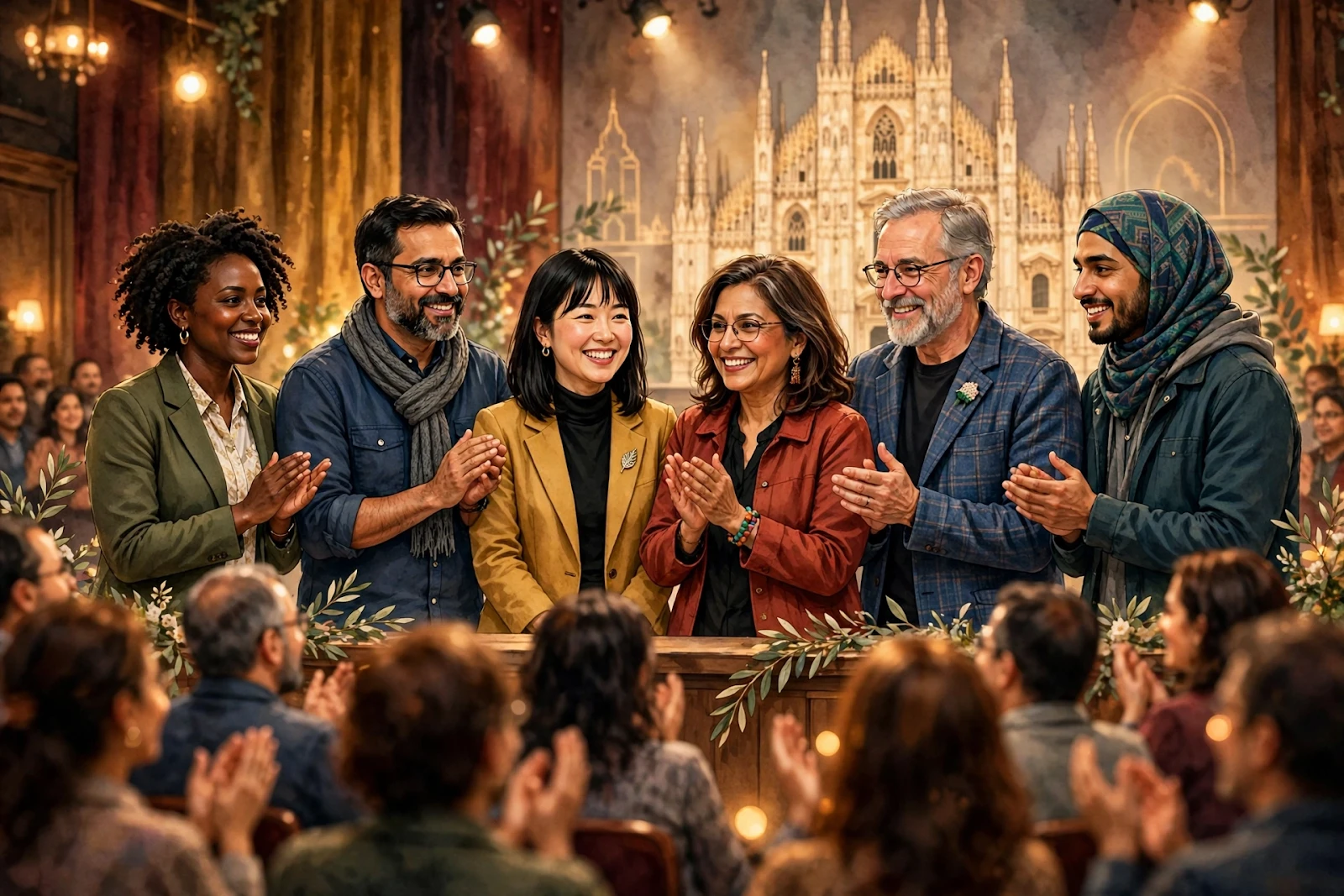
Illustration: Grassroots leaders take the stage at the Intercultural Innovation Hub ceremony at the House of BMW in Milan.
What Happened
The ten initiatives were announced at a ceremony in Milan on 3 November 2026, in the presence of prominent guests, UNAOC said. Each recipient will receive funding together with a comprehensive 12-month capacity-building and mentoring programme, designed to help small, locally rooted projects connect with each other and expand their reach.
The recipients are Fundación Semilla of Chile, for WAYNA, a pedagogical tool for school coexistence; Venezolanos en Barranquilla of Colombia, for a community integration hub for social cohesion, inclusion and economic empowerment; the Foundation for Educational Equity and Development of Ghana, for a mobile literacy and creativity hub called Libraries Without Walls; Organization Earth of Greece, for Sport and Growth; the OASIS Public Charitable Foundation of Kyrgyzstan, for VoiceMap, a project in which people with disabilities map their city; The Girl Child Values Support Initiative of Nigeria, for Interactive Theatre for Gender Equality and Women Empowerment; the Youth Development Foundation of Pakistan, for Inclusive Lens; Asociația Suryam (MureşHub) of Romania, for The Integration Atlas, a multi-stakeholder framework for social cohesion in central Romania; the no-name initiative of South Africa, for nniChat App Dialogues for an Inclusive Society, addressing youth, xenophobia and inclusion; and Fundació Itinerarium of Spain, for VISIBLE-IN Play, inclusive football for diverse societies.
“The initiatives recognized by the Intercultural Innovation Hub show how grassroots initiatives can build mutual understanding, strengthen social cohesion, foster a culture of peace, and transform dialogue into collective action,” said Miguel Ángel Moratinos, United Nations Under-Secretary-General and High Representative for UNAOC, who is also the UN Special Envoy to Combat Islamophobia. He added that in fifteen years the Hub now spans more than 100 organisations across the globe, calling it “a testament to the power of intercultural innovation, the global impact of local action, and the lasting change communities can create when their ideas are given the space and support to grow.”
Alexander Bilgeri, Head of Communications for HR, Production, Purchasing and Sustainability at the BMW Group, said the company was proud of its fifteen-year collaboration with UNAOC. “The recognized organizations are outstanding role models in these polarized times. Through their strength and innovative ideas, they build bridges, strengthen social cohesion and foster trust. Their work gives people hope and shows that together, we can create a better future,” he said.
Background
The Intercultural Innovation Hub is one of UNAOC's flagship programmes, developed in partnership with the BMW Group and implemented with the support of Accenture. UNAOC itself was established in 2005 as the political initiative of former UN Secretary-General Kofi Annan, co-sponsored by the governments of Spain and Türkiye. Its High Representative and Secretariat are based in New York, and its priority areas are education, youth, migration, media and women as peace mediators.
The Hub's premise is deliberately small-scale: rather than funding large institutions, it seeks out grassroots initiatives that are already working in their own communities, using creative and locally adapted methods. Past and present projects use art, culture and sport to drive social change, expand access and opportunity, challenge stereotypes and harmful narratives, and use emerging technologies to promote peace. The programme's support is therefore not only financial; the twelve months of capacity-building and mentoring are meant to turn a promising local idea into something that can be sustained, replicated or adapted elsewhere.
That model matters because the problems these projects address are rarely solved by declarations alone. A school coexistence tool in Chile, a community integration hub for Venezuelan migrants in Colombia, or a dialogue app for young South Africans confronting xenophobia each operate in a specific local context, with specific histories and tensions. The Hub's argument, echoed in both Milan speeches, is that trust is built in those local settings first — and that recognising local work gives it credibility, partners and an audience it would not otherwise reach.
A Closer Look: Theatre, Libraries and Football
Three of the 2026 recipients illustrate how different the Hub's methods can be. In Nigeria, The Girl Child Values Support Initiative was selected for its project “Interactive Theatre for Gender Equality and Women Empowerment.” The participatory theatre initiative uses creative storytelling and community dialogue to advance gender equality and women's empowerment in diverse Nigerian communities, while building intercultural understanding and peaceful coexistence. Theatre, in this model, is not a performance delivered to an audience but a conversation: community members take part, try out different responses to real dilemmas, and carry the discussion back into daily life.

Illustration: A participatory theatre performance brings a Nigerian community together in dialogue about gender equality.
In Ghana, the Foundation for Educational Equity and Development takes a different route to the same goal: Libraries Without Walls, a mobile literacy and creativity hub that reimagines education through creativity, culture and community. Where a fixed library may be out of reach, a mobile hub can meet children and families where they are, turning reading and creative work into a shared, public activity rather than a solitary one.
In Spain, Fundació Itinerarium's VISIBLE-IN Play uses inclusive football to build diverse and inclusive societies. Sport is one of the Hub's recurring tools — Greece's Organization Earth also works through sport — because a team, a pitch and a shared set of rules can create contact between people who might otherwise never meet. The point, in each case, is not the activity itself but the relationships it makes possible.
Other recipients show the Hub's newer directions. Kyrgyzstan's VoiceMap puts people with disabilities at the centre of mapping their own city, turning accessibility from an abstract policy question into concrete, lived knowledge. South Africa's nniChat uses an app to host dialogues for young people on xenophobia and inclusion, while Pakistan's Inclusive Lens and Romania's Integration Atlas work on how communities see — and include — each other. Together, the ten projects span education, migration, disability, gender, youth and sport, a breadth that the organisers present as a strength: intercultural dialogue, they argue, is not one programme but many, adapted to place.
Why It Matters
The Milan ceremony arrives at a moment when its central theme — dialogue across difference — is under strain in many countries. Migration debates, identity politics and online polarisation have made everyday coexistence a contested political question, and grassroots groups often work with little funding and less visibility. An international honour does not resolve those tensions, but it does three practical things: it brings money, it brings mentoring, and it brings a network. For a small theatre group in Nigeria or a mobile library in Ghana, that combination can be the difference between a one-off project and a lasting programme.
There is also a symbolic point that both UNAOC and BMW stressed in Milan. By honouring ten organisations from four continents in a single ceremony, the Hub presents intercultural work as a shared, global practice rather than a problem belonging to any one country. A school in Chile, a migrant hub in Colombia and a football programme in Spain are not tackling the same local issue, but they are, in the Hub's framing, answering the same question: how do people who are different learn to live, learn and play together?

Illustration: People from many cultures in dialogue, with books, a mobile library and inclusive sport in the background.
For UNAOC, the fifteenth anniversary is also a moment of stocktaking. More than 100 projects over fifteen years is a substantial record for a programme of this kind, and the Hub's survival across changing political cycles suggests that its model — small grants, long mentoring, and a global network — has found a durable niche between large UN programmes and purely local charity. Whether the 2026 cohort can scale its work will depend, as ever, less on the ceremony than on the twelve months that follow it.
What Happens Next
Over the coming year, the ten recipients will take part in the Hub's capacity-building and mentoring programme, with support from UNAOC, the BMW Group and Accenture. In practice, that means training, peer learning across the cohort, and help in reaching new partners and funders. The organisers have not published individual grant amounts, and the projects' own timelines will vary: a school tool, a mobile library and a city-mapping project will not grow at the same pace or in the same way.
What to watch, then, is not a single announcement but a pattern. Do the Nigerian theatre performances reach new communities? Does the Ghanaian mobile library add routes or partners? Does VoiceMap's accessibility data change how a Kyrgyz city plans its streets? The Hub's own measure of success, if its fifteen-year history is any guide, will be whether these ten local ideas are still running — and still growing — when the next cohort is honoured.
For now, the Milan ceremony stands as a reminder of a quieter kind of international news: not a summit or a crisis, but ten small organisations, in ten countries, doing the patient work of bringing neighbours into conversation. In a polarised time, the organisers argued, that work deserves a stage.
Sponsored: explore today's featured sponsored offers
FAQ
What is the Intercultural Innovation Hub?
It is a flagship programme of the United Nations Alliance of Civilizations (UNAOC), developed in partnership with the BMW Group and implemented with the support of Accenture. It supports grassroots initiatives that promote intercultural dialogue, social inclusion and peaceful societies.
When and where were the 2026 recipients honoured?
At a ceremony at the House of BMW in Milan, Italy, on 3 November 2026, marking the Hub's fifteenth anniversary and more than 100 projects supported to date.
How many organisations were honoured, and from where?
Ten organisations, from Chile, Colombia, Ghana, Greece, Kyrgyzstan, Nigeria, Pakistan, Romania, South Africa and Spain.
What do the recipients receive?
Funding together with a comprehensive 12-month capacity-building and mentoring programme from UNAOC, the BMW Group and Accenture.
What is Nigeria's winning project?
The Girl Child Values Support Initiative's “Interactive Theatre for Gender Equality and Women Empowerment,” a participatory theatre project that uses storytelling and community dialogue to advance gender equality in Nigerian communities.
Sources
UNAOC / BMW Group announcement, “UNAOC and the BMW Group honour 10 grassroots organizations,” published 4 November 2026, reporting the Milan ceremony of 3 November 2026; The Girl Child Values Support Initiative project page, Intercultural Innovation Hub; UNAOC background on the Alliance, established 2005. All facts above are drawn from these published announcements; quotations are as reported by UNAOC and the BMW Group.
Comments
Post a Comment