
WASHINGTON — Homelessness in the United States fell by its largest margin in more than a decade last year, according to new federal figures announced on 6 November 2026. The U.S. Department of Housing and Urban Development (HUD) said its 2026 nationwide Point-in-Time count found 698,425 people homeless on a single night in January, down 6.3 percent on the year before. HUD described the result as "the largest decrease in homelessness on record in American history."
NPR, reporting on the figures, said the homeless population dropped by more than 6 percent — roughly 49,000 fewer people without housing — and called it the second year in a row that homelessness has declined, after a smaller drop the year before. An independent analysis of the same count, commissioned by the National Alliance to End Homelessness, estimated a similar 6.7 percent decline. Yet nearly 700,000 people still live in shelters or on the streets, significantly more than before the COVID-19 pandemic. The administration credits border enforcement, encampment crackdowns and its move away from "Housing First"; the Alliance credits those programmes, plus softer rents. Both sides agree on the direction; they disagree on the cause — a dispute that will shape billions of dollars of policy.

Illustration: A city skyline at dawn with tents in a park in the foreground. This is an AI-generated illustration, not a photograph of a real encampment.
What Happened
HUD announced the results on Friday, 6 November 2026: the 2026 count found 698,425 people homeless on a single night in January, down 6.3 percent since President Trump took office in 2025. The department tied the result to "historic border control and a Supreme Court victory reaffirming the right of local governments to limit dangerous encampments." HUD Secretary Scott Turner said: "President Trump's actions to secure the border, get criminal illegals off our streets, and restore safety to our communities drove a historic decrease in homelessness." Turner added, however, that "after a decade of failed Housing First policies, homelessness remains near a historic high" and that "there is more work to do."
The independent analysis commissioned by the National Alliance to End Homelessness, authored by Jared Schachner of the University of Southern California's Price School of Public Policy, found a similar decline. Drawing on counts from 261 of 382 Continuums of Care, it estimated a fall of about 6.7 percent (plausible range 8.0 to 5.8 percent) — about 49,000 fewer people, from around 742,000 to around 693,000. Sheltered homelessness fell 7.6 percent; unsheltered homelessness fell 4.9 percent.
Veteran homelessness was down more than 7 percent last year, according to NPR, and nearly 60 percent since 2010; the Alliance analysis put the decline at 7.8 percent. Ann Oliva, chief executive of the National Alliance to End Homelessness, said veteran programmes had been especially effective: "investments in programs like that are much closer to the scale of need for veterans than for any other population experiencing homelessness."
Not every group shared in the improvement. Unlike other groups, there was a small uptick in people who have been homeless for a long time. The Alliance analysis estimated chronic homelessness was roughly flat, rising by about 1.0 percent, with a plausible range that includes no change at all. Oliva said more permanent housing is needed for the chronically homeless, who are more likely to suffer from mental health problems and addiction.
The national improvement also masked sharp local differences. Los Angeles County bucked the trend, recording an estimated 73,040 homeless residents in 2026, a 1.2 percent increase, while the city of Los Angeles saw its homeless population rise 3.4 percent to 45,194, according to the Los Angeles Homeless Services Authority, as reported by the New York Post.
Some caution is warranted: HUD had not yet posted the detailed report behind the numbers, and its official 2026 Annual Homeless Assessment Report, Part 1, has not been released. State-by-state breakdowns are still to come. The Alliance analysis is also preliminary and may change as more Continuums of Care report. It also notes a few communities with very large drops account for much of the decline; using the average of similar communities instead would narrow the estimated decline to about 4.3 percent.
Background
The figures come from the Point-in-Time count, known as the PIT count: a local census of sheltered and unsheltered people experiencing homelessness on a single night in January, required by HUD. Continuums of Care organise the counts, and HUD compiles the results into its Annual Homeless Assessment Report. It is a one-night snapshot, not a census, and can miss people hidden from counters or staying temporarily with friends or family.
The count had been moving in the wrong direction for years. According to HUD figures reported at the time, the January 2024 count of 771,480 was the highest since HUD standardised its counting method in 2007; the following count showed a roughly 3 percent decline. HUD says homelessness rose 28 percent from 2022 to 2025 under the Biden administration's Housing First mandate, amid pandemic disruption, rising rents and an influx of asylum seekers into shelters.
Housing First has been the federal government's longstanding approach for more than a decade. It puts people into permanent housing first, then offers voluntary treatment, without making housing conditional on sobriety or treatment. The Trump administration argues the policy failed and is to blame for the pandemic-era spike in homelessness. Announcing a funding overhaul in June 2026, Secretary Turner said: "The 'housing first' experiment failed Americans by warehousing the vulnerable without results." He added that billions of taxpayer dollars had been spent while homelessness rose to record levels.
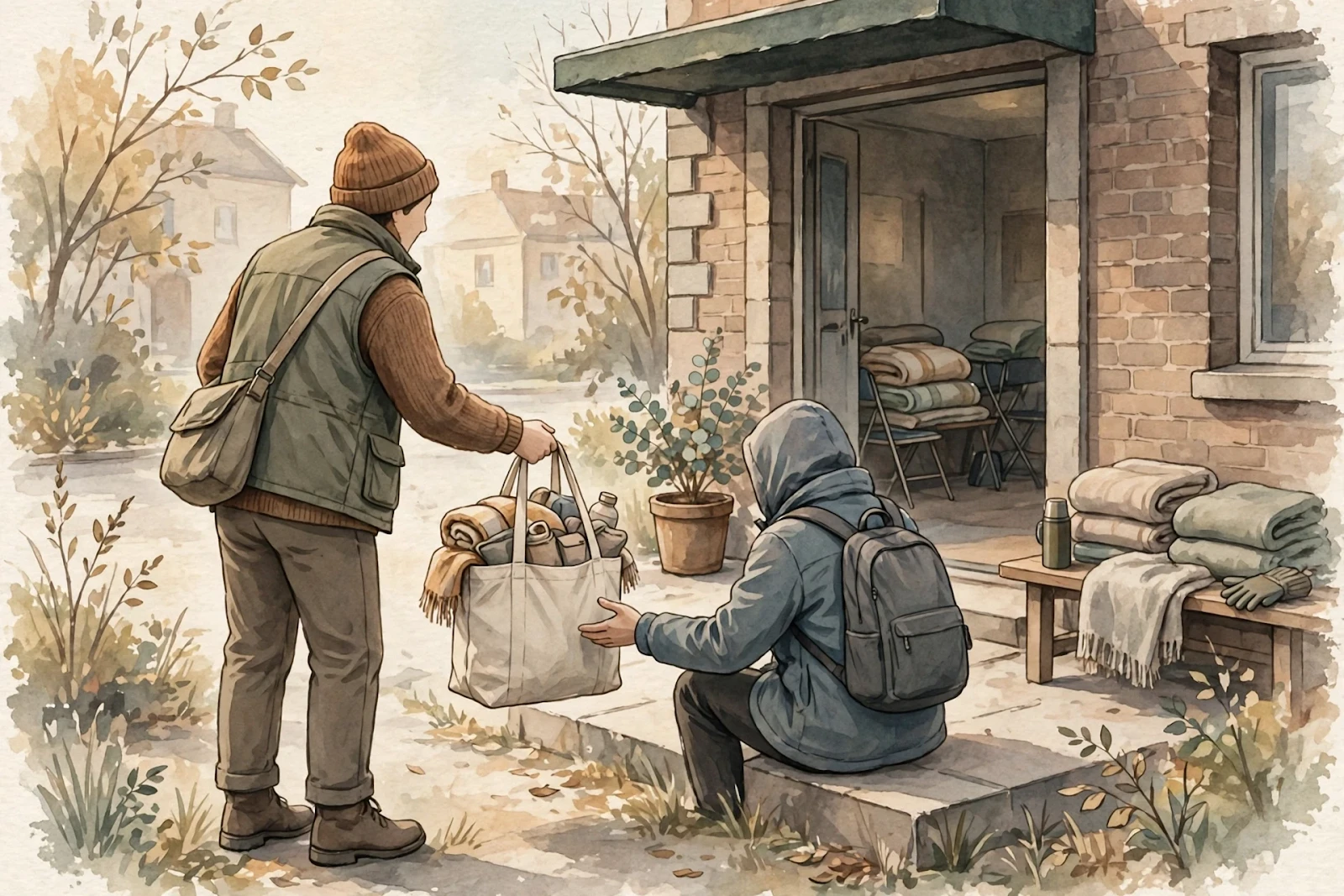
Illustration: An outreach worker hands a bag of supplies to a person outside a shelter. This is an AI-generated illustration, not a photograph of a real person.
The administration's alternative is "Treatment First": short-term housing with mandated addiction and mental-health treatment, emphasising recovery before permanent housing. In July 2025, President Trump signed an executive order titled "Ending Crime and Disorder on America's Streets," empowering HUD to tackle substance abuse as part of addressing homelessness. In June 2026, HUD announced a $4.04 billion Continuum of Care funding competition — the most competitive in the programme's history, it said — with $1.3 billion for new projects prioritising transitional housing and supportive services. It drew a record-setting 3,700 new applications.
In August 2026, the drug-policy, health and housing agencies jointly launched a "Best Practices Toolkit: Addressing Homelessness and Addiction through Treatment First," presented as the first resource of its kind. "Housing is essential, but housing alone is not enough," Secretary Turner said at the launch in San Diego.
HUD also credited a crackdown on homeless encampments after the Supreme Court ruled in 2024 that cities can ban people from sleeping and camping in public places. The administration says the ruling, with the July 2025 executive order, gave local governments legal backing to clear encampments it describes as dangerous. Critics, including the Alliance, argue clearing encampments without offering stable housing simply moves people elsewhere and makes outreach harder.
Why It Matters
The dispute over why homelessness fell matters because the answer will decide how the United States spends several billion dollars a year on the problem. If the administration is right, its shift toward Treatment First looks vindicated. If the Alliance is right, dismantling Housing First risks reversing the gains. The two readings point in opposite directions, and both cannot be fully true.
The administration's case rests heavily on immigration and on a handful of large cities. During the Biden administration, New York, Chicago, Boston and Denver all saw a surge in asylum seekers who turned up at homeless shelters. "That's also the four cities that have driven half of the drop most recently," said Devon Kurtz, public safety policy director at the Cicero Institute, an administration ally on homelessness policy, in an interview with NPR. HUD's release said homelessness had increased largely in states with sanctuary-city policies such as New York, Illinois, California and Massachusetts. Kurtz also pointed to San Francisco, which is moving toward more sober-living options — housing that bans drugs and alcohol. The administration says drug-free requirements aid recovery; critics say they can push people back to the street if they relapse, which is common.
The National Alliance to End Homelessness tells a different story about the same numbers. Its chief executive, Ann Oliva, said: "It's good news that more people are getting housed, and that the programs that are funded by Congress are working." Oliva said Housing First programmes — those that get people off the street without preconditions — "were a big part of the latest declines, especially among veterans." She also called the decline broad and likely due to several factors, including rents that have softened from pandemic peaks, which could stem the flow of newly unhoused people. Declines also came in disaster-hit areas such as western North Carolina and Hawaii, where relief for displaced people also reached people already unhoused.

Illustration: A house key beside a bar chart with declining bars, symbolising the fall in US homelessness. This is a conceptual AI-generated illustration.
On encampments, the Alliance's analysis directly challenges the administration: Oliva said cities with encampment bans "actually did worse than the national average." That finding, if confirmed by HUD's detailed report, would undercut a central administration claim. The Alliance analysis is preliminary and based on partial data, but both analyses agree on the headline fact: homelessness fell by the most in years. Even so, the scale of what remains is stark: 698,425 people were homeless on a single night in January, and Los Angeles shows national progress can coexist with deepening local crises. One national percentage can hide as much as it reveals.
What Happens Next
The first thing to watch is the detailed data. HUD has yet to publish the full report behind its headline numbers, and the state-by-state breakdowns that follow should show which states and cities drove the decline — and whether the four cities cited really account for half of it, as Devon Kurtz claimed, or whether the improvement was as broad as the Alliance suggests. They will also test the Alliance's finding on encampment-ban cities, and show whether veteran gains were widespread or concentrated.
The second is the courts. The administration wants to shift several billion dollars of homelessness spending toward short-term housing with mandated addiction and mental-health treatment. So far, that effort has been blocked by courts, according to NPR. How judges rule will determine whether Treatment First becomes the new national standard or remains an aspiration. The $4.04 billion funding competition announced in June drew a record 3,700 applications, suggesting local providers are already adapting, whatever the courts decide.
The third is the next count itself. The January 2027 count will show whether the decline continues for a third year or proves a one-off. Winter is the hardest season for people sleeping rough. If rents keep softening and veteran programmes keep funding, the decline could deepen; if chronic homelessness grows, or cities such as Los Angeles keep moving the other way, it could stall. For now, the United States has its best homelessness numbers in more than a decade — and a fierce argument about what to do with them.
Sponsored: explore today's featured sponsored offers
FAQ
How many people are homeless in the United States now?
HUD's 2026 Point-in-Time count found 698,425 people homeless on a single night in January 2026, down 6.3 percent — the largest decrease on record, HUD says. NPR reported the drop as roughly 49,000 fewer people without housing. Even so, nearly 700,000 people still live in shelters or on the streets — significantly more than before COVID-19.
How is homelessness counted in the US?
Through the annual Point-in-Time count: local Continuums of Care count sheltered and unsheltered people on a single night each January, and HUD compiles the results into its Annual Homeless Assessment Report. It is a one-night snapshot, not a census, and can miss people hidden from counters or staying temporarily with friends or family.
Why did homelessness fall?
The cause is disputed. The administration credits border enforcement, an encampment crackdown after a 2024 Supreme Court ruling, and its move away from Housing First. The National Alliance to End Homelessness credits Housing First programmes funded by Congress, especially for veterans, and softening rental markets. Its chief executive, Ann Oliva, said the decline was broad and likely due to several factors. Both analyses agree the decline itself is real.
Did homelessness fall everywhere in the US?
No. Los Angeles County bucked the national trend, with an estimated 73,040 homeless residents in 2026, up 1.2 percent, and the city of Los Angeles up 3.4 percent to 45,194, according to the Los Angeles Homeless Services Authority. Chronic homelessness also ticked up slightly nationwide. State-by-state breakdowns from HUD are still to come.
What happens to homelessness policy now?
The administration wants to shift several billion dollars of homelessness spending toward short-term housing with mandated addiction and mental-health treatment, but courts have so far blocked the overhaul. It has launched a $4.04 billion funding competition favouring transitional housing and recovery services, plus a "Treatment First" toolkit with the health and drug-policy agencies. HUD's detailed report on the 2026 count is still pending.
Sources
- U.S. Department of Housing and Urban Development, "HUD Announces Largest Decrease in Homelessness," 6 November 2026 — https://www.hud.gov/news/hud-no-26-090
- NPR (Jennifer Ludden), "Homelessness in the U.S. saw its largest drop in more than a decade last year," 7 November 2026 (via Kansas Public Radio) — https://kansaspublicradio.org/npr-news/2026-11-07/homelessness-in-the-u-s-saw-its-largest-drop-in-more-than-a-decade-last-year
- National Alliance to End Homelessness, "Preliminary 2026 [Point-in-Time Analysis]," by Jared Schachner, USC Price School of Public Policy — https://endhomelessness.org/wp-content/uploads/2026/11/PIT-Analysis-Main_V3.pdf
- New York Post, "Trump administration touts historic drop in homelessness as HUD scraps Biden-era policies," 6 November 2026 — https://nypost.com/2026/11/06/us-news/trump-administration-touts-historic-drop-in-homelessness-as-hud-scraps-biden-era-policies/
- U.S. Department of Housing and Urban Development, "HUD Overhauls Federal Homelessness Assistance," 1 June 2026 — https://www.hud.gov/news/hud-no-26-038
- White House Office of National Drug Control Policy, U.S. Department of Health and Human Services and U.S. Department of Housing and Urban Development, "ONDCP, HHS, and HUD Launch First-Ever 'Treatment First' Toolkit to Combat Homelessness and Addiction," August 2026 — https://www.hud.gov/news/hud-no-26-059
Comments
Post a Comment