
WASHINGTON — The United States is tying its renewed peace diplomacy in Myanmar to a strategic prize: access to the country's rare-earth minerals, according to a recently published State Department strategy document reported by Reuters on 2 November 2026. The document sets out a goal of working toward a ceasefire that opens a pathway to a lasting peace agreement by 2030, while also creating openings for American companies in a country whose mineral exports currently flow mostly to China.
The strategy marks a sharp departure from years of US policy aimed at isolating Myanmar's military, which seized power in a 2021 coup and now runs what Reuters describes as a nominally civilian government led by the former general behind that coup. The civil war that followed the takeover has, according to United Nations estimates cited by Reuters, killed 100,000 people and displaced more than 3.5 million.
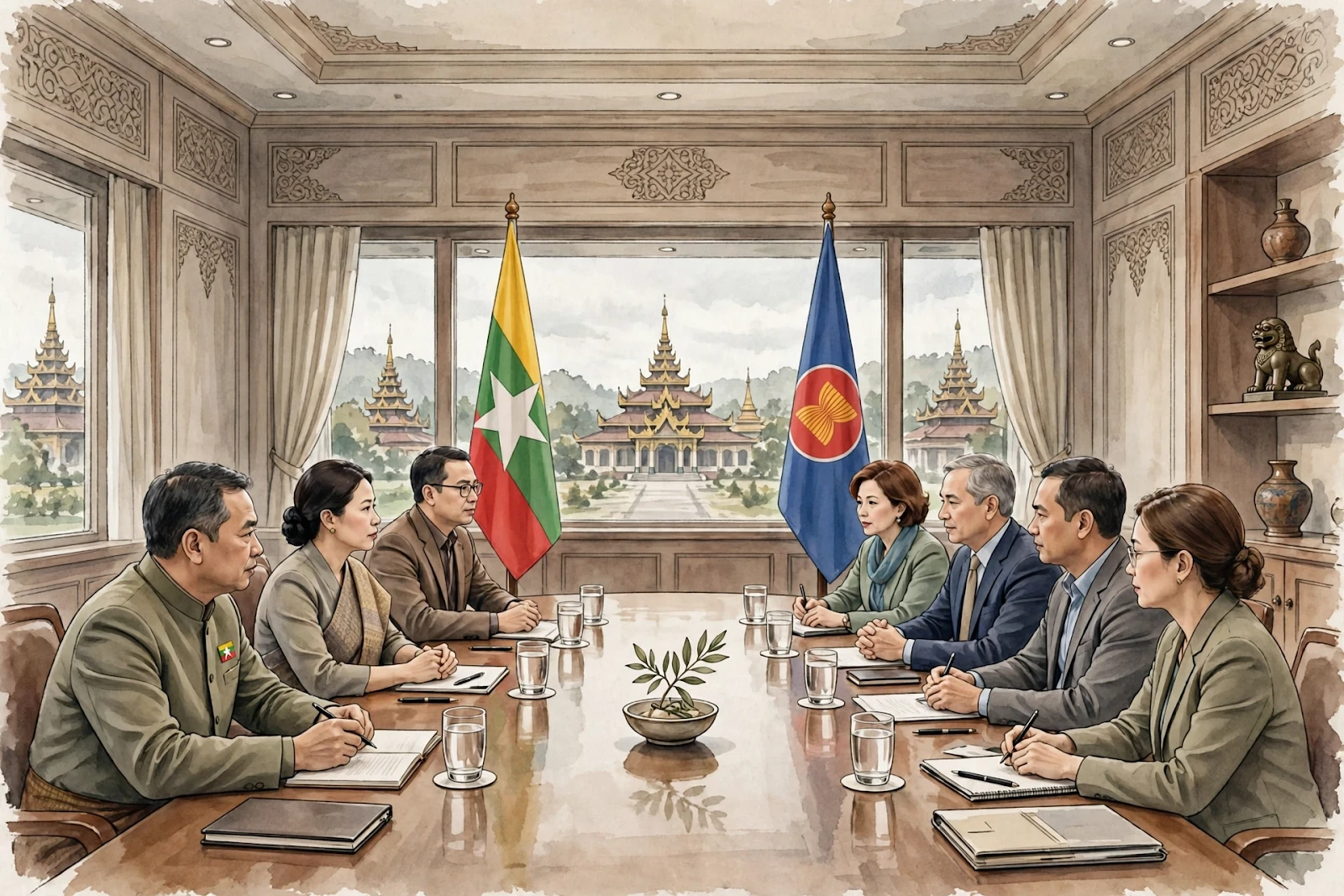
Illustration: Diplomats seated at a long table in a meeting room in Myanmar discussing peace. This is an illustration, not a photograph of a real event.
What Happened
Reuters reported that the United States has quietly held talks with Myanmar's government, with the re-engagement involving the State Department's top intelligence official, Michael Vance. Those talks have included discussions of how to gain access to rare-earth minerals mainly located in conflict-affected areas and currently exported to China, according to the report.
The integrated country strategy for the US mission in Myanmar — a country the document also refers to by its former name, Burma — was approved on 31 August but was posted on the State Department's website more recently, Reuters said. The State Department did not respond to a request for comment on the document, according to the report.
The strategy is unusually explicit about the commercial logic behind the diplomacy. It says the US mission will facilitate "at least three multistakeholder forums that produce concrete agreements or policy proposals advancing fiscal federalism and territorial demarcation in Burma, which will create opportunities to access Burma's bountiful rare earth resources and combat scam centers." Fiscal federalism, in this context, refers to how revenue and spending powers are shared between a central government and regions — a central question in a country where ethnic armed groups have fought for decades seeking autonomy.
On the commercial side, the strategy says the embassy aims to secure "at least three major commercial or investment deals valued above $5 million each" for US companies, and to work to increase US exports to reduce Washington's trade deficit with Myanmar. It also prioritises law-enforcement cooperation against online scam centres that target Americans, and expanded cooperation with authorities to repatriate Myanmar nationals from the United States.
Background
Myanmar's conflict began with the military's seizure of power in February 2021, which ended a decade of tentative democratic opening and triggered mass protests, a crackdown, and then armed resistance. Pro-democracy groups and ethnic insurgent organisations — some of which have fought the central state for decades — now control significant territory, while the military-backed government holds the major cities and the administrative capital, Naypyitaw.
For years, Washington's approach was isolation: sanctions on the coup leader-turned-president, Min Aung Hlaing, on other military-backed government figures, and on businesses connected to them. Those financial sanctions remain in place, Reuters noted, even as the Trump administration has removed several Myanmar nationals and companies from its sanctions list. The strategy document does not spell out whether the United States intends to lift sanctions or address other compliance concerns that deter investment in Myanmar — a gap that matters, because sanctions and conflict risk are precisely what have kept most Western companies out.
Rare earths — a group of minerals essential for electric vehicles, wind turbines, smartphones and defence equipment — give the story its strategic weight. Myanmar is a significant source of these minerals, and its output has largely been exported to China, which dominates global rare-earth processing. For Washington, which has spent years trying to diversify critical-mineral supply chains away from China, a foothold in Myanmar would be commercially and geopolitically valuable. For Myanmar's warring parties, control of mining areas and the revenue they generate is itself a driver of the conflict, which is why linking peace talks to mineral access is both promising and fraught.
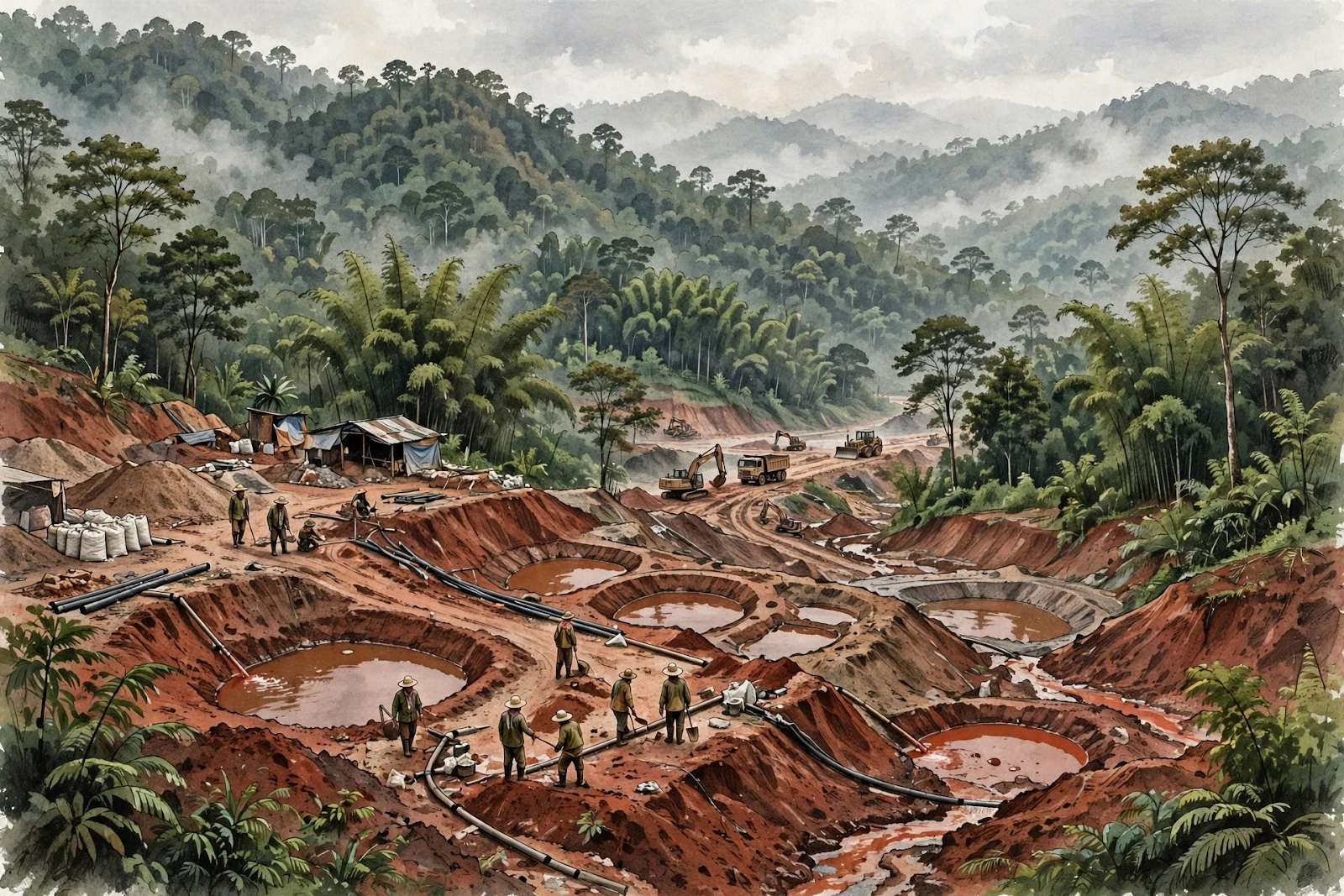
Illustration: A rare-earth mining landscape in northern Myanmar, with reddish earth and distant machinery. This is an illustration, not a photograph of a real mining site.
Why It Matters
First, the document makes the bargain explicit in a way strategy papers rarely do. Peace diplomacy is often presented in purely humanitarian terms; here, Washington is openly connecting a ceasefire process to commercial access. That candour may help the administration make its case at home — that engagement delivers tangible returns — but it also risks fuelling suspicion among Myanmar's armed groups and civil society that the peace process is a vehicle for resource extraction rather than a settlement of their political grievances.
Second, the plan tests whether economic incentives can move a conflict that sanctions and isolation did not end. The forums the strategy proposes — bringing together the military-backed government, armed groups and other stakeholders to agree on fiscal federalism and territorial demarcation — touch the core political questions of the war: who governs what, and who keeps the revenue. If those forums produce concrete proposals, they could become a scaffolding for a wider settlement. If they are seen as a cover for mining deals, they could deepen mistrust.
Third, the strategy sits inside a wider contest over critical minerals. China currently buys most of Myanmar's rare-earth output, and any shift in that flow would have implications far beyond Myanmar's borders. At the same time, the United States is not the only actor courting Naypyitaw: regional neighbours and other powers have maintained their own channels to the military-backed government throughout the war. Washington's re-engagement is therefore also a bid not to be left out of whatever political order eventually emerges.
Finally, the humanitarian stakes remain enormous. With more than 3.5 million people displaced, according to UN estimates cited by Reuters, any credible path to a ceasefire matters regardless of its commercial subtext. The question is whether a strategy that pairs peace with profit can deliver relief for civilians, or whether the profit motive distorts the peace itself.
What Happens Next
The immediate test is whether the promised forums materialise and who sits at them. A multistakeholder process that includes pro-democracy groups and ethnic armed organisations — not just the military-backed government and business interests — would signal a genuine peace effort. A narrower process would suggest the commercial track is leading.
Watch also for any move on sanctions. The document's silence on lifting sanctions leaves a key question open: American companies are unlikely to commit major investment in conflict zones while sanctions and compliance risks remain, so the $5 million-plus deals the strategy targets may depend on future sanctions decisions that have not yet been announced.
Regional reactions will matter too. Neighbours that have managed the Myanmar crisis through ASEAN channels — including the bloc's envoy diplomacy — will be watching whether the US track complements or competes with their efforts. And in Washington, the strategy's unusual frankness about rare earths is likely to draw scrutiny from lawmakers and human-rights advocates who have long argued that engagement with Myanmar's military should be conditioned on political progress, not commercial opportunity.
For now, the document sets a horizon rather than a deadline for peace itself: a ceasefire that "presents a pathway to a lasting peace agreement by 2030." Whether that pathway is built on shared governance and revenue — or on mining deals struck while the war continues — is the question the next rounds of talks will answer.

Illustration: A peaceful Myanmar village at dawn, with pagoda rooftops and farmers. This is an illustration, not a photograph of a real place.
Sponsored: explore today's featured sponsored offers
FAQ
What does the US strategy for Myanmar actually say?
According to Reuters, the State Department strategy says the US mission will work toward a ceasefire that presents a pathway to a lasting peace agreement by 2030, facilitate at least three multistakeholder forums on fiscal federalism and territorial demarcation, and seek at least three major commercial or investment deals above $5 million each for US companies.
Why are rare earths so important in Myanmar?
Rare earths are minerals essential for electric vehicles, wind turbines, electronics and defence equipment. Myanmar is a significant source, and its output is currently exported mostly to China, which dominates global processing — making access strategically valuable for the United States.
Has the US lifted sanctions on Myanmar?
No. Reuters reports that the United States maintains financial sanctions on Min Aung Hlaing, others in the military-backed government and connected businesses, although the Trump administration has removed several Myanmar nationals and companies from its sanctions list. The strategy document does not say whether further sanctions relief is planned.
Who is involved in the US re-engagement with Myanmar?
Reuters reports that US officials have quietly held talks with Myanmar's nominally civilian government, with the re-engagement involving the State Department's top intelligence official, Michael Vance. The talks have included discussions of rare-earth access.
How bad is Myanmar's civil war?
According to United Nations estimates cited by Reuters, the civil war triggered by the 2021 coup has killed 100,000 people and displaced more than 3.5 million.
Sources
- Reuters, "US strategy links Myanmar peace talks to rare-earth access," 2 November 2026 — https://www.reuters.com/world/asia-pacific/us-strategy-links-myanmar-peace-talks-rare-earth-access-2026-11-02/
- US Department of State integrated country strategy for the US mission in Myanmar, as reported by Reuters (approved 31 August 2026, posted more recently)
- United Nations estimates on deaths and displacement in Myanmar's civil war, as cited by Reuters
Comments
Post a Comment