
LYON, France — A single dose of the chikungunya vaccine IXCHIQ still protects nearly all recipients five years after vaccination, French vaccine maker Valneva SE announced on Tuesday, November 10, 2026, in new long-term data that strengthen the case for the world’s first licensed chikungunya vaccine as outbreaks of the mosquito-borne disease continue to spread across the Americas, Asia and Africa.
According to the company, 94 percent of the 221 healthy adults who could be evaluated at the five-year mark still maintained a seroresponse — meaning their blood carried neutralizing antibody levels well above the threshold agreed with regulators — five years after receiving just one shot of IXCHIQ.

Illustration: A scientist examines a vial of the chikungunya vaccine in a laboratory, representing the long-term antibody research behind IXCHIQ.
What Happened
Valneva released the five-year antibody persistence results on November 10, 2026, through a press release distributed by GlobeNewswire and published on the company’s website. The data come from trial VLA1553-303, a long-term follow-up study of adults who received a single dose of IXCHIQ, the company’s live-attenuated chikungunya vaccine. The trial received funding support from the Coalition for Epidemic Preparedness Innovations (CEPI) and the European Union’s Horizon Europe programme, and participants will continue to be followed for up to ten years after vaccination.
The headline finding is straightforward: among the 221 healthy adults who were evaluable at Year 5, 94 percent maintained neutralizing antibody titers well above the seroresponse threshold five years after the single-dose vaccination. That threshold — a neutralizing antibody titer of at least 150, measured by a test known as µPRNT50 — is the level agreed with regulators under the accelerated approval pathway.
Just as important as the overall figure is who it covers. Antibody persistence in older adults aged 65 years and above was comparable to that observed in younger adults aged 18 to 64 years, with similar geometric mean titers — the average antibody levels across the group — and similar seroresponse rates. That matters because older adults face a higher risk of severe disease, and vaccines do not always work as durably in older immune systems.
The five-year result fits a steady pattern rather than standing alone. Valneva previously reported positive antibody persistence at 12 months, at 24 months in a study published in the Journal of Travel Medicine in 2024, at three years, and at four years, when 95 percent of participants still showed a seroresponse. The step from 95 percent at four years to 94 percent at five years points to a plateau rather than a decline.
Hanneke Schuitemaker, Valneva’s chief scientific officer, said the results reinforce the vaccine’s value for a disease whose outbreaks are hard to predict. “These five-year data further reinforce IXCHIQ’s unique value proposition,” she said in the company’s statement. “For diseases such as chikungunya, where outbreaks are difficult to predict, durable immune persistence following a single dose represents a significant public health advantage. This is particularly important not only for travelers, but also for populations living in endemic regions, many of which are in low- and middle-income countries where access to healthcare and vaccination may be more limited.”
Valneva also pointed to real-world evidence now being gathered in Brazil. Between February and October 2026, a Pilot Vaccination Strategy carried out by the Brazilian Ministry of Health and Instituto Butantan, with support from Valneva, vaccinated nearly 80,000 adults aged 18 to 59 years — the first large-scale public vaccination campaign using IXCHIQ. Post-marketing studies will now assess its effectiveness and safety in everyday use.
Background
Chikungunya is a viral disease spread by the bites of infected Aedes mosquitoes, principally Aedes aegypti and Aedes albopictus, the same mosquitoes that transmit dengue and Zika. The illness typically begins with a sudden fever, severe joint pain, headache, muscle pain, nausea, fatigue and a rash. The joint pain is often debilitating and can persist for weeks, months or even years.
There is no specific antiviral treatment for chikungunya. Care is supportive: rest, fluids and medicines such as paracetamol to reduce fever and pain. That absence of a cure is one reason prevention — through mosquito control and, where available, vaccination — carries so much weight in public health planning.
Since the virus re-emerged in 2004, it has spread quickly around the world and has now been identified in more than 110 countries in Asia, Africa, Europe and the Americas, according to the World Health Organization (WHO). Between 2013 and 2023, more than 3.7 million cases were reported in the Americas alone, according to data from the Pan American Health Organization (PAHO) cited by Valneva. A 2024–2025 resurgence produced more than 1.6 million suspected cases globally, according to a 2026 review in Frontiers in Immunology. The WHO assessed the global public health risk of chikungunya transmission as moderate in its rapid risk assessment in May 2026, and the agency has highlighted the disease as a major public health problem. The burden is expected to grow as climate change allows the mosquitoes that carry the virus to spread into new regions.
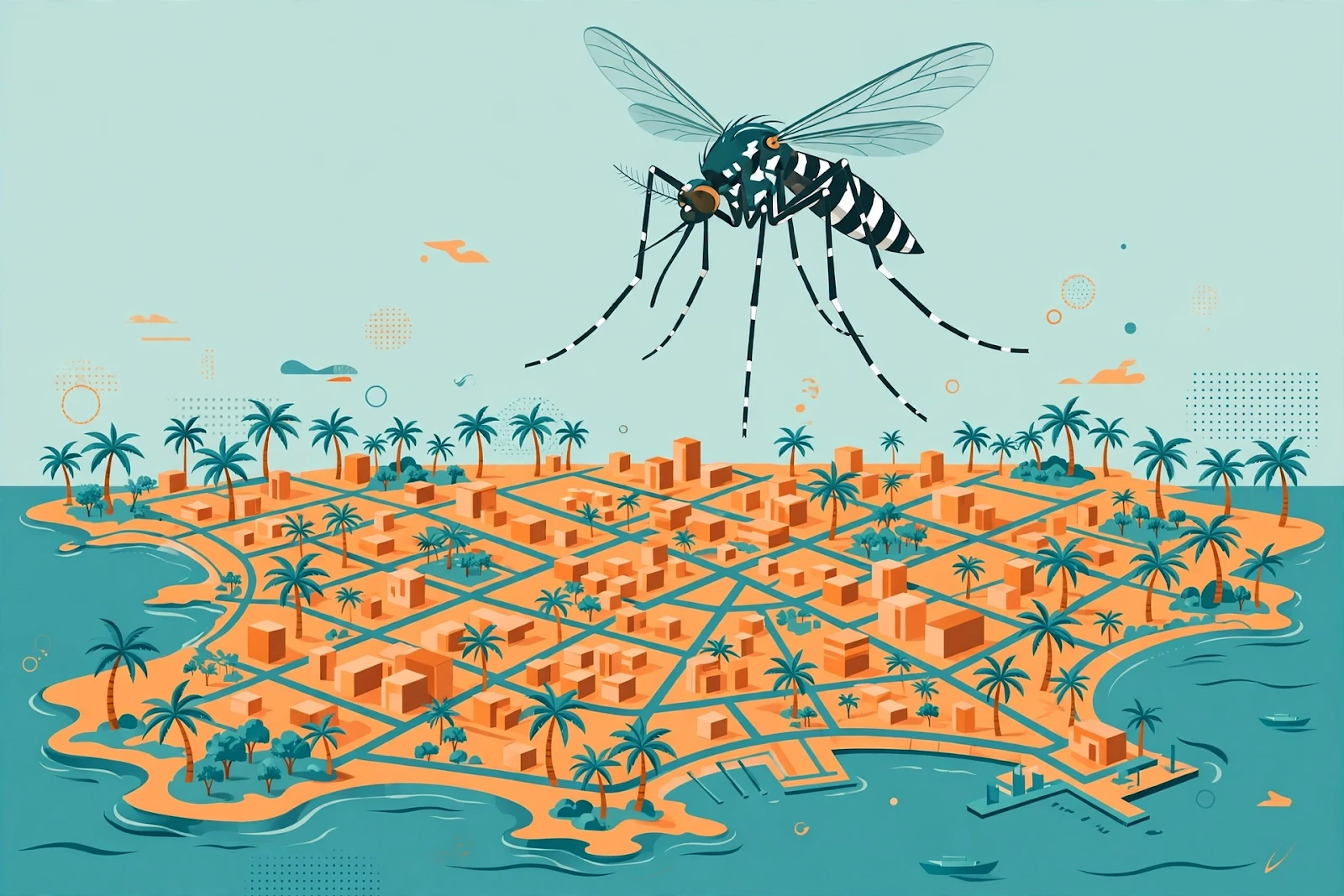
Illustration: An Aedes mosquito above a stylized tropical city, representing how chikungunya spreads through urban mosquito populations.
IXCHIQ was developed by Valneva as a single-dose, live-attenuated vaccine — a weakened form of the chikungunya virus designed to train the immune system without causing the disease. The United States Food and Drug Administration (FDA) approved it on November 9, 2023, under the accelerated approval pathway, making it the world’s first licensed chikungunya vaccine. It was later authorized in the European Union in June 2024. A second chikungunya vaccine, Bavarian Nordic’s virus-like particle vaccine VIMKUNYA, received FDA approval in February 2025, according to the Frontiers in Immunology review.
Readers should also be aware of an important part of IXCHIQ’s regulatory history. On August 22, 2025, the FDA suspended the vaccine’s biologics license in the United States after reports of serious chikungunya-like illness in some recipients, and in January 2026 Valneva voluntarily withdrew its U.S. biologics license application, according to Drugs.com’s approval history for the vaccine. In June 2026, the European Medicines Agency recommended restricting the vaccine’s use to people at high risk of infection. The new durability data do not change that regulatory picture; they answer a different question — how long the immune response lasts — and the vaccine continues to be used in other settings, including the Brazilian public campaign described above.
One clarification for regular readers of this blog: this article is not the same story as our October 26, 2026 report, “PAHO Warns the Caribbean to Prepare as Dengue and Chikungunya Rise Across the Americas.” That article, published as post #338, covered a PAHO warning about rising case numbers and the need for Caribbean health systems to prepare. This article reports different news: five-year vaccine durability data released by Valneva on November 10, 2026. The two stories share a disease, but they describe different events, different sources and different dates.
Why It Matters
The central promise of a single-dose vaccine is simplicity: one visit, one injection, and — if the protection lasts — years of cover without the need to track people down for a booster. That promise only holds if the immune response endures. The new data suggest that for IXCHIQ, it does.
The result is especially relevant where chikungunya hits hardest. Outbreaks are difficult to predict: a virus can circulate quietly for years and then surge when conditions change. A vaccine that must be given shortly before an outbreak is far less useful than one that can be given in advance and trusted to still be working when the outbreak arrives. That makes durable single-dose protection valuable both for travelers and for residents of endemic areas, many of them in low- and middle-income countries where returning for repeat doses is difficult.
The age finding adds to that case. Older adults face a higher risk of severe disease, and immune responses in older people are often weaker and shorter-lived. The trial found that participants aged 65 and over maintained antibody levels comparable to those of adults aged 18 to 64, with similar average titers and seroresponse rates. That is a reassuring signal for vaccination programmes aimed at protecting the most vulnerable age groups, even though the numbers involved are modest and the findings come from a company-sponsored trial rather than an independent study.
What Happens Next
The trial is not over. Under the study protocol, participants in VLA1553-303 will continue to be followed for up to ten years after vaccination, so further durability data will show whether the 94 percent figure holds or drifts downward, and whether a booster is ever needed.
The more immediate test will come from Brazil. The Pilot Vaccination Strategy that ran from February to October 2026 vaccinated nearly 80,000 adults aged 18 to 59 in what Valneva described as the first large-scale public vaccination campaign using IXCHIQ. Post-marketing studies built on that campaign are expected to generate effectiveness and safety data from a real population rather than a trial cohort. Those studies will be watched closely by health authorities in other countries in the Americas weighing whether to introduce the vaccine.

Illustration: A health worker vaccinates an adult in a clinic in Brazil, where nearly 80,000 people received IXCHIQ in a 2026 pilot campaign.
Regulators, meanwhile, will continue to weigh the vaccine’s benefits against its risks. The U.S. license suspension and withdrawal in 2025 and 2026, and the European recommendation to limit use to people at high risk of infection, mean IXCHIQ’s future will depend as much on safety monitoring as on durability data. People in affected regions should continue to follow local health guidance, including mosquito-bite prevention.
For now, the message of November 10, 2026 is a narrow but significant one: a single shot of IXCHIQ, given five years ago, still leaves most recipients with antibody levels well above the level regulators consider protective.
Sponsored: explore today's featured sponsored offers
FAQ
What did Valneva announce on November 10, 2026?
Valneva announced five-year antibody persistence data for its single-dose chikungunya vaccine IXCHIQ. Among 221 healthy adults who could be evaluated five years after vaccination, 94 percent still maintained a seroresponse, meaning their neutralizing antibody levels remained well above the threshold agreed with regulators. The company said the results matched earlier data at 12 months, 24 months, three years and four years.
How is this different from the blog’s earlier chikungunya article?
This blog’s post #338, published on October 26, 2026, reported a warning from the Pan American Health Organization that Caribbean countries should prepare as dengue and chikungunya cases rose across the Americas. That was an outbreak warning based on case numbers. This article reports a different event: five-year vaccine durability data released by Valneva on November 10, 2026.
Does a 94 percent seroresponse rate mean the vaccine protects 94 percent of people?
Not exactly. Seroresponse measures the proportion of trial participants whose blood still contained neutralizing antibodies above a set threshold — in this case a titer of at least 150 measured by the µPRNT50 test — five years after one dose. Antibody levels are a surrogate measure regulators accepted as likely to predict protection, but the study did not directly measure how many vaccinated people avoided illness. The figure is strong evidence of durable immune response, not a direct measure of real-world effectiveness.
Who can receive IXCHIQ, and where is it available?
IXCHIQ was first approved by the U.S. FDA on November 9, 2023, for adults aged 18 years and older at increased risk of exposure to chikungunya virus, and was later authorized in the European Union in June 2024. However, the FDA suspended the vaccine’s U.S. license in August 2025, and Valneva voluntarily withdrew its U.S. application in January 2026. In June 2026 the European Medicines Agency recommended restricting its use to people at high risk of infection. Availability varies by country; anyone considering vaccination should consult a healthcare professional.
What is chikungunya, and is there a treatment?
Chikungunya is a mosquito-borne viral disease spread by infected Aedes mosquitoes. It causes sudden fever and severe joint pain that can be debilitating and may persist for weeks, months or even years, along with headache, muscle pain, nausea, fatigue and rash. There is no specific antiviral treatment; care focuses on rest, fluids and medicines to relieve fever and pain. The virus has been identified in more than 110 countries. Prevention through mosquito-bite protection and, where available and recommended, vaccination remains the main defence.
Disclaimer: This article is general information about a news event and is not medical advice. Decisions about vaccination should be made with a qualified healthcare professional.
Sources
- Valneva SE, “Valneva Reports Sustained 94% Seroresponse Five Years After a Single Dose of Chikungunya Vaccine IXCHIQ,” press release, November 10, 2026. valneva.com
- GlobeNewswire via Morningstar, “Valneva Reports Sustained 94% Seroresponse Five Years After a Single Dose of Chikungunya Vaccine IXCHIQ,” November 10, 2026, 06:00 GMT. morningstar.com
- U.S. Food and Drug Administration, “FDA Approves First Vaccine to Prevent Disease Caused by Chikungunya Virus,” November 9, 2023. fda.gov
- Drugs.com, “Ixchiq (chikungunya vaccine, live) FDA Approval History,” last updated August 26, 2025 (license suspension August 22, 2025; voluntary BLA withdrawal January 19, 2026). drugs.com
- World Health Organization, “Chikungunya fact sheet.” who.int
- “Chikungunya virus: from global emergence to immunopathology and therapeutic frontiers,” Frontiers in Immunology, 2026 (WHO May 2026 rapid risk assessment; 2024–2025 resurgence figures; VIMKUNYA approval February 2025). frontiersin.org
Comments
Post a Comment