
BOULDER, Colorado — NASA's James Webb Space Telescope has given astronomers their clearest forensic read yet of planet-shattering collisions around other stars, sorting the dusty wreckage of 21 young star systems into two distinct kinds of impact — and offering a new window on the violent era that produced Earth and its Moon.
The study, led by Kate Su of the Space Science Institute in Boulder, Colorado, and published in The Astrophysical Journal on October 1, 2026, examined a rare class of systems known as extreme debris disks: young stars wrapped in unusually large amounts of warm dust, close to the star, in the region where rocky planets orbit. By reading the mineral fingerprints in that dust, the team inferred how violent each collision had been — and how large the bodies that collided were.
Webb did not film a collision, and it did not photograph a planet being smashed apart. The colliding bodies are far too small and distant to be seen directly. What the telescope captured, through its Mid-Infrared Instrument (MIRI), was the glow of the dust left behind — and that dust, the researchers report, carries a readable record of the impact that made it.

Illustration: Two rocky planetary embryos collide around a young star — Webb reads the dust left behind, not the impact itself.
What Happened
Extreme debris disks were first recognised as a subclass during the mission of NASA's retired Spitzer Space Telescope, which surveyed stars in their debris-disk stage — the gas-poor phase that follows the gas-rich protoplanetary disk in which planets first form. Spitzer found that a small minority of young stars carried far more warm dust than ordinary debris disks, concentrated close in, where rocky planets would be expected to form.
Su's team assembled the largest sample of these systems yet studied in this way: 21 extreme debris disks in total. Sixteen were observed with Webb, including 12 receiving their first mid-infrared spectra and four previously examined by Spitzer; the remaining five came from Spitzer's archive. The combined spectra let the team compare the disks' mineral composition systematically for the first time.
"This is the first time we have gathered enough systems to truly understand this subclass that we call extreme debris disks," Su said in NASA's announcement of the findings. "Before Webb, we had limited information. We knew that they are weird and very different from the typical cold debris disks that we know, like Vega and Fomalhaut. Now that we have more data, we can pin down what these disks represent for planet formation and evolution."
The team confirmed that extreme debris disks share three defining properties: dust grains smaller than those in protoplanetary or classic debris disks, a high concentration of warm dust, and irregular variations in infrared brightness — all revealed by the mid-infrared spectra from Webb and Spitzer.
Background
To understand why these disks matter, it helps to picture how a planetary system grows up. A young star begins surrounded by a gas-rich protoplanetary disk, the raw material from which planets assemble. As the system ages, the gas disperses and the disk thins into a debris disk, mostly dust and rubble left over from planet formation. In most systems that debris is cold and sparse. In extreme debris disks, something has gone violently wrong — or, from a planet-formation point of view, violently right: sizeable rocky bodies have already formed and begun striking one another, grinding and vaporising rock into a dense, warm cloud of dust.
That is why the class is so interesting despite its rarity. Observations so far suggest that only about 1% of young stars show an observable extreme-debris-disk phase, even though theoretical predictions had suggested such systems should be more common. Their scarcity makes each one valuable — and makes a sample of 21, with consistent Webb spectra, a genuine step forward rather than a handful of anecdotes.
The most famous giant impact in our own history is the one thought to have created the Moon. About 4.5 billion years ago, according to the widely accepted giant-impact hypothesis, a Mars-sized body often called Theia collided with the infant Earth, vaporising vast amounts of rock and blasting material into orbit; some of that material coalesced into the Moon. Simulations suggest terrestrial planets such as Earth should form within the first few hundred million years of a solar system's life — a timescale that, as the new study shows, matches the ages of the most violent disks in the sample.

Illustration: Silica-rich dust resembles volcanic glass, while silica-poor dust is rich in green forsterite grains like those on Hawaiian beaches.
Two Kinds of Collision
The study's central result is a split. By analysing the mineral composition of the dust — particularly the silicate features around the 10-micrometre mark in the infrared spectrum — the team divided the 21 disks into two groups: silica-rich and silica-poor.
Eight of the 21 disks, about one-third of the sample, are silica-rich. Silica-rich material on Earth includes volcanic glass such as obsidian, formed when rock is melted and cooled rapidly. The researchers interpret these disks as the aftermath of high-energy impacts between Mars-sized bodies, collisions violent enough to vaporise a significant portion of the colliding rock. Crucially, silica-rich disks appear only around stars younger than about 300 million years — exactly the window in which simulations say the giant-impact phase of terrestrial planet formation should be playing out.
The remaining 13 disks, about two-thirds of the sample, are silica-poor. Their dust is rich instead in crystalline silicates such as forsterite, a mineral that appears as green sand grains on some beaches in Hawaii. The team interprets these as the products of less energetic encounters: grazing collisions between smaller, roughly Moon-sized bodies, or lower-velocity impacts that crush and grind rock rather than vaporising it. Unlike their silica-rich counterparts, silica-poor disks span a broad range of stellar ages and often show greater variability in infrared brightness — a flickering that the team proposes is driven by the rapid evolution of fresh debris through orbital changes and further impacts.
That age split is one of the study's most telling patterns. Only three disks in the sample orbit stars older than 300 million years, and all three are silica-poor, with very strong 10-micrometre features. The authors are careful about the limits of that evidence: with only three older systems, the absence of old silica-rich disks is a hypothesis to test, not a settled rule. "We expect no silica-rich systems among older extreme debris disks," co-author Attila Moor of Konkoly Observatory said. "We only have three disks in our sample that fit that age criteria, so it'll be nice to observe more of these systems to confirm our hypothesis."
Why It Matters
For astronomers, the result turns dust chemistry into a forensic tool. Until now, extreme debris disks were known to be weird — hot, dusty, variable — but it was difficult to say what kind of event had produced any given one. The silica split gives researchers a way to read, from a spectrum alone, whether a system was shaped by a vaporising Mars-sized smash or a grinding Moon-sized graze. That distinction matters because the two kinds of impact do different things to a planetary system: vaporising impacts reset chemistry and redistribute material on a grand scale, while grazing collisions chip away at growing planets more gradually.
For our own solar system, the findings offer a mirror — held up with appropriate caution. The study suggests our Sun may itself have passed through a silica-poor extreme-disk phase billions of years ago. If the older silica-poor disks, with their irregular infrared brightening, reflect orbital instability among young planets, that pattern would be broadly consistent with the Late Heavy Bombardment hypothesis, in which the giant planets migrated, gravitationally disrupted smaller bodies and triggered a wave of catastrophic collisions. The silica-rich disks, meanwhile, fit the timeline of the Moon-forming impact: models place the Earth-Moon collision at roughly 100 million years after the Sun formed, squarely inside the under-300-million-year window where silica-rich disks are found.
The work also underscores a practical limit that shapes the whole field. As co-author Agnes Kospal of Konkoly Observatory in Budapest put it, Webb's spectra are, for now, the only way to study these planetary embryos at all. "To just see their mid-infrared emission and beautiful spectral features with Webb, which allowed us to identify their compositions, was the most exciting thing for me," Kospal said. "We have no other way to study these planetary embryos directly because they are too small."
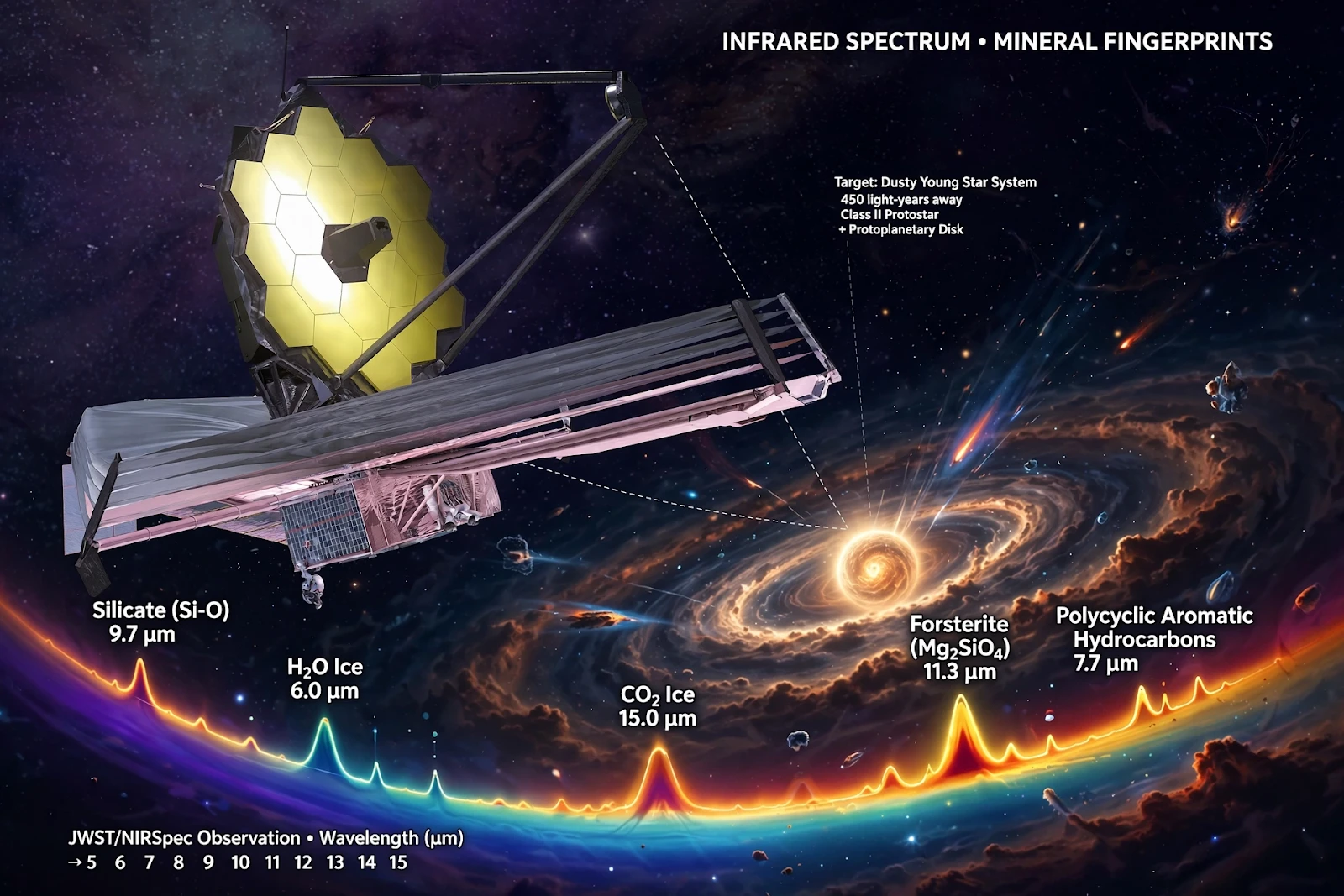
Illustration: Webb's Mid-Infrared Instrument reads mineral fingerprints in warm dust that no other method can reach.
What Happens Next
The next step is more systems, especially older ones. Expanding the sample beyond 21 disks — and finding more extreme debris disks around stars older than 300 million years — would test whether the silica-rich cutoff is real or an artefact of a small sample. If old silica-rich disks turn up, the timeline of giant impacts would need revising; if they continue to be absent, the 300-million-year boundary would harden into a genuine clock for terrestrial planet formation.
Follow-up observations can also track how individual disks change over time. Because silica-poor disks vary in brightness, repeated Webb measurements could show whether that flickering follows the pattern expected from fresh debris evolving and colliding again — and could catch a system in the act of changing from one state to another. Longer-term, the same mineral-fingerprint technique could be applied to other dusty systems, building a catalogue of impact histories across many young stars.
There is also a broader lesson in the method itself. The study shows that some of the most violent events in planet formation leave their clearest record not in light from the impact, but in the quiet, warm glow of the dust that remains. For a field that cannot watch planets form in real time, learning to read that dust — grain by grain, mineral by mineral — is the closest thing to being there. As Su put it: "How rocky planets formed and giant planets evolved are part of the broader story of the solar system's formation. It's all one story. Our work on extreme debris disks helps us bring together the big picture of what we currently understand."
Sponsored: explore today's featured sponsored offers
FAQ
What is an extreme debris disk?
It is a young star system carrying an unusually large amount of warm dust close to the star, in the region where rocky planets orbit. Extreme debris disks are rare — only about 1% of young stars show an observable phase of this kind — and they are thought to be the aftermath of collisions between already-formed rocky bodies.
How many systems did the Webb study examine?
Twenty-one extreme debris disks: 16 observed with Webb's Mid-Infrared Instrument (12 for the first time in the mid-infrared, plus four previously studied by Spitzer) and five more from Spitzer's archive.
What is the difference between silica-rich and silica-poor disks?
Silica-rich disks (8 of 21) contain glassy, vaporised-rock material like obsidian and are interpreted as the result of high-energy impacts between Mars-sized bodies, found only around stars younger than 300 million years. Silica-poor disks (13 of 21) are rich in crystalline silicates such as forsterite and are interpreted as gentler, grazing collisions between Moon-sized bodies, spanning a wider range of ages.
Did Webb actually see planets colliding?
No. Webb did not photograph a collision or the colliding bodies, which are too small and distant to observe directly. The researchers inferred the collisions from the mineral composition of the dust left behind — an interpretation based on spectra, impact models and system ages, not a direct observation of an impact.
What does this say about Earth and the Moon?
The silica-rich disks match the expected timing of the giant-impact phase that produced the Moon: simulations place terrestrial planet formation within the first few hundred million years, and the Moon-forming collision about 100 million years after the Sun formed. The study also suggests the Sun may have gone through a silica-poor disk phase, consistent with a later period of orbital instability and heavy bombardment.
Sources
- NASA, "Webb provides crash course on planet-shattering collisions," October 1, 2026: 21 extreme debris disks, Kate Su (Space Science Institute) lead author, silica-rich and silica-poor classification, 300-million-year cutoff, 1% rarity estimate.
- Su et al., "Extreme Debris Disks: Insights into Violent Collisions in Planet Formation and Destruction," The Astrophysical Journal 1010, 1 (2026), doi: 10.3847/1538-4357/ae88fe: 16 Webb + 5 Spitzer disks, 8 silica-rich / 13 silica-poor, mineral interpretation and age pattern.
- Nanowerk News, "Webb reveals the telltale dust of giant planetary collisions," October 1, 2026: sample composition (12 newly observed Webb disks, four Spitzer follow-ups), three shared disk properties, obsidian and forsterite analogies, co-author quotations.
- Universe Today, "Webb Observes Extreme Debris Disks, Providing a Window into the Early Solar System," October 2026: 8 silica-rich / 13 silica-poor counts, broad age range of silica-poor disks, possible silica-poor phase for the early Sun.
Comments
Post a Comment