
LONDON — The World Health Organization has proposed a sweeping new way to judge packaged food, one that looks beyond fat, sugar and salt to the colours, flavours and sweeteners that make products taste and look more appealing — and the world's biggest food companies are already pushing back. The draft guidance, published on Monday, 2 November 2026, would give governments a single tool for deciding which industrially produced foods should be eaten only in moderation, and which could face warning labels, marketing limits or taxes. The plan, reported by Reuters on Monday, 9 November, marks the first time the UN health agency has built such ingredients into its food guidance, amid a fierce global debate about ultra-processed food.

Illustration: A shopper reads a food label in a supermarket aisle of colourful packaged foods.
What Happened
The WHO published its draft Integrated Food Profiling Model for Regulatory Measures on 2 November 2026 and opened it for public consultation until Friday, 27 November. The document is designed to help governments identify "industrially produced, pre-packaged foods to be consumed in moderation" — a category the WHO calls IFM — and to give them a consistent basis for regulating those products.
Under the model, a product is flagged if it meets either of two tests. The first is familiar: it exceeds WHO thresholds for nutrients of public health concern, namely saturated fat, trans fat, sugars or sodium. The second is new. A product is also flagged if it contains specified flavours, colours or sweeteners that the WHO says are used primarily for sensory purposes — to make food look, smell or taste more appealing and, potentially, to encourage people to eat more of it.
The proposal drew swift criticism from the food industry. The International Food and Beverage Alliance (IFBA), which represents major multinational food and drink companies, said it was concerned the approach shifts attention away from nutritional quality and could sweep more products into potential regulation. "Of particular concern is the potential to undermine established nutrition priorities and reformulation efforts," IFBA Secretary General Rocco Renaldi said.
Industry groups also raised practical worries: higher costs from reformulating products, stricter labelling requirements, the risk of class-action lawsuits like those seen in the United States, and higher taxes for processed-food companies. Kraft Heinz chief executive Steve Cahillane told Reuters last week that food companies should have a voice in the process. "We're in the food business and we care about consumers deeply," Cahillane said. "And so we ought to have a seat at the table as these discussions evolve." The WHO stressed that the draft is not a regulation and bans or taxes nothing itself; it is a tool governments may adapt to their own laws — for marketing limits, warning labels, taxes or public food purchasing.
Background
To understand why the proposal matters, it helps to know how food regulation has worked until now. For years, the WHO's guidance to governments focused on nutrient profiling: models that score foods mainly on fat, salt and sugar. Those models underpin many of the world's warning-label and marketing rules, from Chile's black octagon labels to taxes on sugary drinks. They say nothing, however, about the industrial ingredients that give a brightly coloured snack its colour or a diet drink its sweetness.
The new draft changes that. "This draft goes beyond traditional nutrient profiling by recognising that foods may need to be considered not only for their nutrient content, but also for other aspects of their formulation" in order to prevent diet-related disease, said Katrin Engelhardt, a technical officer at the WHO's department of nutrition and food safety.
The model pulls together several strands of existing WHO work — nutrient recommendations, regional nutrient profile models, global sodium benchmarks, trans-fat elimination advice and food-environment policies — into a single practical tool for regulators.
The draft is also the WHO's attempt to guide member states through a polarised debate about ultra-processed foods, or UPFs — foods and drinks made using industrial processing techniques, additives and industrial ingredients, which often contain little whole food. Carbonated soft drinks and instant noodles are commonly cited examples. Many food scientists say UPFs pose numerous health risks, while others — and the food industry — argue the category is defined too widely and risks demonising healthy products.
The WHO is careful about where its model sits in that debate. The agency says the model is not intended to classify foods according to how processed they are, nor to decide whether any single product is "healthy" or "unhealthy." Instead, it is meant to give governments consistent criteria for identifying products that may warrant regulation to reduce the dietary risks linked to noncommunicable diseases such as heart disease, type 2 diabetes and some cancers.

Illustration: A magnifying glass inspects a food package's ingredient list beside a front-of-pack warning label.
The agency also made a point that could easily be lost in the argument: including flavours, colours and sweeteners in the model does not mean those ingredients are inherently unsafe. Their inclusion, the WHO said, reflects their sensory functions and their potential influence on how much people eat — a question separate from established food-additive safety assessments. The draft is about consumption patterns and regulation, not a new safety verdict on additives.
Before publishing the draft, the WHO tested the model on a vast dataset: about 1.5 million food and beverage products sold in 84 countries and territories, drawn from the Mintel product database. Around 1.1 million of those products had validated nutrition declarations and ingredient lists. The analysis found that the proposed nutrient thresholds, combined with the criteria for flavours, colours and sweeteners, identified 97.27 percent of the nutrient-validated foods classified as ultra-processed under the widely used NOVA classification system. The share ranged from 95.59 percent to 98.30 percent across WHO regions.
The scale of the problem is stark. Around 11 million deaths a year are linked to unhealthy diets, according to the WHO, based on data from a global study, and diet-related diseases now rank among the world's leading causes of death and disability.
Why It Matters
The draft matters because it could reshape the rules that decide what appears on supermarket shelves and in advertising — and because it arrives as governments are already rethinking food policy. If adopted in its current form, the model would give regulators a single, globally consistent yardstick. A product that today escapes a warning label because its sugar content sits just under a threshold could still be flagged because it contains added sweeteners or colours designed to make it more appealing.
That prospect is exactly what worries the industry. Companies have spent years reformulating products to meet nutrient thresholds, and the IFBA argues the new ingredient criteria could pull the rug from under those efforts: if a reformulated drink is still flagged because it contains a sweetener, the incentive to reformulate weakens. Critics counter that swapping sugar for sweeteners may not meaningfully improve a product's health profile.
The debate also reflects a deeper disagreement about how to measure food. Lindsey Smith Taillie, co-director of the Global Food Research Program at the University of North Carolina at Chapel Hill, told Reuters that the point of the model was to target unhealthy foods by combining both nutrients and ultra-processed food criteria. "These two frameworks have never been mutually exclusive and can and should be used by policymakers as the starting place," she said, adding that healthiness is measured by multiple criteria.
For consumers, the most visible consequence could be labels. Front-of-package warnings are among the most direct ways a government can influence shopping habits, and the model is explicitly designed to support them — alongside marketing limits, taxes and public procurement rules for schools, hospitals and government canteens.
The proposal also matters for global trade. Because the WHO tested the model on products from 84 countries and territories, it is designed to work across very different food systems. But a single global yardstick can also create friction: a product considered acceptable in one country could be flagged in another, and multinational companies would face pressure to reformulate globally rather than market by market. That is one reason the industry is lobbying hard during the consultation period.
There is also a fairness question. Supporters argue that nutrient-only rules can be gamed — a product can be engineered to pass a sugar test while remaining, in dietary terms, a poor choice. By looking at formulation as well as nutrients, the WHO says, regulators get a truer picture of what people actually eat. Opponents argue the opposite: that a broad net catches products that are not the problem, from flavoured yoghurts to fortified foods, and risks confusing shoppers rather than helping them.
What Happens Next
The immediate next step is the public consultation, which runs until Friday, 27 November 2026. The WHO is asking for comments from member states, experts, civil society, academia and other stakeholders on the model's clarity, practicality and any missing evidence. Food companies, health researchers and consumer groups are all expected to file detailed responses.
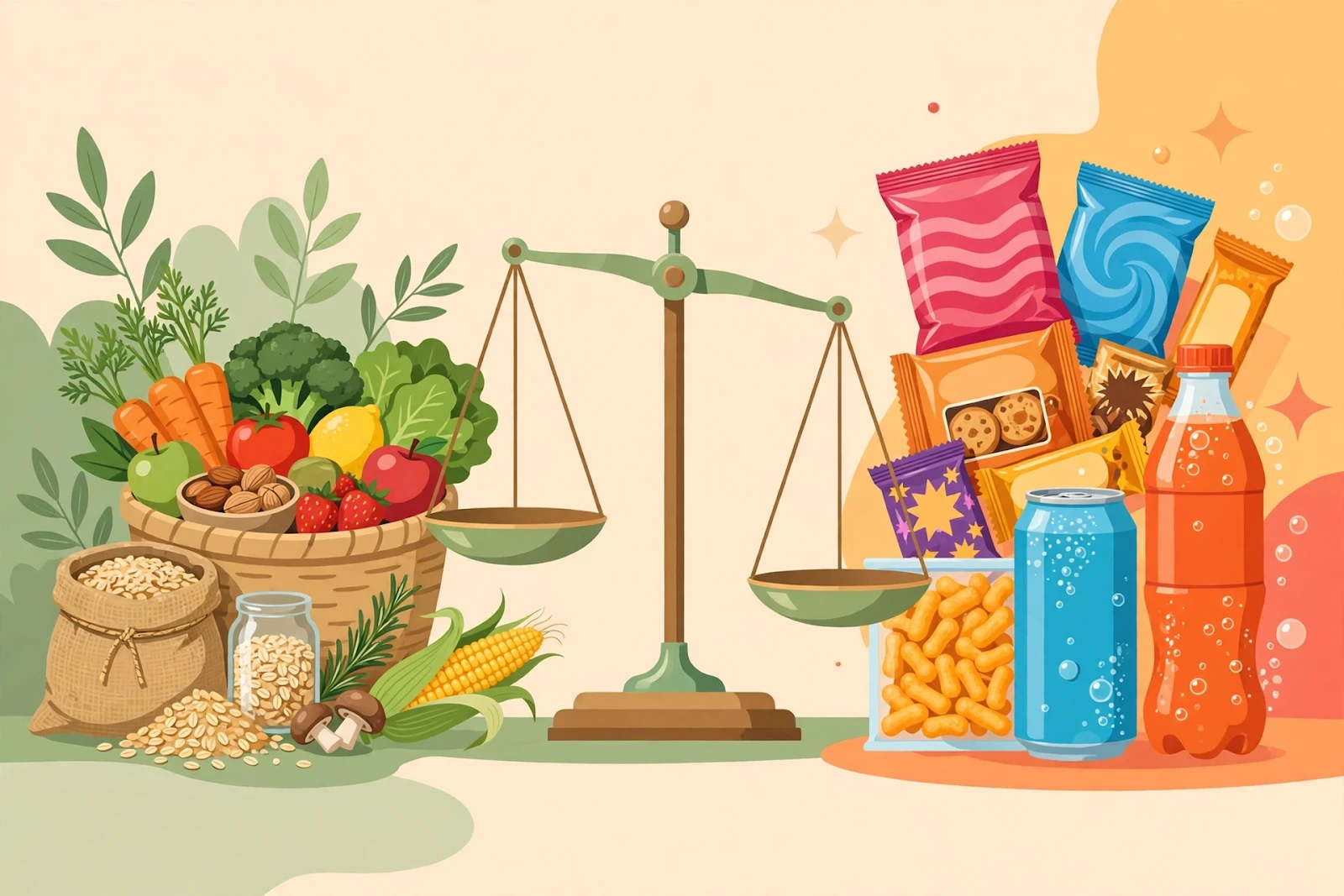
Illustration: Fresh whole foods and ultra-processed packaged snacks balanced on a scale.
After the consultation closes, the WHO will revise the document before issuing it in final form. That process could take months, and the final version may look different from the draft — the ingredient criteria, in particular, are likely to be the most contested part.
Even after a final model is published, nothing changes automatically. The WHO cannot impose food rules on any country; each government must decide whether to adopt the model, adapt it, or ignore it. Countries that already have nutrient-profiling systems — such as Chile, Mexico and the United Kingdom — would need to decide how the new criteria fit with their existing rules.
For now, the draft stands as a marker of where global food policy may be heading: away from judging food by nutrients alone, and towards judging it by how it is made and marketed as well. Whether governments follow the WHO's lead, and how far they go, will be decided in the months after the consultation closes on 27 November.
Disclaimer: This article is for general information only and is not medical advice. It does not replace professional guidance from a qualified health professional. If you have questions about your diet or health, please consult a doctor or a registered dietitian.
Sponsored: explore today's featured sponsored offers
Frequently Asked Questions
What is the WHO's draft food profiling model?
It is a draft tool, published on 2 November 2026, that helps governments identify industrially produced, pre-packaged foods that should be consumed in moderation. It combines nutrient thresholds for saturated fat, trans fat, sugars and sodium with criteria for added flavours, colours and sweeteners, and it is open for public consultation until 27 November 2026.
Why does the WHO want to include colours, flavours and sweeteners?
According to the WHO, these ingredients are used primarily for sensory purposes — to make products look, smell or taste more appealing — and may encourage people to eat more of them. The agency says the model goes beyond traditional nutrient profiling by considering other aspects of a food's formulation, not just its nutrient content. The WHO stresses this does not mean the ingredients are inherently unsafe.
Does the draft ban or tax any food?
No. The draft is not a regulation and does not itself ban, tax or label any product. It is a tool that governments may adapt to their own laws for measures such as marketing restrictions, front-of-package warning labels, taxes or public food procurement standards.
Why is the food industry opposed to the proposal?
The International Food and Beverage Alliance said the approach could shift attention away from nutritional quality, capture more products for potential regulation and undermine reformulation efforts. Companies also cited higher reformulation and labelling costs, the risk of class-action lawsuits and the prospect of higher taxes on processed foods.
What happens after the consultation closes on 27 November 2026?
The WHO will review comments from member states, experts, civil society, academia and other stakeholders, then revise the document before issuing a final version. Each country would then decide separately whether to adopt or adapt the model; the WHO cannot impose food rules on any government.
Sources
- Reuters — "Food industry pushes back on WHO guidance for products with added colour, sweeteners" — 9 November 2026 — by Alexander Marrow and Jennifer Rigby
- Food Safety Magazine — "WHO Proposes Food Profiling Model to Inform Regulation of Ultra-Processed Foods" — 5 November 2026
- The Acta Group — "WHO's Draft Integrated Food Profiling Model for Regulatory Measures Includes Definition of Ultra-Processed Foods; Comments Due November 27, 2026" — 4 November 2026
- The Future of Food — "WHO Draft Food Profiling Model Would Flag Added Colors, Flavors and Sweeteners, Natural Ones Included" — 6 November 2026
- World Health Organization — "Integrated food profiling model for regulatory measures" (draft) — published 2 November 2026
- Insurance Journal (Reuters syndication) — "Food Industry Pushes Back on WHO Guidance for Products With Added Color, Flavor" — 9 November 2026
Comments
Post a Comment