
LUSAKA — Zambia will begin construction in November 2026 on what President Hakainde Hichilema has described as Africa's first oral cholera vaccine plant, at the Lusaka South Multi-Facility Economic Zone, even as the country's latest cholera outbreak has reached 1,622 cases and 30 deaths, according to the Zambia Daily Mail's report of the President's remarks on 30 October 2026.

Illustration: A vaccine manufacturing facility under construction in Zambia.
What Happened
President Hichilema announced the planned groundbreaking during a ministerial swearing-in ceremony — for Christopher Kalila and Charles Milupi — reported the Zambia Daily Mail on 30 October 2026. According to the Daily Mail's report, the plant is planned to produce 20 million doses of oral cholera vaccine a year once operating.
The announcement comes in the middle of an active outbreak. Health Minister Roma Chilengi told Parliament, in remarks reported by the Zambia Monitor and the Daily Mail in the week of 27–30 October, that 1,622 cases and 30 deaths had been recorded in 20 districts across six provinces since 28 July 2026. Of those, 228 were laboratory-confirmed, 1,488 people had recovered or been discharged, and 104 were admitted as of 28 October.
The most recent 24-hour figures reported to Parliament showed 74 new cases in 12 districts, with no deaths in that period. Lusaka Province accounts for the largest share of cases, with 1,090, followed by Central Province with 298, Luapula with 133, Northern with 88, Southern with 11 and Copperbelt with 2.
Sixteen of the 30 people who died did so in their communities before reaching a health facility, according to the figures reported to Parliament — a stark reminder that rapid rehydration can be life-saving, and that access to care remains decisive.
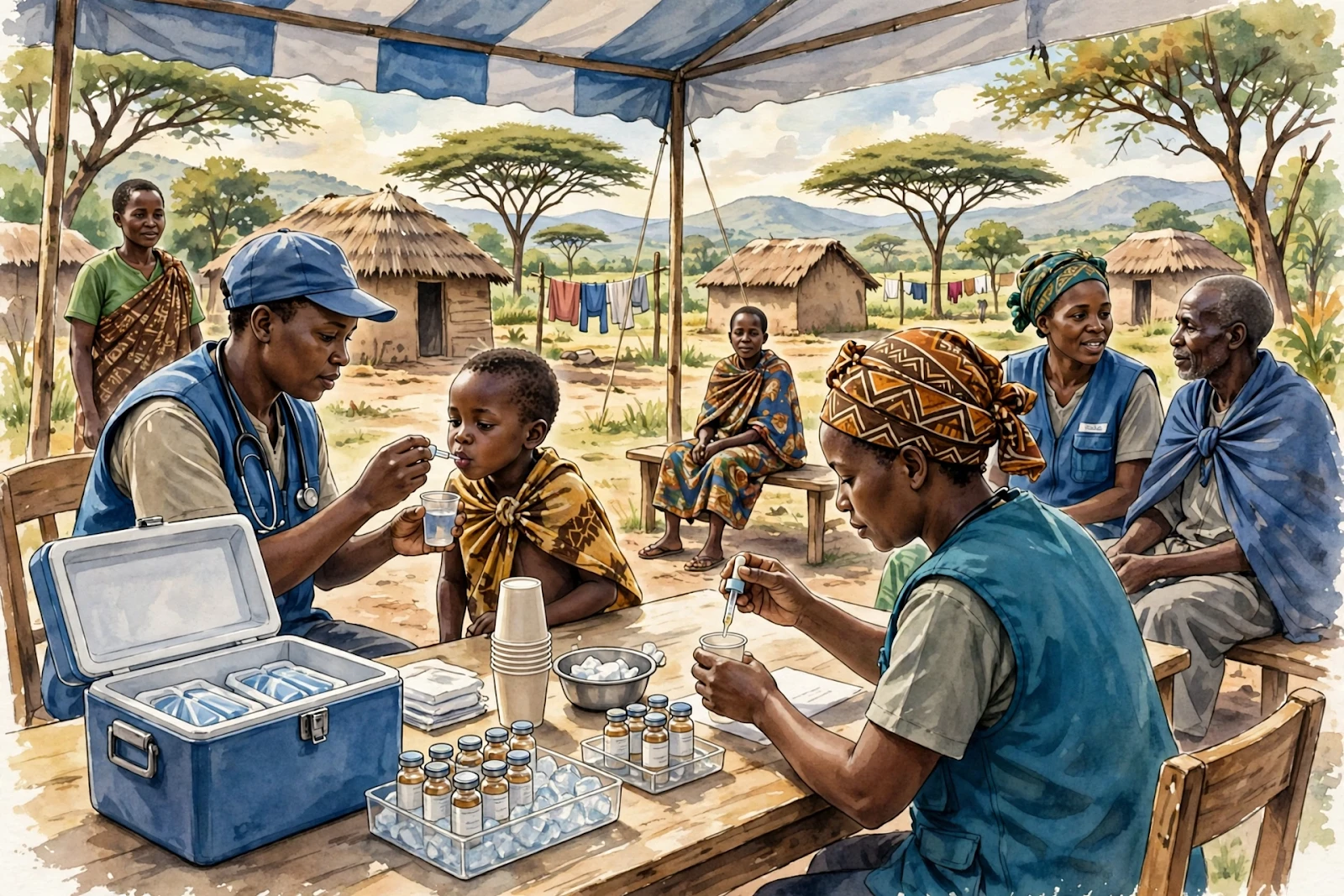
Illustration: An oral cholera vaccination campaign in Zambia.
Alongside the plant announcement, the government has pressed ahead with vaccination and emergency water measures. The International Coordinating Group, which manages the global emergency stockpile of oral cholera vaccines, released 782,147 doses for Zambia, and 709,018 people aged one year and older have been vaccinated — about 91 per cent of the target — concentrated on 10 wards in Lusaka District, four in Chibombo and one in Chongwe.
The Treasury has also released K13 million to the Ministry of Water Development and Sanitation for emergency safe water, a recognition that vaccines alone cannot end an outbreak driven by contaminated water. Cholera spreads through water and food contaminated with Vibrio cholerae, so emergency water provision and hygiene promotion sit alongside vaccination in the response.
Background
The plant is not a new idea invented for this outbreak. It dates from a memorandum of understanding signed on 8 October 2024 between Zambia's Industrial Development Corporation and China's Jijia International Medical Technology Corporation, reported at the time by Anadolu Agency. Under that plan, the first phase was costed at US$37 million, with output then put at about 3 million doses a year, plus roughly 3 million donated doses before production began.
That history matters for judging the new announcement. The figure now reported — 20 million doses a year — is considerably larger than the roughly 3 million doses a year described in 2024, and the reporting read for this article does not explain the difference: whether the scope has expanded, whether 20 million refers to a later phase, or whether it reflects different counting. This article therefore attributes the 20 million figure to the Daily Mail's report of the President's remarks, and does not present it as confirmed final capacity.
Similarly, no separate statement from the Industrial Development Corporation or from the Chinese partner appeared in the reporting read for this article. The public record available here therefore rests on the President's remarks as reported by the Daily Mail, and readers will reasonably look for project documents and timelines that turn an announced groundbreaking into a verifiable production schedule.
President Hichilema is the African Union's cholera champion, a role that gives the announcement a continental dimension. The project has been framed as Zambia's contribution to eliminating cholera by 2030. For a continent where cholera outbreaks recur each year, a regional manufacturing base would, if realised, reduce dependence on a global emergency stockpile that is frequently stretched thin.

Illustration: Safe water measures to prevent cholera in Lusaka.
Why It Matters
A vaccine plant on African soil would matter for three reasons: supply, speed and sovereignty. Global oral cholera vaccine supply has repeatedly fallen short of demand, forcing the International Coordinating Group to ration doses, including single-dose strategies in emergencies where two doses would normally be given. A plant producing even a fraction of the announced figure would ease that pressure, first for Zambia and potentially for neighbours facing their own outbreaks.
Speed matters almost as much as volume. Vaccines shipped from distant manufacturers take time to procure and transport, and in an outbreak, weeks can mean thousands of additional cases. Local production also builds the workforce and regulatory capacity needed for other essential health products — a point African health leaders have made repeatedly since COVID-19 exposed the continent's dependence on imported vaccines.
Yet the plant is not a substitute for clean water. Cholera is fundamentally a disease of inadequate water, sanitation and hygiene, and no vaccination campaign can permanently end transmission while communities still drink unsafe water. The K13 million for emergency safe water acknowledges that reality, but the longer test will be sustained investment in water infrastructure in Lusaka's high-density areas and the districts now reporting cases.
The global context underlines the stakes. Cholera deaths worldwide have in recent years reached their highest levels since 1999, according to World Health Organization context previously reported on this blog — a reminder that Zambia's outbreak is part of a wider resurgence, and that its manufacturing bid is being watched well beyond its borders.
What Happens Next
The immediate milestone is the groundbreaking itself, which the President said will take place in November 2026 at the Lusaka South Multi-Facility Economic Zone — the first concrete test of whether a site plan and published timeline follow the words. Observers will also watch for financing and partnership details not set out in the reporting read here, including any updated agreement with Jijia International Medical Technology Corporation and the Industrial Development Corporation.
In the meantime, the outbreak response continues. Health authorities will be judged on whether daily new cases fall, whether community deaths decline as access to treatment improves, and whether vaccination can be extended beyond the wards already reached, since cholera does not respect campaign boundaries.
Longer term, the question is whether the plant moves from groundbreaking to production before the next rainy season brings the next surge. Vaccine plants take years to build, validate and license, and the 2030 elimination goal leaves little room for delay. What Zambia needs next is the detail — and the construction — that turns a presidential promise into doses in arms.
Sponsored: explore today's featured sponsored offers
FAQ
What has Zambia announced about a cholera vaccine plant?
President Hakainde Hichilema said construction of what he described as Africa's first oral cholera vaccine plant will begin in November 2026 at the Lusaka South Multi-Facility Economic Zone, according to the Zambia Daily Mail on 30 October 2026. The report put planned output at 20 million doses a year, attributed here to that report rather than presented as confirmed final capacity.
How large is Zambia's current cholera outbreak?
Health Minister Roma Chilengi told Parliament that 1,622 cases and 30 deaths had been recorded in 20 districts across six provinces since 28 July 2026, with 228 laboratory-confirmed, 1,488 recovered or discharged, and 104 admitted as of 28 October. Lusaka Province has the most cases (1,090).
How many people have been vaccinated against cholera?
The International Coordinating Group released 782,147 oral cholera vaccine doses, and 709,018 people aged one and older have been vaccinated — about 91 per cent of the target — mostly in 10 Lusaka District wards, four in Chibombo and one in Chongwe.
Is the 20 million doses a year figure confirmed?
No — not on the reporting read for this article. An earlier plan reported by Anadolu Agency in October 2024 put first-phase output at about 3 million doses a year, and the reporting read here does not explain the difference or include a separate statement from the Industrial Development Corporation or its Chinese partner. Treat 20 million as the figure reported from the President's remarks, pending further detail.
What else is Zambia doing to fight the outbreak?
Beyond vaccination, the Treasury released K13 million to the Ministry of Water Development and Sanitation for emergency safe water. Vaccination, rapid treatment before severe dehydration sets in, and safe water, sanitation and hygiene measures together form the core of the response.
Sources
Zambia Daily Mail, 30 October 2026; Zambia Monitor, 29 October 2026; Anadolu Agency, 8 October 2024; Lusaka Brief, 1 November 2026.
Comments
Post a Comment