
LONDON, Oct 23 — More than eight in ten professional men's tennis players who attract attention online were targeted by social media abuse over the past year, the ATP said on Thursday, revealing that its Safe Sport initiative stopped some 234,000 abusive comments from ever reaching players and fans.
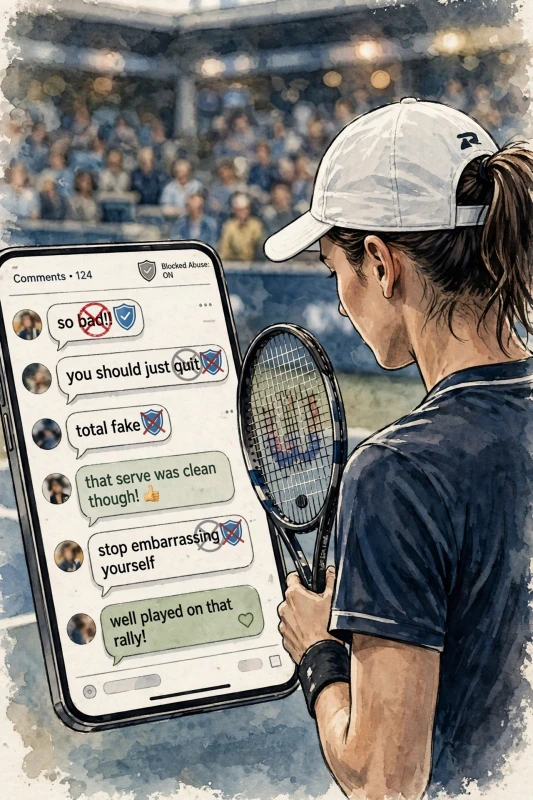
Illustration: a tennis player looking at a smartphone covered in comment bubbles, with a shield icon blocking abusive messages
What Happened
The men's tennis governing body published the findings on Thursday, based on an analysis of more than 3.7 million comments across ATP and player social media channels, according to reporting by Reuters on October 22, 2026. The review found that abuse was directed at over 85 percent of men's players who attract engagement online — a measure of how routine online hostility has become at the top of the sport.
Of the comments analyzed, more than 284,000 were identified as abusive, and over 82 percent of them were removed in real time before they could be seen by players or supporters. During the programme's first year, it identified and hid upwards of 162,000 comments containing what the ATP classified as "severe" abuse, the governing body said.
The Safe Sport initiative combines AI-enabled moderation with specialist threat assessment, screening the flood of messages aimed at players on their own accounts and on the ATP's channels. "Player welfare sits at the heart of the ATP's safeguarding work," said Andrew Azzopardi, the ATP director of safeguarding, in the announcement reported by Reuters.
"Preventing more than 234,000 abusive comments from reaching players and fans demonstrates the tangible impact the programme is having every day. Online abuse has no place in tennis," Azzopardi said. He added that the ATP would keep investing in the technology, expertise and partnerships that protect players, and would continue working with the authorities to hold those responsible to account.
Background
Tennis players, like many athletes, have long dealt with the anger of anonymous abusers online — and a large share of it comes from gamblers. Reuters noted that French player Gael Monfils, 40, once humorously hit back at some of his abusers following an early defeat in Stuttgart last year, saying at the time he was surprised people still put money on him to win against much younger opponents.
The abuse is not confined to losing bettors. American star Coco Gauff said earlier this month that she received an "insane" amount of racist abuse at the China Open, an episode that prompted condemnation from the United Nations Human Rights Office, according to Reuters. Her case underlined that the hostility players face is often not about results at all, but about identity.
The ATP's decision to build a dedicated safeguarding operation reflects a wider reckoning across professional sport. Governing bodies in football, cricket and athletics have all wrestled with how to protect athletes from targeted harassment that arrives instantly, anonymously and at industrial scale — often spiking within minutes of a missed shot, a lost match or a controversial call. Tennis, an individual sport in which players read their own mentions between matches, is especially exposed.

Illustration: a glowing digital shield protecting a tennis court net from incoming abusive social media comments
Why It Matters
The numbers give the clearest picture yet of the scale of the problem — and of what organized moderation can achieve. Blocking 234,000 abusive comments means hundreds of thousands of hostile messages that players never had to read, many of them arriving in the raw hours after a defeat when athletes are most vulnerable.
The findings also put a figure on something players have described for years: that abuse is not a fringe problem affecting a few high-profile stars, but a near-universal experience. When more than 85 percent of players who attract engagement are targeted, silence from the sport's authorities is no longer an option — and the ATP's programme offers a template other sports are watching closely.
There is a commercial dimension too. Sponsors and broadcasters have grown increasingly uneasy about associating their brands with toxic online environments, and governing bodies face mounting pressure — from players' unions, from human rights offices and from regulators — to show they are protecting the people who make the product. A system that removes abusive content in real time, at scale, is becoming a competitive necessity rather than a nice-to-have.
What Happens Next
The ATP says it will keep investing in the technology, expertise and partnerships behind Safe Sport, and will continue working with authorities to hold abusers to account — language that suggests the programme's next phase may move beyond blocking messages toward identifying persistent offenders for law enforcement.
Player advocates will be watching whether the initiative expands beyond the men's tour. The Reuters report covered the ATP's findings for men's players; the women's tour, where stars like Gauff have spoken publicly about racist abuse, faces the same threats. Coordination between tours, platforms and regulators is likely to be the next frontier.
For the players, the immediate test is simpler: whether the start of the 2027 season feels different on their phones. The ATP's data suggests the shield is working — the question now is whether the abuse itself can be reduced at the source, not just filtered at the destination.

Illustration: a packed tennis stadium at dusk with floodlights, symbolizing the call for respect and player welfare
Sponsored: explore today's featured sponsored offers
Frequently Asked Questions
How many abusive comments did the ATP block?
The ATP said its Safe Sport initiative prevented more than 234,000 abusive comments from reaching players and fans. Its analysis of over 3.7 million comments identified more than 284,000 as abusive, with over 82 percent removed in real time.
What is the ATP's Safe Sport initiative?
Safe Sport is the ATP's safeguarding programme against online abuse. It uses AI-enabled moderation combined with specialist threat assessment to screen comments on ATP and player social media channels, hiding abusive messages before players or fans see them. In its first year it identified and hid more than 162,000 comments containing "severe" abuse, according to the ATP.
Who is behind most of the abuse aimed at players?
According to Reuters, many of the anonymous abusers are bettors venting after losing wagers. But abuse is not limited to gambling-related anger — players also face racist and identity-based harassment, as Coco Gauff described after the China Open.
What happened to Coco Gauff at the China Open?
Gauff said earlier in October 2026 that she received an "insane" amount of racist abuse at the China Open, prompting condemnation from the United Nations Human Rights Office, according to Reuters.
What does the ATP plan to do next?
ATP safeguarding director Andrew Azzopardi said the organization will keep investing in the technology, expertise and partnerships that protect players, and will continue working with authorities to hold those responsible for abuse to account.
Sources
- Reuters, "Tennis-ATP blocks 234,000 abusive comments from reaching players, fans," October 22, 2026
- ATP Safe Sport initiative findings, October 2026, cited via Reuters
Comments
Post a Comment