
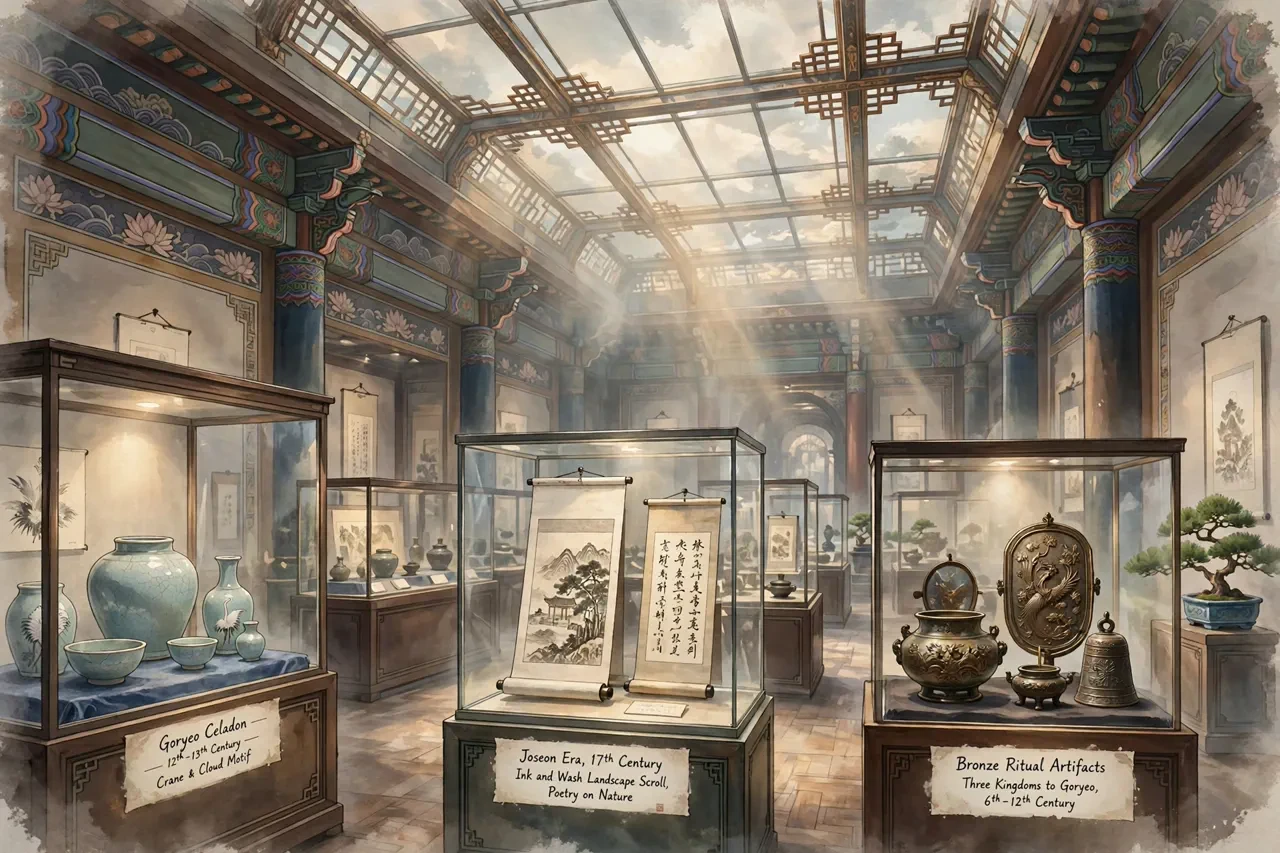
Illustration of a grand museum hall displaying Korean ceramics and scrolls beneath a glass ceiling
London — The first major exhibition of Korean art at the British Museum in more than forty years may also be the most significant: around one hundred masterpieces spanning two thousand years of Korean creativity, drawn from the extraordinary private collection of the late Samsung chairman Lee Kun-hee. Opened on October 1, 2026, Korea: 2,000 Years of Creativity runs at the museum's Joseph Hotung Great Court Gallery until January 31, 2027 — London is the grandest stop on an international tour that has already taken in Washington and Chicago.
What Happened
The exhibition was inaugurated with a gala on September 30, hosted by Samsung Electronics together with the British Museum. Samsung's Executive Chairman Jay Y. Lee — the son of the collector — was joined by family members including Hong Ra-hee, director emerita of the Leeum Museum of Art. "For generations, my family has held a guiding principle that art and culture should be preserved and shared," Lee said. "I hope this exhibition offers a gateway into Korean culture, spanning two thousand years of creativity and heritage."
The show is organized by the British Museum in partnership with the National Museum of Korea and the National Museum of Modern and Contemporary Art, Korea. Most works come from the National Bequest of the Lee Kun-hee Collection: after the Samsung chairman's death in 2020, his heirs donated more than 23,000 works to Korea's national museums in 2021 — one of the largest art donations in history. Samsung serves as the exhibition's corporate partner.
Among the roughly 100 masterpieces are 10 National Treasures and 13 Treasures of Korea. More than 20 works are being shown internationally for the first time, including National Treasure bronze artifacts from Bisan-dong in Daegu and a celadon incense burner with a lid shaped like the mythical girin. The exhibition's span is deliberately vast: from ritual bronzes of around 300 BC through the Three Kingdoms, Unified Silla, Goryeo and Joseon periods, to modern and contemporary Korean art.
Background
Lee Kun-hee, who chaired Samsung from 1987 until his death in 2020, is credited with transforming it into one of the world's largest businesses. Less publicly known was his parallel career as one of the great art collectors of the modern era, whose collection ranged from Korean ceramics, Buddhist sculpture, calligraphy and painting to modern and contemporary masterworks.
The 2021 donation changed Korea's national holdings almost overnight. Works that had been held privately — some never publicly exhibited — became the property of the National Museum of Korea and the National Museum of Modern and Contemporary Art. The international tour began at the Smithsonian's National Museum of Asian Art in Washington, D.C., in November 2025, moved to the Art Institute of Chicago in March 2026, and has now reached London as its European stop: listings count roughly 185 individual objects on display, including six loans from the British Museum's own Korean holdings, and this edition contains more National Treasures than either American venue.
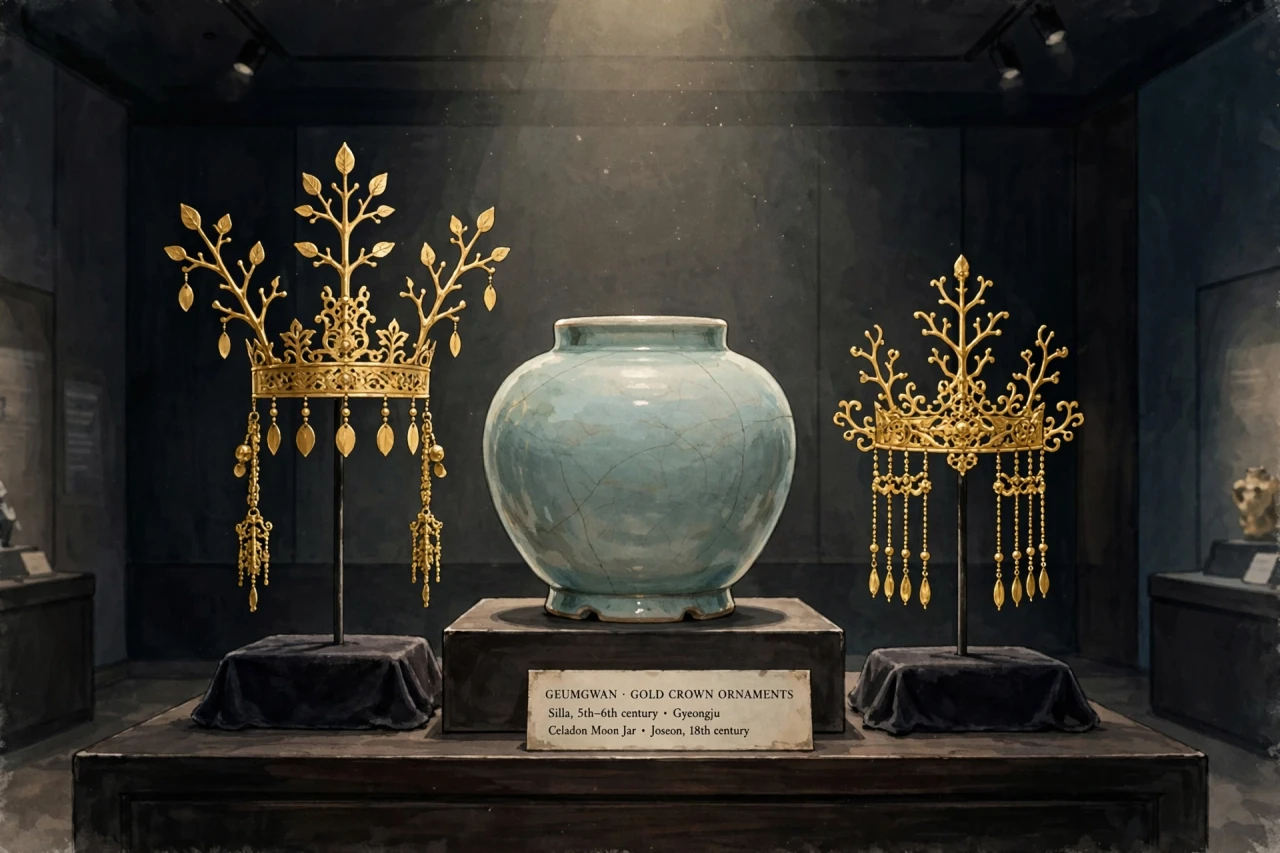
Illustration of a Korean celadon moon jar and gold crown-style ornaments glowing in a dark gallery
The highlights are astonishing in their range. The exhibition includes an 8th-century bronze Buddhist bell; Goryeo-era celadon from the dynasty that gave the word "celadon" much of its fame in the West, including the gourd-shaped ewer of the 13th century and the girin-lidded incense burner; latticed gilt bronze burial shoes from AD 400–600, which one reviewer noted would not look out of place on a fashion runway; and an 18th-century moon jar, the softly asymmetrical white porcelain vessel that has become an icon of Korean aesthetics, prized precisely for its imperfect join.
One of the rarest loans is a 1,000-year-old Korean scroll — the Mahaprajnaparamita Sutra, a Buddhist text created as an offering seeking divine aid to protect the country from invasion. At the center of the show's engagement with Korea's landscape tradition stands Jeong Seon's 1751 ink painting Clearing After Rain on Mount Inwang, which The Guardian's review singled out as the exhibition's most powerful encounter with Korea's artistic heritage. The modern section includes works being shown internationally for the first time: Nam June Paik's Brahms, Lee Jungseop's Bound People and Park Rehyun's Woman.
Why It Matters
The exhibition matters on several levels at once. For the British Museum, it is the first major special presentation of Korean art in more than four decades, arriving at a moment when Korean culture — from cinema to the global phenomenon of K-pop — commands an international audience previous generations of curators could only have imagined. For Korea, the show is cultural diplomacy of the highest order: the objects tell the story of a civilization that absorbed influences from neighboring cultures while developing highly distinctive forms of its own, from the luminous glazes of Goryeo celadon to the stark confidence of Joseon porcelain.
Illustration of ancient Korean scrolls and bronze artifacts arranged beside a world tour route map
But the exhibition has also drawn serious critical attention for what it leaves out. A Guardian review, widely discussed since late September, praised the ancient sections while arguing the show stumbles on the 20th century: the collection's strength in elite, collector-grade art, the review argued, leaves little room for Japan's 1910–1945 colonization of Korea or the Korean War, in which three million people died. Lee Jung-seop's wartime works offer a somber exception.
That debate is itself part of the exhibition's significance. When one private collector's taste becomes the basis for a nation's self-presentation abroad, questions about whose history gets told — and whose gets softened — are inevitable, and the British Museum's choice of corporate partner has made the show as much a conversation about cultural power as about ceramics.
What Happens Next
The exhibition runs until January 31, 2027, giving audiences four full months to see it. Standard tickets are listed at £20, with concessions available, and the museum offers a free audio tour of selected highlights through its app. After the ticketed show, visitors can walk to the museum's free Korea Foundation Gallery for its permanent Korean collection.
After London, the tour's future stops have not been announced — and given that this edition is described as the densest of the three, with more National Treasures than Washington or Chicago, the London show may well stand as the tour's definitive presentation. A companion volume by lead curator Sang-ah Kim is available from the museum's press.
Whether the critical debate about the show's handling of Korea's modern history will reshape how future exhibitions from the Lee Kun-hee bequest are framed remains an open question — but with the objects this beautiful, the argument will play out in front of very large crowds.
Sponsored: explore today's featured sponsored offers
FAQ
What is the British Museum's 'Korea' exhibition?
Korea: 2,000 Years of Creativity is a major exhibition at the British Museum in London, open from October 1, 2026, to January 31, 2027. It brings around 100 masterpieces spanning two millennia of Korean art to the museum's Joseph Hotung Great Court Gallery, most of them drawn from the collection of the late Samsung chairman Lee Kun-hee.
Who was Lee Kun-hee?
Lee Kun-hee (1942–2020) was the chairman of Samsung from 1987 until his death, credited with building it into one of the world's largest companies. He was also one of the great private art collectors of the modern era: after his death, his heirs donated more than 23,000 works from his collection to Korea's national museums in 2021, one of the largest art donations ever made.
What are the exhibition's highlights?
Highlights include 10 National Treasures and 13 Treasures of Korea, with more than 20 works shown internationally for the first time: an 8th-century bronze Buddhist bell, Goryeo celadon masterpieces, an 18th-century moon jar, gilt bronze burial shoes, a 1,000-year-old Buddhist scroll, Jeong Seon's 1751 landscape Clearing After Rain on Mount Inwang, and modern works by Nam June Paik and Lee Jungseop.
Why has the exhibition been controversial?
A widely discussed Guardian review praised the ancient sections but argued the show underplays Korea's traumatic 20th century — Japan's 1910–1945 colonization and the Korean War — reflecting the elite, collector-grade taste of the Lee Kun-hee collection rather than a fuller history.
Where has the exhibition been shown before?
London is the third stop of an international tour that began at the Smithsonian's National Museum of Asian Art in Washington, D.C., in November 2025 and continued at the Art Institute of Chicago in March 2026. The London edition is the densest of the three, with more National Treasures than either American venue.
Sources
- Samsung Global Newsroom — "Lee Kun-Hee Collection Expands to Europe With Opening of 'Korea' Exhibition at the British Museum" (October 2026), including gala details and Jay Y. Lee's remarks.
- The Times — "Korea review — ancient bling meets KPop Demon Hunters at the British Museum" (October 2026).
- The Guardian review, summarized by SkimNews — "British Museum Korea: Beauty Dazzles, Then Falls Apart" (September 27, 2026).
- theluxereview.com — "British Museum brings 2,000 years of Korean art to London with Samsung-backed Korea exhibition" (October 1, 2026).
- thecreativnetwork.com — "Korea brings 2,000 years of creativity into one view" (October 2026).
- ianvisits.co.uk — "An ancient scroll created to protect Korea makes a rare visit to London" (October 2026).
- atthebanquet.com — "Korea: 2,000 Years of Creativity 2026: Where to Stay & How to Plan" (October 2026).
- astrofella.wordpress.com — "Korea: The British Museum" (October 3, 2026).
- tennewstoday.com — "British Museum Korea Exhibition Captures Ancient Beauty and Modern" (October 2026).
Comments
Post a Comment