
NEW DELHI, 29 October 2026 — Cyclone Arnab weakened into a depression over central India on Thursday, 29 October 2026, a day after battering India's east coast, leaving at least five people dead in Andhra Pradesh, tens of thousands of electricity poles flattened, and flood and landslide risks lingering across several states as relief teams worked to restore power and clear roads.

Illustration: A battered Indian east-coast town after a cyclone, with uprooted trees, leaning electricity poles, flooded streets and residents clearing debris.
What Happened
Arnab made landfall as a very severe cyclonic storm in the early hours of Wednesday, 28 October 2026, crossing the Andhra Pradesh coast between Bapatla and Visakhapatnam, close to Yanam, with maximum sustained winds of 125 to 135 kilometres per hour and gusts of up to 150 kilometres per hour, according to reporting on the India Meteorological Department (IMD) bulletins. The crossing took more than six hours, and torrential rain accompanied the winds, uprooting trees, bringing down electricity poles, damaging roads and inundating low-lying homes and farmland.
By Thursday morning, the system had weakened considerably. The IMD said in its bulletin that the deep depression, the remnant of the very severe cyclonic storm, was centred at 5:30 a.m. IST on 29 October over south Chhattisgarh and adjoining south Odisha, near Jagdalpur, and was very likely to weaken further into a well-marked low-pressure area by the evening. Weakening, however, did not mean the danger had passed: the remnant was still moving northwards and bringing heavy rainfall to parts of eastern and central India, raising concerns about localised flooding, waterlogging, landslides, damage to standing crops and disruption of essential services.
Andhra Pradesh bore the initial brunt. Chief Minister N. Chandrababu Naidu confirmed five deaths in cyclone-related incidents involving electrocution, falling electricity poles, an uprooted palm tree and a wall collapse, with fatalities reported from Visakhapatnam, Anakapalli, Konaseema and the Bhimavaram area, according to reporting on 29 October. Some other outlets reported higher tolls — six or seven deaths — citing officials and local reports, so the confirmed figure and the higher reported figures should not be treated as the same thing: at least five deaths were confirmed by the state leadership, while the full toll was still being verified as damage assessments continued.
More than 180,000 people had been evacuated ahead of the storm across Andhra Pradesh and Odisha, according to reporting on the evacuations. In Andhra Pradesh, 84,396 people were shifted to 290 relief camps, while in Odisha 43,827 people were accommodated in 634 relief centres, with additional facilities on standby, according to the figures reported on 29 October. Flights and train services were cancelled and some schools closed as the storm approached.
Background
Arnab formed over the Bay of Bengal and intensified into a very severe cyclonic storm — the third-highest category on the IMD scale — before striking the coast. The Bay of Bengal is one of the world's most cyclone-prone basins, and storms that make landfall on India's east coast regularly threaten densely populated coastal districts, fishing communities and farmland. Some coverage on 29 October drew comparisons with Cyclone Hudhud, which devastated the Visakhapatnam region in 2014, but Arnab's final damage picture was still emerging and the two storms are not the same event: the comparison reflects the geography and the scale of disruption, not a confirmed equivalence in casualties or losses.
The storm arrived during a season in which India's east coast was already on alert. Our earlier report on 28 October covered Arnab as it bore down on the coast, with forecast landfall winds in the same 125 to 135 kilometre-per-hour range and a storm surge of 1.5 to 2.5 metres feared. That forecast proved broadly accurate for the wind speeds at landfall; the new development on 29 October is what happened after the storm came ashore — the deaths, the power damage, the evacuations' aftermath and the inland flood risk as the weakened system moved north.
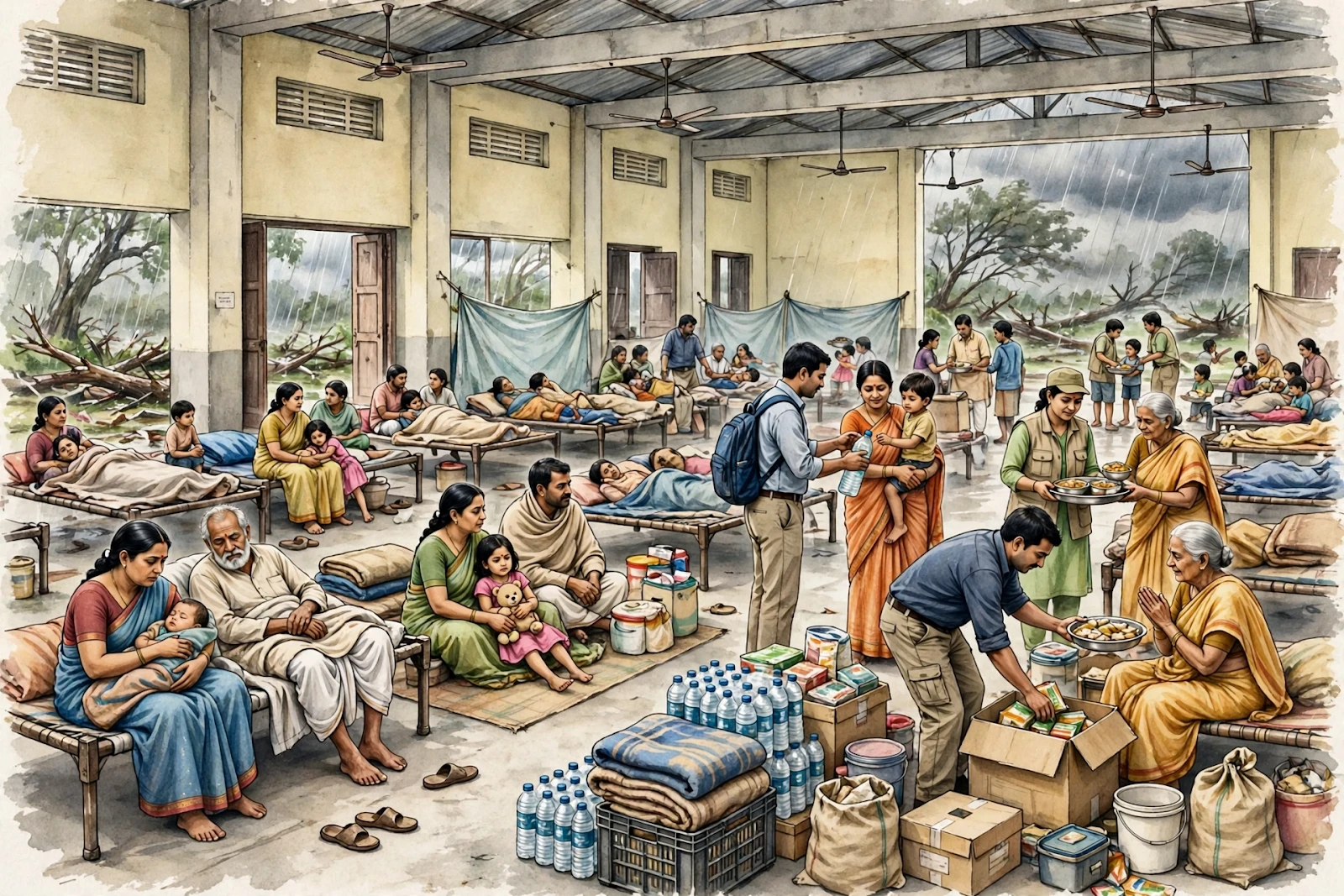
Illustration: A cyclone relief camp in India, with families sheltered in a large hall and relief workers distributing food and water.
Odisha, to the north of the landfall point, escaped the worst of the winds but not the rain. Chief Minister Mohan Charan Majhi said at least 17 districts in southern Odisha were affected, with widespread rainfall, according to reporting on 29 October. The IMD also issued a flash flood risk warning for 13 districts of Andhra Pradesh and Yanam, including Bapatla, Guntur, Krishna, East Godavari, Kakinada, Visakhapatnam, Vizianagaram, Anakapalli and West Godavari, warning of moderate to heavy flash flood risk over a few watersheds and neighbourhoods.
Why It Matters
First, the power damage shows how a cyclone's impact outlasts its winds. Around 15,000 electricity poles were brought down in Andhra Pradesh, according to the chief minister, disrupting supply across affected areas and temporarily blocking National Highway 16 until debris was cleared. By Thursday, power had been restored in most districts, but Konaseema and West Godavari remained among the areas still facing disruptions, with repair crews continuing to work. For households, hospitals, water pumps and small businesses, the length of a power outage often matters as much as the storm itself.
Second, the evacuation numbers show both the strength and the limits of early warning. Moving more than 180,000 people before landfall is a major logistical operation, and it almost certainly reduced the risk to life. But shelters, food, water and medical care must then be sustained for days, and people return to damaged homes, waterlogged fields and lost crops. The chief minister of Andhra Pradesh announced ex gratia payments of 500,000 rupees for the families of those killed, according to reporting on 29 October — a measure that acknowledges loss but cannot replace homes or harvests.
Third, the inland track is a reminder that a cyclone does not end at the coast. As Arnab weakened and moved north into Chhattisgarh and Odisha, the hazard shifted from wind and surge to rain, flooding and landslides. That transition is often the most dangerous phase for inland communities that did not experience the landfall winds and may underestimate the rainfall that follows.
What Happens Next
Union Home Minister Amit Shah said on Thursday, 29 October that he had spoken with the chief ministers of Andhra Pradesh, Puducherry, Odisha and Chhattisgarh, assuring each of full central government support. National Disaster Response Force and State Disaster Response Force teams were already carrying out rescue and relief operations, he said, and Inter-Ministerial Central Teams would soon be sent to assess the impact and identify what additional federal assistance is required.

Illustration: Electricity repair crews restoring power lines after a cyclone in India, with workers on poles and trucks amid fallen cables and wet roads.
In the immediate term, heavy rainfall in parts of coastal Andhra Pradesh and Yanam was expected to continue at least until 30 October, with thunderstorms and lightning also likely in the region between 30 October and 3 November, according to IMD advisories reported on 29 October. Heavy rain was also forecast for parts of Bihar, Uttar Pradesh, Chhattisgarh and Madhya Pradesh as the remnant moved north, and a separate low-pressure area over the south Andaman Sea was very likely to become a well-marked low and then concentrate into a depression over the southeast Bay of Bengal in the following days — a system that forecasters will watch, but that should not be confused with Arnab itself.
Damage assessments will now determine the scale of the agricultural and infrastructure losses, and the final death toll. Until those assessments are complete, the figures in this article should be read as reported on 29 October, not as a final accounting. The test of the response in the coming days will be how quickly power, roads and water are fully restored, how long evacuees must remain in camps, and whether the inland flood risk is managed before the next spell of heavy rain arrives.
Sponsored: explore today's featured sponsored offers
Frequently Asked Questions
When and where did Cyclone Arnab make landfall?
Arnab crossed the Andhra Pradesh coast between Bapatla and Visakhapatnam, close to Yanam, in the early hours of Wednesday, 28 October 2026, with sustained winds of 125 to 135 kilometres per hour and gusts up to 150 kilometres per hour.
How many people died?
Andhra Pradesh Chief Minister N. Chandrababu Naidu confirmed five deaths in cyclone-related incidents. Some outlets reported six or seven deaths, citing officials and local reports, so the toll was still being verified on 29 October.
What happened to the storm after landfall?
It weakened into a deep depression and then a depression over south Chhattisgarh by the morning of 29 October, and was expected to weaken further into a well-marked low-pressure area by the evening, while still bringing heavy rain inland.
How many people were evacuated?
More than 180,000 people were evacuated across Andhra Pradesh and Odisha before landfall, including 84,396 people in 290 relief camps in Andhra Pradesh and 43,827 people in 634 relief centres in Odisha, according to figures reported on 29 October.
What help is the central government providing?
Home Minister Amit Shah said on 29 October that he had spoken to the chief ministers of Andhra Pradesh, Puducherry, Odisha and Chhattisgarh, that NDRF and SDRF teams were already in action, and that Inter-Ministerial Central Teams would soon assess the damage and further assistance needed.
Sources
- The Environment, "Cyclone Arnab weakens into deep depression after battering Andhra, Odisha; five killed, 17 Odisha districts affected," 29 October 2026.
- Nation Press, "Cyclone Arnab: Shah assures aid to Andhra, Odisha, 5 dead, 17 districts hit," 29 October 2026.
- Skymet Weather, "Weather Forecast October 30: Cyclone Arnab Weakens, Heavy Rain Likely in Bihar, UP, Chhattisgarh and MP," 29 October 2026 (IMD bulletin, 5:30 a.m. IST, 29 October 2026).
- World Eyes News, "Cyclone Arnab Weakens; Heavy Rain and Landslide Risks Persist in Odisha," 29 October 2026.
- The Daily Jagran, "Cyclone Arnab Updates: Flash Flood Alert Issued For 13 Andhra Districts," 29 October 2026.
Comments
Post a Comment