
Standing on Frontline Soil: Pacific Islands Take Their Climate Survival Case to COP31 After Tuvalu Visit
On a strip of new land reclaimed from the Pacific, representatives of around 30 countries stood where the ocean is winning and listened to a warning: Tuvalu, a nation of about 10,000 people on atolls averaging just 2 metres above sea level, is fighting to keep its main island from being lost to rising waves — and its leaders used a pre-COP gathering in Fiji in early October 2026 to turn that fight into fresh money, a signed declaration and a survival case they will carry to the COP31 climate summit in Antalya, Turkey, in November.

Illustration: A Pacific atoll where white sand is dredged to reclaim new land from the lagoon, symbolizing Tuvalu's fight against rising seas.
What Happened
The Pacific pre-COP meeting ran from 5 to 8 October 2026 in Fiji, bringing around 4,000 delegates together to prepare the region's positions for COP31. On 7 October, a group from around 30 countries travelled to Tuvalu, where they watched white sand dredged from an atoll lagoon being used to reclaim land from the ocean, Reuters reported. The reclamation, spread over six hectares, is part of work costing about $50 million in donor funds that also built sea walls and barriers to protect land.
"You are standing on frontline soil," Tuvalu's Foreign Minister Paulson Panapa told the visitors, according to Reuters. "Promises will not hold back rising tides... what this moment requires is decisive delivery." In pouring rain, Faiva Namoliki, a 39-year-old architect, put the stakes in personal terms: "We are sinking. Here they see the reality. We hope they will carry those messages away with them and it will make a difference."
The visit produced tangible results. Representatives of around 30 countries signed a declaration endorsing Pacific goals and calling for "deep, rapid and sustained emissions reductions," Reuters reported. And at the pre-COP in Fiji, nations including Fiji and Ireland joined the Netherlands and Denmark in pledging about $15 million to the Pacific Resilience Facility, the island-owned fund that finances climate resilience and adaptation projects across the Pacific. The pledges took the fund's pot to slightly under $200 million, according to its chief executive Finau Soqo — still far below its target of $500 million after COP31, and its ultimate goal of $1.5 billion.
Turkey's climate minister Murat Kurum, who presides over COP31, closed the pre-COP with a stark message. "This 1.5 degree goal... is a matter of survival," he said at a press conference. "The survival of cultures, history, memories, your homeland, your homes." Contrasting the threat facing Tuvalu with NATO nations' commitments to raise defence spending to 5 percent of GDP, he asked: "What does it mean to spend 5% for defence if you don't have a country to live on? What does it mean to defend it?"
Background
Tuvalu is one of the nations most vulnerable to climate change anywhere on Earth. Its thin strips of land sit on average around 2 metres above sea level, and it suffers from increasing flooding, saltwater encroachment into drinking water and farmland, and volatile weather. The UN Environment Programme has said the world is set to exceed the 1.5-degree Celsius warming limit in the coming years — a threshold Pacific leaders insist must still be defended, because for atoll nations the difference between 1.5 and 2 degrees is measured in habitability.
The Pacific Resilience Facility was created precisely because island governments say they struggle to access money from global climate funds. Its model is to invest its capital and spend the earnings — what Soqo called "small grants at scale." Its first two projects — restoration of a mangrove-fringed taro patch farmed by women in Palau and restoration of a Second World War-era aquifer in the Federated States of Micronesia — were funded in recent months, and 12 more projects have since been funded, she said.
The pre-COP also drew attention to a wider financing push. Asian Development Bank President Masato Kanda travelled to Tuvalu during the pre-COP programme to see sea-level rise impacts first-hand, and the bank is preparing the Funafuti Climate Adaptation and Disaster Resilience Infrastructure Project to expand coastal protection in Tuvalu. A major regional resilience programme developed with the bank's 14 Pacific members was due to be presented to the Green Climate Fund board later in October 2026 for $250 million in financing, intended to leverage $1 billion for adaptation. On the sidelines of the pre-COP events, Kanda and Fiji's prime minister witnessed the signing of a $210 million ADB financing package for Fiji.
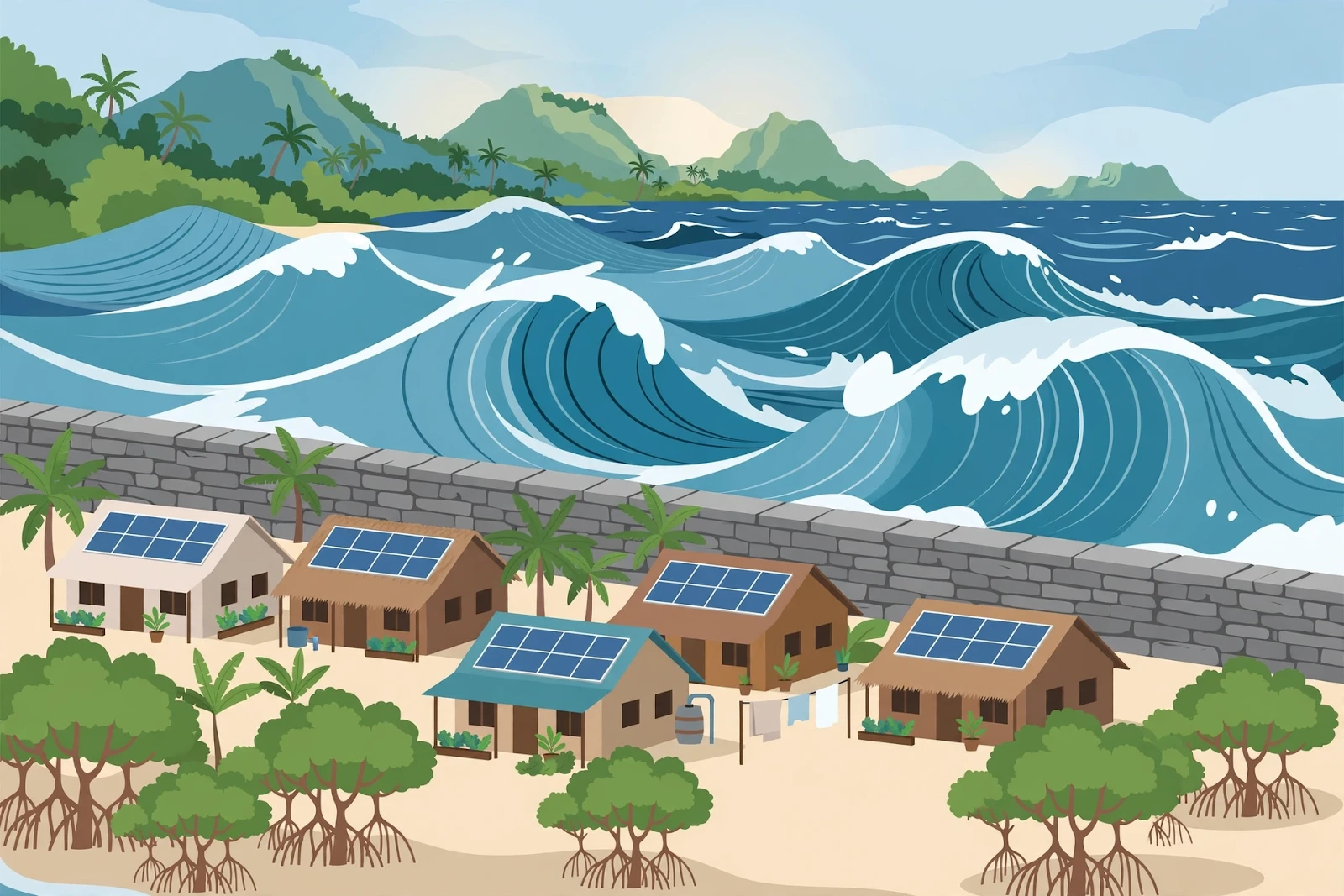
Illustration: A Pacific island village protected by a seawall and mangroves, symbolizing climate resilience funding for island nations.
Why It Matters
The Tuvalu visit matters because it replaced abstraction with evidence. Climate negotiations often trade in degrees, gigatonnes and distant deadlines; the pre-COP put negotiators on land that is literally being built back from the sea, in rain, watching dredgers work. That imagery — and the declaration signed afterwards — is designed to travel to Antalya, where Pacific negotiators will press for the same priorities: holding warming beneath 1.5 degrees, protecting oceans, and getting money for resilience projects that can actually be accessed by small island governments.
The financing gap on display is itself the story. The $15 million in new pledges is real money, and the fund's rise to just under $200 million — roughly half of it from Pacific island governments, New Zealand and Australia — shows the region is putting its own resources in first. But it remains far from the $500 million target for after COP31, let alone $1.5 billion. "This is the moment to invest," Cook Islands Prime Minister Mark Brown told delegates. "Your investment buys us time." Australian Prime Minister Anthony Albanese added: "More is needed now. Every investment now will make a difference and mean less cost of remediation tomorrow and in the future."
The episode also exposed the politics of climate diplomacy. The pre-COP guest list was thin at leader level: diplomats from several Western nations said they could not justify sending their leaders on a multi-day journey when they would also be expected at COP31 weeks later, and one European diplomat criticised Australia for treating the event as a diplomatic win rather than a negotiating step. Pacific leaders pushed back — if partners would not come to see the front line, they argued, the promises made in distant conference halls would keep arriving too late. That tension will follow the Pacific delegation to Antalya.
For the wider world, Tuvalu is an early warning, not an exception. The same forces — rising seas, saltwater intrusion, more volatile weather — are already pressing on coastlines from Bangladesh to Florida. What Pacific nations are asking for at COP31 — accessible adaptation finance, faster delivery, and a credible path back below 1.5 degrees — is a test of whether the global climate system can serve the countries that did least to cause the problem and face its worst consequences first.
What Happens Next
All roads now lead to Antalya, where COP31 runs from 9 to 20 November 2026 under Turkey's presidency, with Australia leading the formal negotiations under the compromise that resolved the hosting contest. Pacific negotiators will arrive with the pre-COP declaration behind them and a clear set of asks: progress on the $500 million Resilience Facility target, better access to global adaptation funds, ocean protection, and language that keeps 1.5 degrees alive as a goal rather than a memory.
Several near-term decisions will show whether the pre-COP momentum survives contact with the main summit. The Green Climate Fund board's consideration of the $250 million Pacific adaptation programme, due later in October, will test whether large funds can move at the speed island nations need. The Resilience Facility's fundraising will be watched pledge by pledge in Antalya. And the summit's wider negotiations — including the European Union's push for a package turning existing climate pledges into real-world emissions cuts — will determine whether the declaration's call for "deep, rapid and sustained emissions reductions" finds its way into agreed text.
Back in Tuvalu, the dredgers will keep working regardless of what happens in Antalya. The six hectares of new land are both a practical defence and a symbol: a nation refusing to disappear quietly, building ground to stand on while it argues for a world that will let it keep standing. As Panapa told the visitors on that rain-soaked shore, the moment requires decisive delivery — and COP31 will be judged, in the Pacific at least, on whether it delivers.

Illustration: A large international climate conference hall, symbolizing the COP31 summit in Antalya.
Sponsored: explore today's featured sponsored offers
FAQ
What is the Pacific pre-COP?
It is a preparatory climate conference held in Fiji from 5 to 8 October 2026, where Pacific nations agreed their positions — and hosted a visit to Tuvalu — ahead of the COP31 summit in Antalya, Turkey.
Why did delegates visit Tuvalu?
To see sea-level rise first-hand. Representatives of around 30 countries watched land being reclaimed from the ocean on an atoll nation averaging just 2 metres above sea level, and heard Tuvalu's leaders argue for decisive delivery over promises.
What is the Pacific Resilience Facility?
It is an island-owned fund that finances climate resilience and adaptation projects in Pacific nations, investing its capital and spending the earnings on "small grants at scale." New pledges of about $15 million at pre-COP took its pot to just under $200 million.
What is the fund's target?
The facility aims to reach $500 million after COP31 wraps up in November, and ultimately $1.5 billion. Roughly half of the current pot has come from Pacific island governments, New Zealand and Australia.
When and where is COP31?
COP31 runs from 9 to 20 November 2026 in Antalya, Turkey, under Turkey's presidency, with Australia leading the formal negotiations.
Sources
- Reuters, 6 October 2026 — "Pacific leaders watch Tuvalu reclamation effort ahead of UN climate meet" (six-hectare reclamation; $50 million donor project; Panapa and Namoliki quotes; 30 nations).
- Reuters, 7 October 2026 — "Pacific's new climate fund gets $15 million boost but remains far below target" (Fiji, Ireland, Netherlands, Denmark pledges; pot just under $200 million; $500 million and $1.5 billion targets; Soqo; Brown and Albanese quotes).
- Reuters, 8 October 2026 — "Keeping global temperature gain in check is a matter of survival, COP31 president says" (Kurum "matter of survival" and 5 percent defence-spending remarks; 30-country declaration).
- Reuters, 2 October 2026 — "Pacific Islands get their climate moment with pre-COP meeting, but the guest list is thin" (pre-COP dates and 4,000 delegates; Pacific priorities; Tuvalu visit; guest-list criticism).
- Funds for NGOs / ADB, 8 October 2026 — "ADB President Masato Kanda urges faster climate resilience finance for Pacific islands ahead of COP31" ($250 million Green Climate Fund proposal; $1 billion leverage aim; Funafuti project; $210 million Fiji package).
Comments
Post a Comment