
Trump Signs Order Creating NIH Women's Health Division and White House Task Force
October 20, 2026 — President Donald Trump signed an executive order on Monday, October 19, 2026, alongside first lady Melania Trump, directing the U.S. Department of Health and Human Services to create a new Women's Health Division inside the National Institutes of Health within 90 days. The order, titled "Advancing Women's Health to Improve Outcomes in All Phases of Life," also establishes the first White House Women's Health Task Force, which will be co-chaired by Health Secretary Robert F. Kennedy Jr. and White House chief of staff Susie Wiles, according to HHS and Reuters.
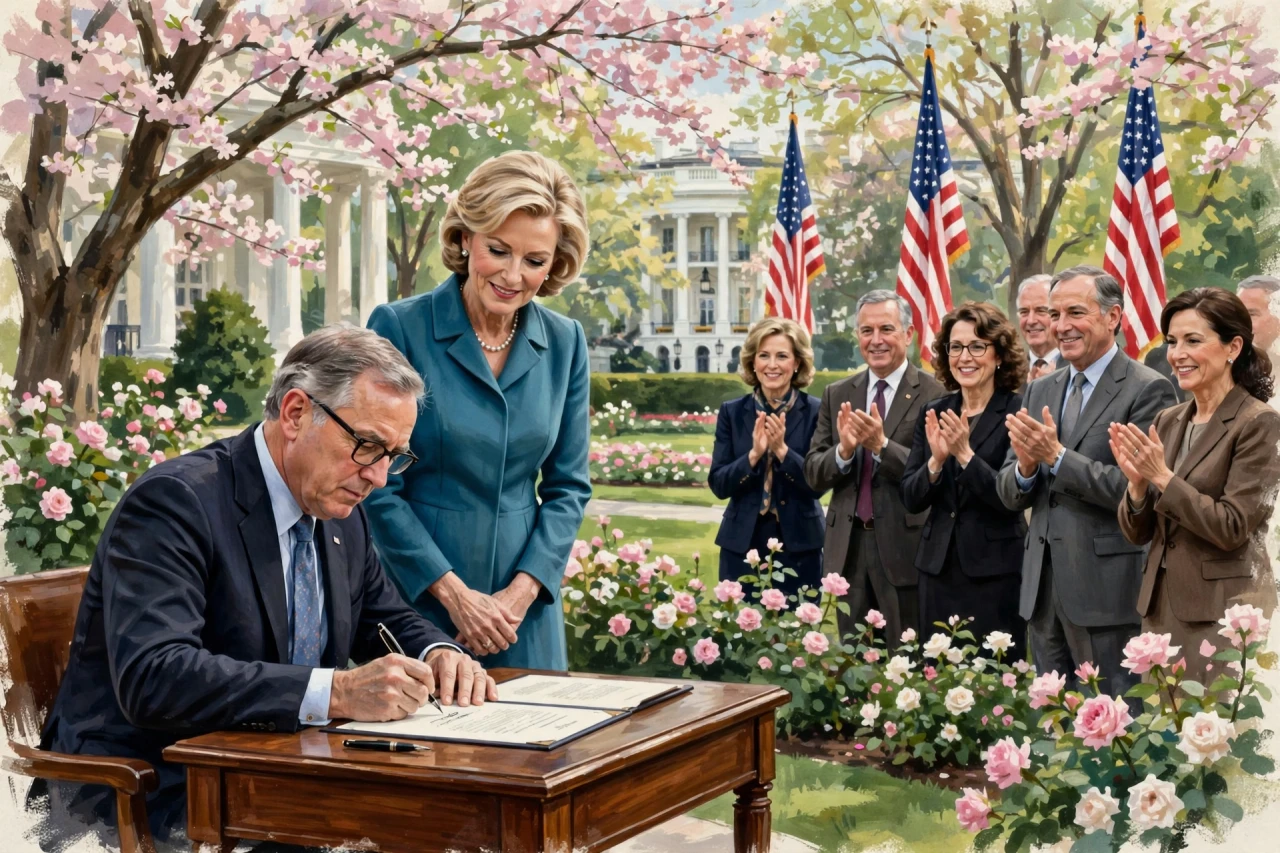
Illustration: A presidential executive-order signing ceremony in the White House Rose Garden, marking the launch of the new women's health initiative.
What Happened
The signing took place at a Rose Garden ceremony on Monday morning, where the first lady was flanked by senior administration officials including Wiles, Kennedy, Kennedy's wife Cheryl Hines, Centers for Medicare and Medicaid Services administrator Dr. Mehmet Oz, and EPA Administrator Lee Zeldin, the New York Post reported. Trump and his wife signed the order together, passing it between them and exchanging pens, according to the Post.
The order directs HHS, working through the NIH, to stand up the new Women's Health Division within an appropriate NIH institute or center within 90 days — roughly by mid-January 2027. According to HHS, the division will advance research into conditions that uniquely or disproportionately affect women, strengthen accountability in federally funded research, and accelerate the translation of scientific discoveries into prevention, diagnosis, treatment, and clinical care.
Separately, the order creates the White House Women's Health Task Force, charged with coordinating federal efforts on women's health from infancy and adolescence through the reproductive years, midlife, menopause, and healthy aging. The task force held its first meeting on Monday afternoon in the White House Roosevelt Room, the Post reported. The signing coincided with Breast Cancer Awareness Month, and Wiles — who recently announced she is cancer-free after breast cancer treatment, according to Reuters — is a prominent figure in the announcement.
Speaking before the signing, Trump said: "The executive order I'll sign in just a moment will direct the Department of Health and Human Services to establish a new women's health division within the National Institute of Health. That's a big deal. They've been after it for a long time." He added: "These are mothers, daughters, sisters, wives, and under the Trump administration, we're going to get them the care and support that they need and deserve," according to the New York Post.
Melania Trump, who championed the initiative, said at the ceremony: "This is a transformative moment for women in America. Beginning today, we will change the reality of women's health." She described the order as setting "a new standard for women's health in America," according to the Post.

Illustration: Scientists at work in a modern NIH biomedical research laboratory, where the new Women's Health Division is to be established.
Background
The NIH already houses an Office of Research on Women's Health, established in 1990. The new division will operate in coordination with that office rather than replace it, Reuters reported. The White House says the point of the new structure is to broaden the government's focus beyond research alone and prioritize turning scientific discoveries into clinical care for women and girls.
The order also reflects the first lady's stated interest in using artificial intelligence to speed up women's health discoveries, as well as her focus on access to and affordability of care, a White House official told Reuters. USA Today first reported that the order was planned, according to Reuters.
The announcement lands against a complicated policy backdrop. Reuters has reported that the Trump administration has pushed for cuts to federal health-care spending — including at the NIH — moved to downsize the federal health-care workforce, and sought to cancel NIH grants for research on diversity-related topics. The White House has not yet detailed how the new division will be funded or staffed, and HHS did not immediately respond to questions about the order before its signing, according to Reuters. Analysts quoted in coverage of the order note that the mandate will be judged on whether the 90-day deadline produces a functioning division with real resources, not just a nameplate.
Why It Matters
Women's health research has long lagged behind research focused on men, a gap that medical groups and patient advocates have documented for decades. Conditions such as endometriosis, polycystic ovary syndrome, and autoimmune diseases that disproportionately affect women receive a fraction of the research attention devoted to comparable conditions affecting men, researchers have said. A dedicated NIH division with a mandate spanning "all phases of life" — from adolescence through menopause and healthy aging, in the order's own language — signals an attempt to close that gap at the federal level.
The task force's remit is unusually broad: rather than concentrating on a single disease or age group, it is meant to coordinate everything from maternal health to menopause care to healthy aging. If it works as described, that coordination could matter most in areas where women's care currently falls between bureaucratic cracks — for example, in clinical trials that have historically under-enrolled women, or in translating research findings into treatment guidelines that physicians actually use.
The political dimension is significant too. By putting Susie Wiles — a breast cancer survivor and the president's chief of staff — in a co-chair role alongside Kennedy, the administration has given the initiative a personal story as well as a policy one. And by scheduling the signing during Breast Cancer Awareness Month, it maximized the symbolic reach of the announcement. The test will be the details: the division's budget, its leadership, and whether its mandate to translate research into clinical care produces measurable changes for patients.

Illustration: A doctor consulting with women of different ages, representing the initiative's goal of improving women's health across all life stages.
What Happens Next
The clock is now running on the 90-day deadline:
- Division setup: HHS must establish the Women's Health Division inside an appropriate NIH institute or center by roughly mid-January 2027, and name its leadership and organizational home.
- Funding and staffing: Watch for budget requests, staffing announcements, and whether existing NIH women's-health funding is expanded or simply reorganized under the new banner.
- Task force agenda: With its first meeting already held, the Wiles-Kennedy task force is expected to set an agenda spanning research coordination, clinical practice, and AI-assisted discovery — including the first lady's push on using AI to accelerate breakthroughs.
- Accountability measures: HHS says the division will strengthen accountability in federally funded research; researchers and advocates will look for concrete standards on trial enrollment and research priorities.
- Clinical translation: The order's promise to move discoveries into "prevention, diagnosis, treatment, and clinical care" will be tested by whether treatment guidelines and care standards visibly change in the coming years.
Sponsored: explore today's featured sponsored offers
FAQ
What does the executive order actually do?
The order, titled "Advancing Women's Health to Improve Outcomes in All Phases of Life," directs HHS to create a new Women's Health Division within the NIH within 90 days, and establishes the first White House Women's Health Task Force to coordinate federal women's-health efforts, according to HHS and Reuters.
Who will lead the task force?
The task force is co-chaired by Health Secretary Robert F. Kennedy Jr. and White House chief of staff Susie Wiles, who recently announced she is cancer-free after breast cancer treatment, Reuters reported. It held its first meeting on October 19 in the White House Roosevelt Room, according to the New York Post.
Does the new division replace the NIH's existing women's health office?
No. The NIH's Office of Research on Women's Health, established in 1990, remains in place; the new division will operate in coordination with it, Reuters reported. The White House says the division's mandate is broader than research alone, covering the translation of discoveries into clinical care.
What role does the first lady play?
Melania Trump championed the initiative and spoke at the signing ceremony, calling it "a transformative moment for women in America." A White House official told Reuters she also plans to address using artificial intelligence to speed up women's health discoveries, as well as access and affordability of care.
What happens by the 90-day deadline?
HHS must have the Women's Health Division established within an appropriate NIH institute or center by roughly mid-January 2027. The division's leadership, budget, and research priorities are expected to become clearer as that deadline approaches.
Sources
- U.S. Department of Health and Human Services, "President Trump Signs Historic Executive Order to Advance Women's Health, Championed by First Lady Melania Trump," October 19, 2026
- Reuters (Trevor Hunnicutt and Ahmed Aboulenein), "Trump signs order creating NIH division, task force for women's health," October 19, 2026
- New York Post, "Donald Trump signs executive order creating NIH task force as Melania unveils 'new standard for women's health in America,'" October 19, 2026
Comments
Post a Comment