
Brazil Closes Its COP30 Presidency With Fossil-Fuel and Forest Roadmaps, Urging Action Over More Talks
BRASÍLIA — Brazil is closing its year-long presidency of the United Nations climate process with two roadmaps — one to accelerate the shift away from fossil fuels and one to curb deforestation — and a blunt message to governments: stop negotiating the same promises and start implementing them.
COP30 President André Corrêa do Lago, who led last November's UN climate summit in Belém, told Reuters on Tuesday, November 3, 2026, that governments must now integrate climate goals into everyday policymaking, bringing finance, infrastructure and transport ministers to the table alongside environment ministers. "We don't need more negotiations. What we need is for governments to start taking action," he said. "We need to completely change the way governments deal with climate change."
The message lands a week before COP31 opens in Antalya, Turkey, on November 9, where summit president Murat Kurum, Turkey's environment, urbanisation and climate change minister, has also said the agenda will focus on implementation rather than new pledges, based on what he has described as "dialogue, consensus and action."
Brazil's roadmaps do not themselves settle the two hardest questions in climate diplomacy — how fast to replace fossil fuels, and who pays to protect forests. Both plans failed to win consensus for inclusion in the final COP30 agreement in Belém, after opposition from major oil-producing countries and persistent disagreements over forest finance. What they do, Corrêa do Lago argued, is give governments a sequenced path they can act on without reopening negotiations that have already taken place.

Illustration: A UN climate summit hall in Belém, Brazil, with delegates beneath a green forest canopy motif. (AI illustration)
What Happened
Reuters reported on November 3 that Brazil is ending its COP30 presidency by presenting roadmaps aimed at curbing deforestation and accelerating a shift away from fossil fuels, designed to help governments deliver on past climate agreements. The announcement frames Brazil's presidency not as a search for new headline pledges, but as an attempt to turn existing commitments into national plans, regulations and investments.
On energy, Brazil sought in Belém to formalise an energy transition roadmap, following the agreement by more than 100 countries at COP28 in Dubai in 2023 to triple renewable energy capacity by 2030. The plan had European support, Reuters reported, but failed to secure consensus after opposition from major oil-producing countries, which have been reluctant to embrace measures that could undermine a key source of revenue.
Under the roadmap as outlined by Brazil, countries would spend the period to 2028 assessing their energy systems, strengthening regulations and institutions, and developing national transition plans ahead of the second Global Stocktake — the periodic evaluation of whether the world is on track to contain global warming. By 2030, infrastructure upgrades and renewable energy investments should be underway. A final phase between 2031 and 2033 would focus on accelerating renewable energy deployment, replacing fossil fuels and consolidating cleaner energy systems.
On forests, a lack of consensus also kept Brazil's proposed deforestation roadmap out of the final COP30 agreement, reflecting disagreements over how to finance forest protection. Brazil's proposed Tropical Forests Forever Facility, which would use returns from a sovereign fund to provide ongoing payments to countries that preserve their tropical forests, had secured $7.6 billion by the end of COP30, against a target of $10 billion, according to Corrêa do Lago. The roadmap also calls for expanding other funding initiatives, including strengthening carbon markets, improving direct access to finance for Indigenous peoples and local communities, and using debt-relief instruments.
"Public financing from developed countries is absolutely essential," Corrêa do Lago said. "But we have a much more sophisticated and diversified way of financing the various activities that would reduce deforestation." He added that the roadmap's main value was in highlighting the complexity of tackling forest loss: "It is not an easy task, and it is not just about financing. But financing is a central part of this process."

Illustration: The Amazon rainforest canopy with a winding river and a distant patch of cleared land. (AI illustration)
Background
The roadmaps sit on top of a decade of climate agreements that have proved easier to sign than to implement. The Paris Agreement, adopted in 2015, set the goal of limiting global warming to 1.5 degrees Celsius above pre-industrial levels. Shifting away from fossil fuels and reducing deforestation are considered essential to that goal — yet a UN report last month showed 1.5C was increasingly out of reach, Reuters reported.
The energy transition has made real but uneven progress. Global renewable energy capacity reached a record 5,149 gigawatts at the end of 2025, up 692 GW from the previous year, according to the International Renewable Energy Agency. But Brazil's roadmap notes that most recent growth in renewable energy has gone toward meeting new demand rather than replacing fossil fuel use — meaning total fossil fuel consumption has not fallen as fast as clean capacity has grown.
Forest finance tells a similar story of ambition outrunning money. According to the United Nations Environment Programme, annual funding for forests must rise from $84.5 billion in 2023 to more than $300 billion by 2030. Most current funding comes from national governments, which account for 88.3% of forest finance, with international public funding at only 3.4%, placing much of the burden on the developing countries where most of the world's tropical forests are located.
Belém was a symbolic as well as substantive choice for COP30: the first UN climate summit held in the Amazon. Brazil used the setting to argue that forest countries should be paid for the global service their forests provide — storing carbon, regulating rainfall and sheltering biodiversity — rather than left to bear the cost of protection alone. The Tropical Forests Forever Facility is the flagship of that argument, but at $7.6 billion it remains short of its $10 billion target, and its payments model is still being built out.
Brazil's presidency also unfolded against a shifting political backdrop. Oil-producing nations pushed back against language that could be read as a mandated phase-out, while developing countries pressed for finance and for a seat at the table for the ministers who control budgets, grids and transport systems. Corrêa do Lago's refrain — that the negotiation has already taken place and now needs implementation — is aimed at both camps.
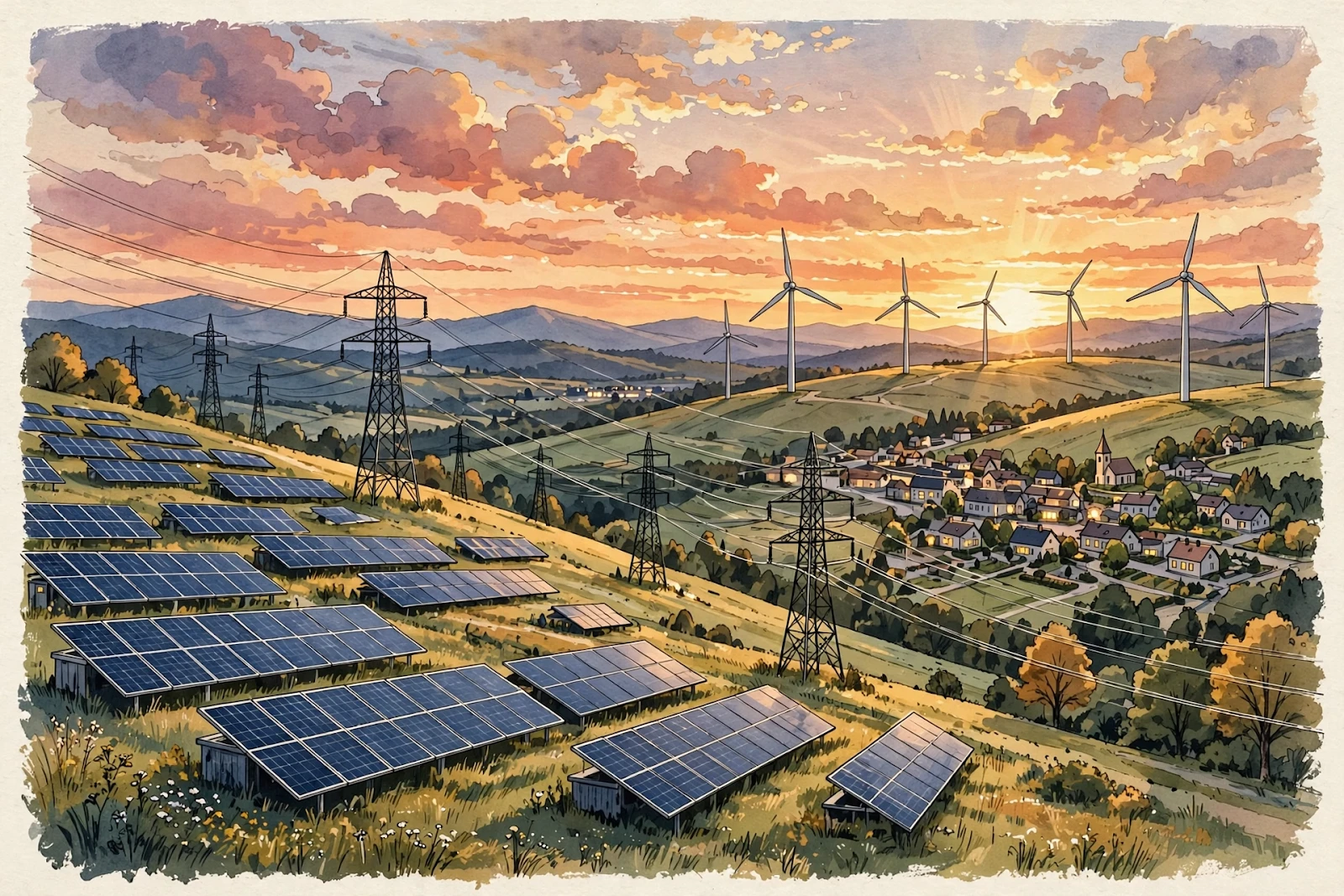
Illustration: Solar panels and wind turbines beside a small town at sunset. (AI illustration)
Why It Matters
The roadmaps matter less as negotiating texts than as a test of whether the climate process can move from pledges to delivery. If governments adopt the energy roadmap's sequencing — assessment and regulation to 2028, investment underway by 2030, accelerated replacement of fossil fuels in 2031–2033 — the next Global Stocktake will have concrete national plans to judge, rather than another round of promises. If they do not, the same roadmaps will join a long shelf of well-designed plans that changed little on the ground.
The forest roadmap carries a parallel test. Tropical forests are among the cheapest large-scale carbon stores available, but only if the countries that host them can afford to protect them against logging, farming and mining pressures. A financing gap that leaves international public funding at 3.4% of forest finance is, in Corrêa do Lago's framing, a design flaw rather than an act of nature — fixable through the mix of public money, carbon markets, direct community finance and debt relief that the roadmap proposes.
For COP31, the stakes are presentational as well as practical. Antalya's presidency has promised an implementation-focused summit, but it inherits the same disagreements that kept both roadmaps out of the Belém agreement: oil producers wary of transition timelines, and forest nations wary of unfunded mandates. Brazil's handover message is, in effect, a warning to Antalya not to spend its presidency renegotiating what Belém already agreed in principle.
There is also a credibility question for Brazil itself. As COP30 president it championed forest protection while its own Amazon policies remain under scrutiny from environmental groups, and its roadmaps will be judged partly by whether Brazil and other forest nations can show falling deforestation alongside rising finance. The $2.4 billion still missing from the Tropical Forests Forever Facility's target is an early, measurable indicator to watch.
What Happens Next
COP31 opens in Antalya, Turkey, on November 9, 2026, with implementation high on the agenda. Delegates will be watching for whether the Turkish presidency picks up Brazil's roadmaps as working documents — particularly the energy transition sequencing and the forest finance mix — or treats them as background papers while negotiations move elsewhere.
On finance, the next milestones are the Tropical Forests Forever Facility's push toward its $10 billion target and any new contributions announced on the Antalya sidelines. On energy, the test will be national transition plans: whether major economies publish credible 2028 assessment and regulation timelines, and whether renewable investment in 2026–2027 begins to displace fossil fuels rather than merely meeting new demand.
A separate financing picture, reported by Spain's Santander on Tuesday, underlines the scale of the task: the bank estimated a global financing gap of around €30 trillion ($33.6 trillion) over the next five years, mainly in energy transition investment but also in AI and defence, with climate-related mitigation and adaptation accounting for between €22 trillion and €26 trillion of that gap for 2026–2030. Closing it, Santander said, will require public-private collaboration — the same message Corrêa do Lago delivered from the climate side.
Finally, the second Global Stocktake looms as the formal moment of judgment. If, by the time it is conducted, countries can point to national plans, grid upgrades and forest payments that trace back to the Belém roadmaps, Brazil's presidency will be remembered as the moment the climate process turned toward delivery. If not, the roadmaps will stand as another reminder that in climate diplomacy, agreement is the easy part.
Sponsored: explore today's featured sponsored offers
FAQ
What did Brazil announce at the end of its COP30 presidency?
Brazil presented two roadmaps — one to accelerate the shift away from fossil fuels and one to curb deforestation — and urged governments to move from negotiation to implementation, according to Reuters on November 3, 2026.
Why were the roadmaps not in the final COP30 agreement?
Reuters reported that the energy transition roadmap failed to secure consensus after opposition from major oil-producing countries, while the deforestation roadmap was held back by disagreements over how to finance forest protection.
What is the Tropical Forests Forever Facility?
It is Brazil's proposal to use returns from a sovereign fund to provide ongoing payments to countries that preserve their tropical forests. It had secured $7.6 billion by the end of COP30, against a $10 billion target, according to COP30 President André Corrêa do Lago.
When does COP31 begin, and what will it focus on?
COP31 is due to get underway in Antalya, Turkey, on November 9, 2026. Its president, Murat Kurum, has said the agenda will focus on implementation rather than new pledges.
How far is the world from its forest funding needs?
According to the United Nations Environment Programme, annual funding for forests must rise from $84.5 billion in 2023 to more than $300 billion by 2030.
Sources
Reuters, "Brazil wraps up COP30 with fossil fuel, forest roadmaps, urging shift from talks to action," November 3, 2026.
Reuters, "World faces €30 trillion financing gap, Santander report warns," November 3, 2026.
International Renewable Energy Agency, global renewable energy capacity data for end-2025, as reported by Reuters.
United Nations Environment Programme, forest finance figures, as reported by Reuters.
Comments
Post a Comment