
Japan's Shodo Calligraphy Wins UNESCO Backing: Traditional Brush Art Nears Intangible Heritage Listing
TOKYO — Japan's traditional art of calligraphy, known as shodo, has moved to the brink of international recognition after a UNESCO evaluation body recommended it for inscription on the Intangible Cultural Heritage list, the Japanese government announced on Thursday, November 5, 2026. A final decision is expected when UNESCO's Intergovernmental Committee meets in Xiamen, China, from November 30 to December 5.

Illustration: A calligrapher holds a large brush over white washi paper as a bold ink character takes shape in a traditional Japanese room.
The recommendation, reported by Kyodo News and carried by Qazinform on November 5, is the strongest signal yet that shodo — literally "the way of writing" — will join Japan's roster of living traditions recognised by the United Nations cultural agency. If the committee in Xiamen approves the nomination, shodo would become Japan's 24th entry on the Intangible Cultural Heritage list, alongside traditions including kabuki theatre, washoku cuisine and the traditional knowledge and skills associated with producing sake and shochu.
Prime Minister Sanae Takaichi welcomed the recommendation in a post on X, saying she was "delighted that 'Shodo,' an important element of Japanese culture, has been recognized as worthy of being passed down to future generations as a UNESCO Intangible Cultural Heritage." Chief Cabinet Secretary Minoru Kihara also told reporters on November 5 that the recommendation was "very pleased" news, according to Kyodo News.
UNESCO's evaluation body noted that shodo remains widely practised throughout Japan and is passed down through schools, clubs and other educational activities, according to the government announcement. Those efforts, the body said, play an important role in preserving cultural knowledge and values across generations — a key test for any tradition seeking a place on the list, which honours living heritage rather than monuments or relics.
What Happened
On Thursday, Japan's Agency for Cultural Affairs announced that UNESCO's Evaluation Body had recommended the inscription of shodo. The announcement capped a nomination journey that has stretched over several years. Japan's Cultural Affairs Council selected shodo for UNESCO nomination in 2023, and the relevant documents were submitted in 2025, paving the way for the evaluation body's recommendation, according to Qazinform's report citing Kyodo.
The path was not straightforward. Japan first sought recognition for shodo in 2024, but UNESCO postponed consideration of that application, according to reporting by The Japan Times. A panel of experts then selected shodo again as a candidate in March 2025, and Japan submitted a fresh nomination by the end of that month. The evaluation body's recommendation this week is the next — and usually decisive — step in that process.
Shodo is a traditional Japanese art form that uses kanji and kana characters. According to Japan's Agency for Cultural Affairs, the country developed its own distinctive calligraphic styles following the introduction of Chinese characters from the continent. Where Chinese calligraphy has already been included on UNESCO's Intangible Cultural Heritage list, Japan's nomination argues that shodo evolved into something distinct: a practice woven into daily life, education, ceremony and art, from New Year calligraphy sessions to the brush-written signs, letters and artworks that still fill Japanese homes.
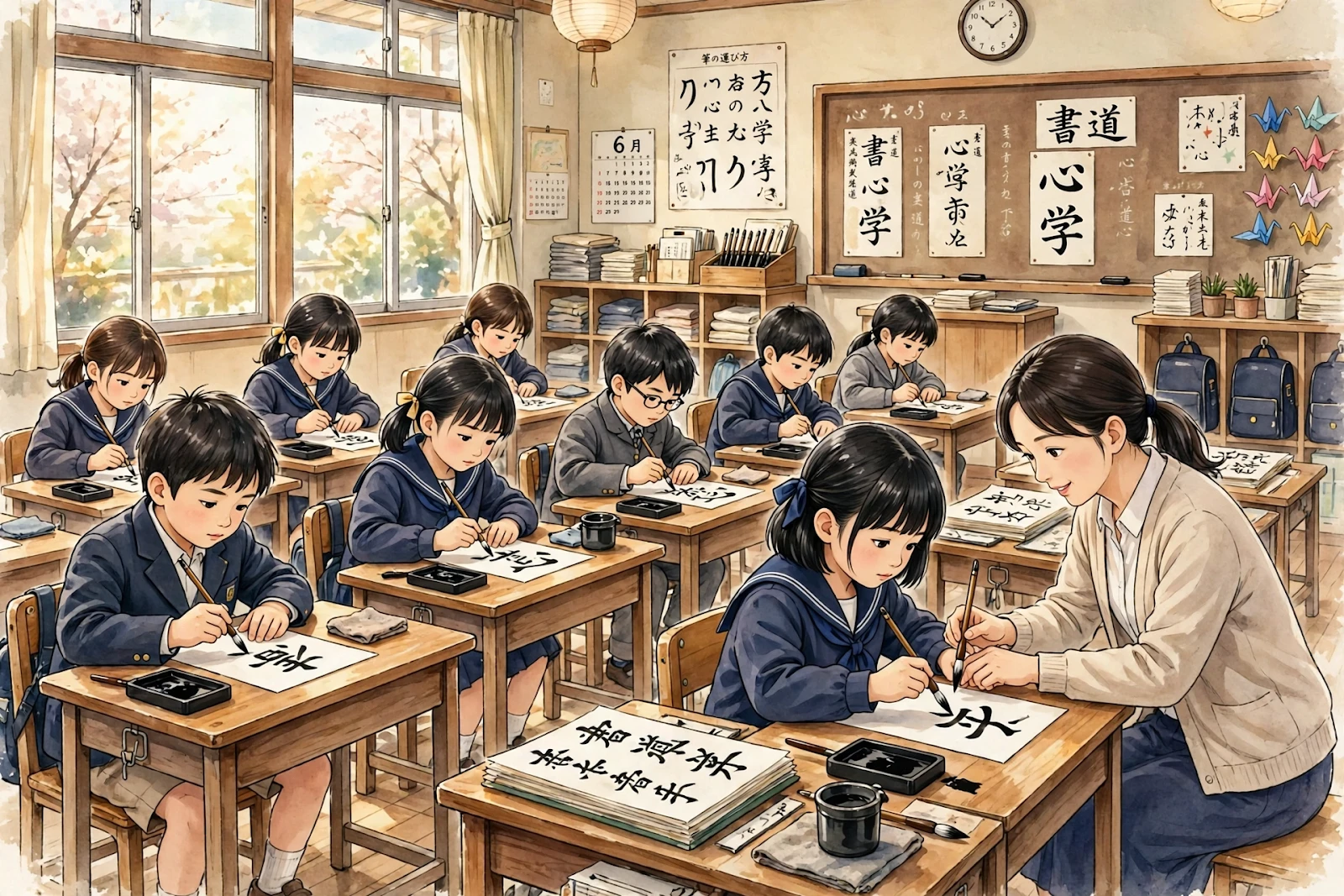
Illustration: School children practise calligraphy at wooden desks with brushes, inkstones and paper in a bright Japanese classroom.
The proposed inscription is also expected to raise international awareness of the cultural and artistic significance of handwritten calligraphy as a living tradition and to encourage cultural dialogue, the evaluation body noted. That framing matters: UNESCO's intangible list is not a prize for the past, but a commitment to keep a practice alive — through teaching, transmission and public support — into the future.
Background
UNESCO's Intangible Cultural Heritage list, established under the 2003 Convention for the Safeguarding of the Intangible Cultural Heritage, now covers hundreds of traditions around the world, from music and dance to craftsmanship, cuisine and oral storytelling. Nominations are assessed by an Evaluation Body, which sorts them into three categories: recommended for inscription, referred back for additional information, or not recommended. Elements recommended for inscription are generally approved by the Intergovernmental Committee, though the final decision rests with the committee itself.
Japan is one of the list's most active participants, with 23 elements inscribed so far. Its most recent addition before shodo was the traditional knowledge and skills associated with sake and shochu production. Earlier entries include kabuki, noh theatre, washoku — the traditional dietary culture of Japan — and the craftsmanship of washi paper. Shodo's advocates have long argued that calligraphy belongs in that company: it is at once an everyday skill, a school subject, a fine art and a spiritual discipline, practised by everyone from primary-school pupils to master calligraphers whose abstract brushwork hangs in museums beside modern painting.
The art's history runs deep. Calligraphy arrived in Japan with Chinese characters and was refined over more than a thousand years into distinct Japanese styles, including the flowing kana script that grew out of cursive kanji during the Heian period (794–1185). In the twentieth century, avant-garde calligraphers broke the character loose from legibility altogether, treating ink on paper as pure expression — work that now sells at international auction and hangs in major museums. Today's nomination embraces all of it: the classroom practice, the ceremonial writing, the professional art and the community clubs that keep the brush in ordinary hands.
Shodo is not the only tradition awaiting a verdict in Xiamen. UNESCO's Evaluation Body considered 59 nominations this year and recommended 56 for inscription, while referring three back to their submitting countries for further work, according to a UNESCO document reported by Qazinform. Among the recommended elements are Kazakhstan's Salburyn horseback festival with Tazy dogs and golden eagles, a joint Central Asian nomination for the art of embroidery, and a traditional feltmaking nomination submitted jointly by eight countries. South Korea's hanji — traditional handmade paper — is also reported by the Korea JoongAng Daily to be likely to be recognised at the same meeting, which would make it Korea's 24th entry on the list.
Why It Matters
For Japan, inscription would be more than a badge of honour. UNESCO recognition tends to bring funding, tourism and, most importantly, a formal safeguarding plan: documented teaching, support for practitioners and public programmes that keep a tradition from fading as lifestyles change. Shodo faces the same pressures as many hand crafts in a digital age — fewer hours of handwriting in schools, fewer young people taking up the brush, and a public that increasingly types rather than writes. A UNESCO listing would give schools, clubs and local governments a powerful reason to protect practice time and pass the art on.
For the wider world, the recommendation is a reminder of what the intangible list is for. In a year when the committee will also weigh eagle-hunting festivals, embroidery traditions shared across borders and feltmaking practised from Anatolia to Mongolia, shodo's case rests on a simple claim: that a way of writing can also be a way of thinking, feeling and belonging. The evaluation body's emphasis on schools and clubs — on transmission rather than perfection — underlines that the list honours living communities, not just beautiful objects.
There is also a quiet diplomatic dimension. Cultural heritage nominations are among the few international processes where countries routinely co-operate across political divides — the feltmaking nomination alone spans eight nations, and the embroidery nomination three. Japan's shodo bid, filed alongside Korea's hanji bid, arrives at a moment when East Asian cultural diplomacy is closely watched, and a shared celebration of paper, ink and brush in Xiamen would be a fitting counterpoint to the region's sharper headlines.
What Happens Next
The Intergovernmental Committee for the Safeguarding of the Intangible Cultural Heritage meets in Xiamen, China, from November 30 to December 5, 2026. There, member states will take up the Evaluation Body's recommendations, including shodo's. Because elements recommended for inscription are generally approved, observers expect shodo to be inscribed — but until the committee votes, the listing is not final, and Japan's government has stopped short of declaring victory.
If approved, Japan will be expected to implement a safeguarding plan for shodo, working with the Agency for Cultural Affairs, schools, calligraphy associations and local communities. Expect announcements in December about exhibitions, school programmes and public calligraphy events marking the inscription — and, in the longer term, a renewed push to bring the brush back into classrooms and daily life.
For now, the recommendation itself is the news: after a postponed first attempt and a fresh nomination in 2025, Japan's art of the brush has been judged worthy of the world's living-heritage list. The final stroke, fittingly, will be written in Xiamen in December.

Illustration: Delegates gather in a grand conference hall for a formal international heritage meeting, where the final inscription decision will be taken.
Sponsored: explore today's featured sponsored offers
FAQ
What is shodo?
Shodo, literally "the way of writing," is the traditional Japanese art of calligraphy, written by hand with brush and ink using kanji and kana characters. It is practised in schools, clubs and studios across Japan, and ranges from everyday handwriting to fine art.
Has UNESCO already listed Japanese calligraphy?
Not yet. On November 5, 2026, UNESCO's Evaluation Body recommended shodo for inscription on the Intangible Cultural Heritage list. The final decision will be taken by the Intergovernmental Committee in Xiamen, China, from November 30 to December 5, 2026.
Why did it take so long for shodo to be nominated?
Japan's Cultural Affairs Council selected shodo for nomination in 2023. A first application in 2024 was postponed by UNESCO, and Japan submitted a fresh nomination in 2025, which led to the evaluation body's recommendation in November 2026.
How many Japanese traditions are already on UNESCO's intangible list?
Japan currently has 23 elements inscribed, including kabuki theatre, washoku cuisine and the traditional knowledge and skills associated with sake and shochu production. If approved, shodo would become the 24th.
What other traditions are awaiting decisions in Xiamen?
The Evaluation Body recommended 56 of 59 nominations this year, including Kazakhstan's Salburyn hunting festival, a joint embroidery nomination from Kazakhstan, Tajikistan and Uzbekistan, and an eight-country feltmaking nomination. South Korea's hanji paper is also reported to be likely to be recognised at the same meeting.
Sources
Qazinform, "UNESCO advisory body backs Japan's traditional calligraphy for cultural heritage list," November 5, 2026 (citing Kyodo News); Qazinform, "Kazakh traditions of Salburyn, embroidery and feltmaking recommended for UNESCO Heritage List," November 5, 2026; Korea JoongAng Daily, "Unesco likely to recognize hanji production as cultural heritage," November 5, 2026; The Japan Times, "Japan seeks UNESCO heritage recognition for calligraphy again," March 4, 2025; TV Asahi News, "Shodo recommended for UNESCO Intangible Cultural Heritage inscription," November 5, 2026.
Comments
Post a Comment