
VIENNA — OPEC+ producers have agreed in principle to leave their oil output targets unchanged for December, setting up a formal sign-off at an online meeting of the group's seven core members on Sunday, 1 November 2026, according to three people familiar with the discussions cited by Reuters. The decision would extend the producers' current policy stance through the end of the year, even as Brent crude — the global benchmark — closed at its highest level since late April after another attack on shipping in the Strait of Hormuz.
The freeze, if confirmed as expected, means no new supply will be added to a market that has already tightened sharply. Brent crude futures for December, which expired on Friday, settled at $117.64 a barrel, up $2.76, or 2.4 percent, after touching $118 during the session. The more active January contract settled at $113.43, while United States benchmark West Texas Intermediate rose $2.12, or 2.08 percent, to $104.12. Over October as a whole, Brent gained 13.6 percent and WTI gained 15.2 percent, leaving both benchmarks at their strongest levels since the spring.

Illustration: Oil pumpjacks and storage tanks in a desert oil field beneath a rising price chart. This is an AI-generated illustration, not a photograph of an actual oil facility.
What Happened
According to Reuters reporting published on 1 November, the seven core members expected to ratify the December freeze are Saudi Arabia, Russia, Iraq, Kuwait, Algeria, Kazakhstan and Oman. The understanding matches expectations that no further policy changes will come until next year, and it follows the completion in September of a 1.65 million-barrel-per-day rollback of earlier cuts. A separate layer of cuts of about 2 million barrels per day, covering most members, remains in place through the end of 2026.
The timing matters. The producers are meeting with prices already running hot: traders pushed crude more than 2 percent higher on Friday as they braced for a possible escalation in the war involving Iran, and as they weighed the risk that shipping through the Strait of Hormuz — the narrow waterway through which a large share of the world's seaborne oil travels — could be disrupted further. Kitco reported that another tanker attack in the strait was the immediate trigger for Friday's rally, and that United States–Iran negotiations over sanctions and Hormuz shipping security remain unresolved.
The freeze is therefore less a decision to tighten the market than a decision not to loosen it. OPEC+ had been widely expected to stand pat through the fourth quarter, and the preliminary agreement confirms that expectation. What it does not do is add barrels: Gulf producers are still pumping below their quotas after months of disruption linked to the Iran war, and the physical route to Asian buyers remains contested.
Background
The oil market's year has been defined by that disruption. Saudi Arabia, OPEC's most powerful member, reported September production of roughly 8.37 million barrels a day to OPEC, according to the group's October monthly report — about 2.1 million barrels a day below its 10.5 million-barrel-a-day quota. The shortfall is not, by that reporting, a matter of chosen restraint: Houthi missiles have hit Saudi refineries, and shipping through Hormuz has been repeatedly attacked, with the IRGC claiming three tankers struck mines on an IMO-approved corridor by 30 October, according to one detailed account of the week's events.
The price path tells the same story in numbers. Brent was trading around $116.72 a barrel a week ago and reached $117.64 by Friday's close, according to a weekly market newsletter summarising the move. Goldman Sachs had raised its December 2026 Brent target to $90 in October, according to Reuters — a figure Brent has since blown past by roughly $27. The bank had earlier described the Hormuz disruption as the largest supply shock in the history of the global crude market.
Meanwhile, the World Bank's October Commodity Markets Outlook sketched a calmer medium-term path: Brent averaging $91 a barrel in 2026, up from $69 in 2025, before easing to an average of $79 in 2027 and $70 in 2028 as production recovers and the market tips into surplus. Global oil supply is expected to fall 5.2 percent in 2026 before rebounding, while global consumption is set to contract by 2.6 million barrels a day, or 2.5 percent, in 2026. The bank also warned of a harsher path in which Brent averages $105 in 2027 and food prices run 12 percent above the baseline — a reminder, in the words of deputy chief economist Ayhan Kose, that the balance between supply and demand remains fragile.

Illustration: Ministers seated around a long conference table beneath national flags at an OPEC-style meeting. This is an AI-generated illustration, not a photograph of the actual meeting.
Why It Matters
For households and businesses, the immediate consequence of $117 oil is fuel prices. United States national average retail gasoline stood at $4.1837 a gallon in data reported by the American Automobile Association — still 16.6 percent below the June 2022 peak, but historically elevated, and the direction of travel matters more than any single reading. Fuel costs feed into transport, food distribution and manufacturing, and they arrive at a moment when central banks are already wrestling with stubborn inflation.
That is the link markets are watching most closely. The United States Federal Reserve held its key rate at 3.75 to 4.00 percent on 28 October, with two officials favouring a hike, and headline personal consumption expenditures inflation was 3.6 percent in September, with core PCE at 3.1 percent. Kitco's analysis argues that higher energy prices strengthen expectations of a more restrictive Fed, with futures pointing to further tightening in December. In Europe, the next readings are euro-zone flash inflation on Wednesday, 4 November — September was 3.8 percent, with core at 2.5 percent, and the European Central Bank held its deposit rate at 2.50 percent on 29 October — and the Bank of England on Thursday, which is expected to raise Bank Rate by 0.25 points from 3.75 percent.
For oil-importing economies, the freeze also removes a hoped-for safety valve. A December increase in OPEC+ targets could have cooled prices; holding targets steady leaves the market to balance itself through demand destruction, inventory draws or a de-escalation in Hormuz. For producers, the same decision protects revenues at a time when their own output is constrained: Saudi Arabia cannot physically capture today's prices on barrels it is not producing, and a quota vote on Sunday cannot change the mined waterway or the damaged refineries behind the shortfall.
The decision also matters for the energy transition debate. High oil prices strengthen the case for alternatives and for efficiency, but they also raise the cost of living — the same pressure that has driven youth-led cost-of-living protests across Europe in recent weeks — and they complicate governments' efforts to shield households without fuelling further inflation. That tension is likely to shape budget and energy-policy debates through the winter.
What Happens Next
First, watch Sunday's online meeting itself. Formal ratification by the seven core members is expected, but any dissent — or any surprise language about 2027 policy — would move prices immediately, given how much of Friday's rally was driven by geopolitical risk rather than fundamentals alone.
Second, watch Hormuz. The market's next leg, up or down, is more likely to come from shipping news than from quota arithmetic: a quiet week on the waterway could let prices retrace from their April highs, while another attack could push the January Brent contract through its Friday levels. Traders will also watch United States stockpile data for signs of whether the surplus the World Bank expects for 2027 is already forming.
Third, watch the data calendar. Euro-zone flash inflation on Wednesday, the Bank of England decision on Thursday, and the United States October jobs report on Friday will each test the same question from a different angle: whether energy-driven price pressure is bleeding into broader inflation, and whether central banks respond by tightening further. OPEC+ must also complete a review of members' production capacity during the fourth quarter, according to Reuters sources — a process that will shape what targets are even credible for 2027.
Finally, watch demand. The World Bank expects global oil consumption to contract this year; if that contraction deepens, today's prices may prove self-correcting. If it does not — if the world keeps buying at $117 — then the December freeze will look less like a pause and more like the opening position in a longer standoff between producers, consumers and the central banks caught between them.
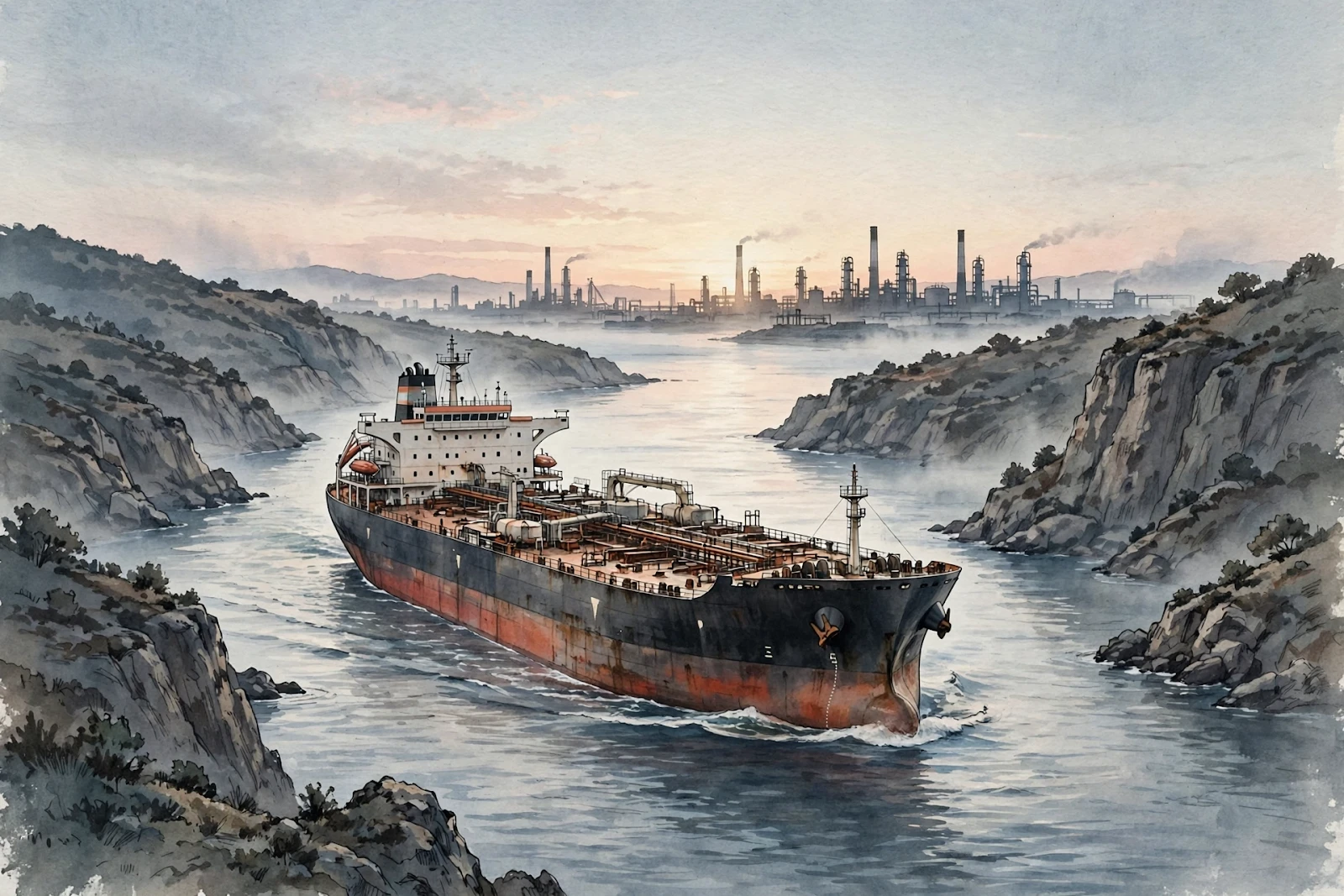
Illustration: A large oil tanker sailing through a narrow strait at dawn with refinery silhouettes on the horizon. This is an AI-generated illustration, not a photograph of an actual tanker transit.
Sponsored: explore today's featured sponsored offers
FAQ
What did OPEC+ agree for December?
According to Reuters sources, producers agreed in principle to leave December output targets unchanged, with formal confirmation expected from seven core members — Saudi Arabia, Russia, Iraq, Kuwait, Algeria, Kazakhstan and Oman — at an online meeting on Sunday, 1 November 2026.
How high is the oil price now?
Brent crude for December expired on Friday at $117.64 a barrel, after touching $118, while the January contract settled at $113.43 and West Texas Intermediate at $104.12 — the highest settlements since late April. Brent rose 13.6 percent in October and WTI 15.2 percent.
Why are prices rising if OPEC+ is not cutting further?
Prices are being driven less by new cuts than by supply disruption: attacks on Hormuz shipping, missile strikes on Saudi refineries, and Gulf producers pumping below quota have tightened a market in which the December freeze adds no new barrels.
What does this mean for fuel prices and inflation?
Higher crude feeds into gasoline, diesel and transport costs, which can push broader inflation higher and strengthen the case for central banks to keep rates restrictive — a particular concern with the Fed, the ECB and the Bank of England all facing key decisions in the coming week.
Will oil prices fall in 2027?
The World Bank's October outlook expects Brent to ease to an average of $79 a barrel in 2027 as production recovers and the market moves into surplus — but it warns that in an adverse scenario, Brent could average $105, so the forecast depends heavily on whether Hormuz shipping normalises.
Sources
- Reuters, via AsiaToday, 1 November 2026: "OPEC+ to Hold December Oil Output Targets Steady"
- BigGo Finance, 1 November 2026: "OPEC+ Nears Deal to Freeze December Output as Brent Tops $113"
- Kitco, via HawkValue, 1 November 2026: "Brent at $117.64: how oil is feeding the Fed hike fears"
- World Bank, October Commodity Markets Outlook, via QNC News, 31 October 2026: "World Bank sees Brent crude easing to 79 dollars in 2027"
- House of Saud Daily Briefing, 1 November 2026: "Brent Hits $116 as OPEC Meets With Saudi Output Below Quota"
Comments
Post a Comment