
MANILA — China and the Philippines pledged on Wednesday, 4 November 2026, to maintain dialogue and communication despite strained ties, offering their own accounts of a lengthy phone call between their foreign ministers the day before. The exchange comes less than two weeks before Manila hosts the 49th ASEAN Summit, a high-stakes gathering that will test whether the two neighbours can keep diplomacy on track while their ships and aircraft continue to meet — and sometimes clash — in the South China Sea.
According to the Philippine foreign ministry, Foreign Minister Ma. Theresa Lazaro spoke at length with her Chinese counterpart Wang Yi on Tuesday, describing the call as "frank, pragmatic and constructive". Beijing's account, carried by state news agency Xinhua, struck a sharper tone: Wang said relations face "malicious interference" and accused some politicians of "irrational and intolerable" conduct that crossed China's red lines. The contrast between the two readouts is itself part of the story — a sign of how far apart the two capitals remain even as both insist the conversation must continue.
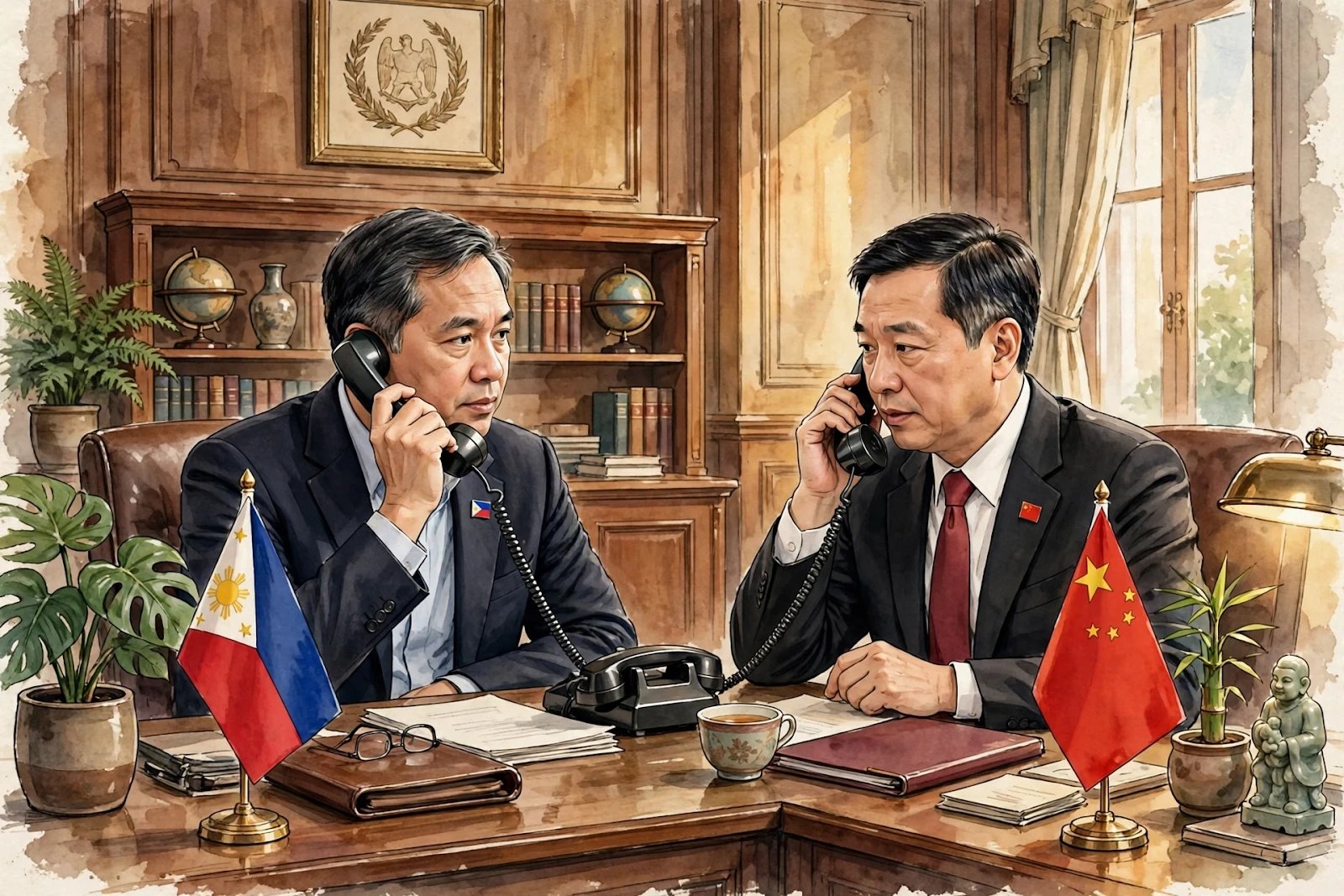
Illustration: The Philippines and China foreign ministers hold a diplomatic call ahead of the ASEAN Summit in Manila.
What Happened
Reuters reported on 4 November that both countries had pledged to keep lines of communication open after the Lazaro-Wang call. The Philippine foreign ministry said Manila takes its responsibilities as this year's ASEAN chair seriously, and that both ministers assured each other their leaders would be accorded the proper courtesies during the ASEAN summit in Manila and at the Asia-Pacific Economic Cooperation (APEC) meetings in Shenzhen later this month.
Chinese Premier Li Qiang is expected to attend the ASEAN meetings in Manila, the Philippine foreign ministry said, according to Reuters. That detail matters: in the weeks before the call, Manila had said Beijing had not confirmed who would lead its delegation, and Philippine officials had publicly said President Xi Jinping would be welcome in Manila — his last visit was in November 2018. The expectation that Li will attend suggests the summit's guest list is coming into focus, even if the top-level question remains open.
The call also touched on the broader calendar. The 49th ASEAN Summit and related summits are scheduled for 16–18 November 2026 in Metro Manila, principally at the Philippine International Convention Center in Pasay City. The Philippines holds the rotating ASEAN chair for 2026 under the theme "Navigating Our Future, Together", and the November gathering closes out its chairmanship year before Singapore takes over in 2027. United States President Donald Trump is among the confirmed attendees, according to Philippine officials cited by BusinessWorld on 3 November.
Preparations in the host city are already visible. Makati City has banned drones across the city for the whole of November, and the government has declared the three summit days holidays in the capital region, while Philippine Airlines has cancelled flights around the summit window to meet security requirements.
Background: A Month of Incidents at Sea
The dialogue pledge lands after a tense October at sea. According to the International Crisis Group's October 2026 CrisisWatch summary, maritime incidents between China and the Philippines persisted through the month and fuelled acrimony between the two states. On 1 October, the Philippine Coast Guard said it had deployed its largest vessel alongside aircraft to challenge a Chinese research vessel operating near the northern province of Batanes since late September, prompting the vessel to leave.
On 3 October, China warned against what it called "provocative acts" after a Philippine aircraft flew in airspace near Scarborough Shoal, and on 5 October the Philippines accused a Chinese fighter jet of interfering with a routine military patrol, repeatedly manoeuvring close to a Philippine aircraft. Manila said another confrontation occurred the next day in the Spratly Islands.
On 8 October, the Philippines accused a Chinese Coast Guard vessel of obstructing the emergency evacuation of an injured serviceman at Second Thomas Shoal by using a water cannon, while China said its coast guard had allowed the evacuation and provided necessary assistance. The Philippines also said the number of Chinese vessels in disputed waters had nearly doubled, from 56 in August to 101 in September — a figure also reported by USNI News, which counted at least six dangerous engagements between Chinese and Philippine forces at several disputed areas since the start of October.

Illustration: Coast guard vessels patrol disputed waters in the South China Sea, where encounters between Manila and Beijing have increased.
The deeper dispute is long-running. China claims much of the South China Sea, while the Philippines, backed by a 2016 arbitration award that Beijing rejects, asserts its own rights in what it calls the West Philippine Sea. A provisional understanding reached in 2024 was meant to make resupply missions to the grounded Philippine outpost BRP Sierra Madre at Second Thomas Shoal more predictable, but Manila has repeatedly accused Chinese forces of blocking or harassing those missions, including a reported ramming of a fisheries vessel in September 2026.
Against that backdrop, Philippine President Ferdinand Marcos Jr. said on 8 October that negotiations between China and ASEAN on a South China Sea Code of Conduct were making progress despite disagreements — while acknowledging his fear that an incident at sea could escalate uncontrollably, according to Crisis Group. That warning is the context for the Lazaro-Wang call: dialogue is not a courtesy here, but a safety mechanism.
Why It Matters
First, the chairmanship puts Manila in a dual role. As ASEAN chair, the Philippines must host all sides and keep the summit's agenda — peace and security, prosperity corridors and people empowerment, under its chairmanship theme — on track. As a claimant state, it is also a party to the very dispute the summit is expected to discuss. The call with Wang was, in that sense, a piece of summit management as much as bilateral diplomacy: reassuring Beijing that its leaders will be treated with proper courtesy, while signalling that Manila will not let the chairmanship mute its own position.
Second, the timing connects two summits. The ASEAN meetings in Manila on 16–18 November are followed almost immediately by the APEC leaders' meeting in Shenzhen, reported for 18–19 November. Leaders and ministers will move from one room to the other within days, and the tone set in Manila — including how China is received and what, if anything, is said about the South China Sea — will carry into Shenzhen.
Third, the differing readouts show how both sides use public messaging. Manila emphasised a constructive conversation and the responsibilities of the chair; Beijing emphasised interference and red lines. Neither account contradicts the core fact — the call happened and both sides say dialogue will continue — but the gap between them is a reminder that a pledge to talk is not the same as an agreement on substance. The Code of Conduct negotiations, the handling of resupply missions and the day-to-day conduct of coast guard vessels remain unresolved.

Illustration: The ASEAN Summit venue in Manila prepares to welcome regional leaders on 16–18 November 2026.
What Happens Next
The immediate test is the summit itself. Watch for whether Beijing confirms its delegation leader, and whether Premier Li Qiang's expected attendance is formally confirmed by China. Watch, too, for any bilateral meeting between Philippine and Chinese leaders on the summit sidelines, and for language on the South China Sea in the summit's outcome documents — particularly any reference to the Code of Conduct talks.
Beyond the summit, the real test will be at sea. If the weeks after Manila pass without a new water-cannon incident, ramming or dangerous aerial intercept, the dialogue pledge will look like more than summit diplomacy. If incidents resume quickly, the pledge will be judged by what it failed to prevent. Either way, the call on 3 November bought something valuable: a commitment, stated publicly by both sides, that the phone line stays open.
For the region, that matters beyond two countries. ASEAN's credibility as a manager of great-power tension rests in part on its ability to host difficult conversations without them breaking down. Manila has less than two weeks to prove it can do exactly that.
Sponsored: explore today's featured sponsored offers
FAQ
Who spoke in the Philippines-China call?
Philippine Foreign Minister Ma. Theresa Lazaro and Chinese Foreign Minister Wang Yi spoke by phone on Tuesday, 3 November 2026, according to statements from both governments reported by Reuters on 4 November.
What did each side say about the call?
Manila described the call as "frank, pragmatic and constructive". Beijing, via Xinhua, said relations face "malicious interference" and accused some politicians of conduct crossing China's red lines. Both sides said dialogue and communication would be maintained.
When is the ASEAN Summit in Manila?
The 49th ASEAN Summit and related summits are scheduled for 16–18 November 2026 in Metro Manila, principally at the Philippine International Convention Center, as the Philippines closes its 2026 ASEAN chairmanship year.
Is China attending the Manila summit?
The Philippine foreign ministry said Chinese Premier Li Qiang is expected to attend the ASEAN meetings in Manila, according to Reuters. Earlier reports had noted Beijing had not confirmed its delegation leader.
Why are Philippines-China relations strained?
The two countries dispute territory and maritime rights in the South China Sea. October 2026 saw a series of incidents — including a research-vessel standoff near Batanes, an aerial intercept near Scarborough Shoal and a water-cannon confrontation during a medical evacuation at Second Thomas Shoal — that kept tensions high.
Sources
- Reuters, "Philippines, China pledge to maintain dialogue despite tensions", 4 November 2026.
- BusinessWorld, "China remarks won't affect ASEAN Summit", 3 November 2026.
- Central Mindanao University, "CMU expresses support for Philippines' hosting of 49th ASEAN Summit", 3 November 2026.
- International Crisis Group, CrisisWatch: South China Sea, October 2026.
- USNI News, "Philippine and Chinese Incidents Spike in South China Sea, Luzon Strait", 9 October 2026.
Comments
Post a Comment